
The inconvenient truth about conquest, inherited guilt and the selective rewriting of human history.
Apparently, we are living on stolen land. What increasingly frustrates me is how this narrative is sometimes presented without the broader historical context, leaving our children with an incomplete understanding of the past while diminishing the contributions of those who helped build our countries.
We hear Indigenous land acknowledgements at many public events, some of which seem to blur the line between recognizing historical injustices and implying collective guilt.
Acknowledging the wrongs of the past should not require us to overlook its complexities or apologize for our very existence. We owe our children an honest account of history, not a selectively edited version of it.
It is a declaration increasingly delivered with the moral certainty of someone who has just discovered history, but apparently hasn’t had time to finish reading it.
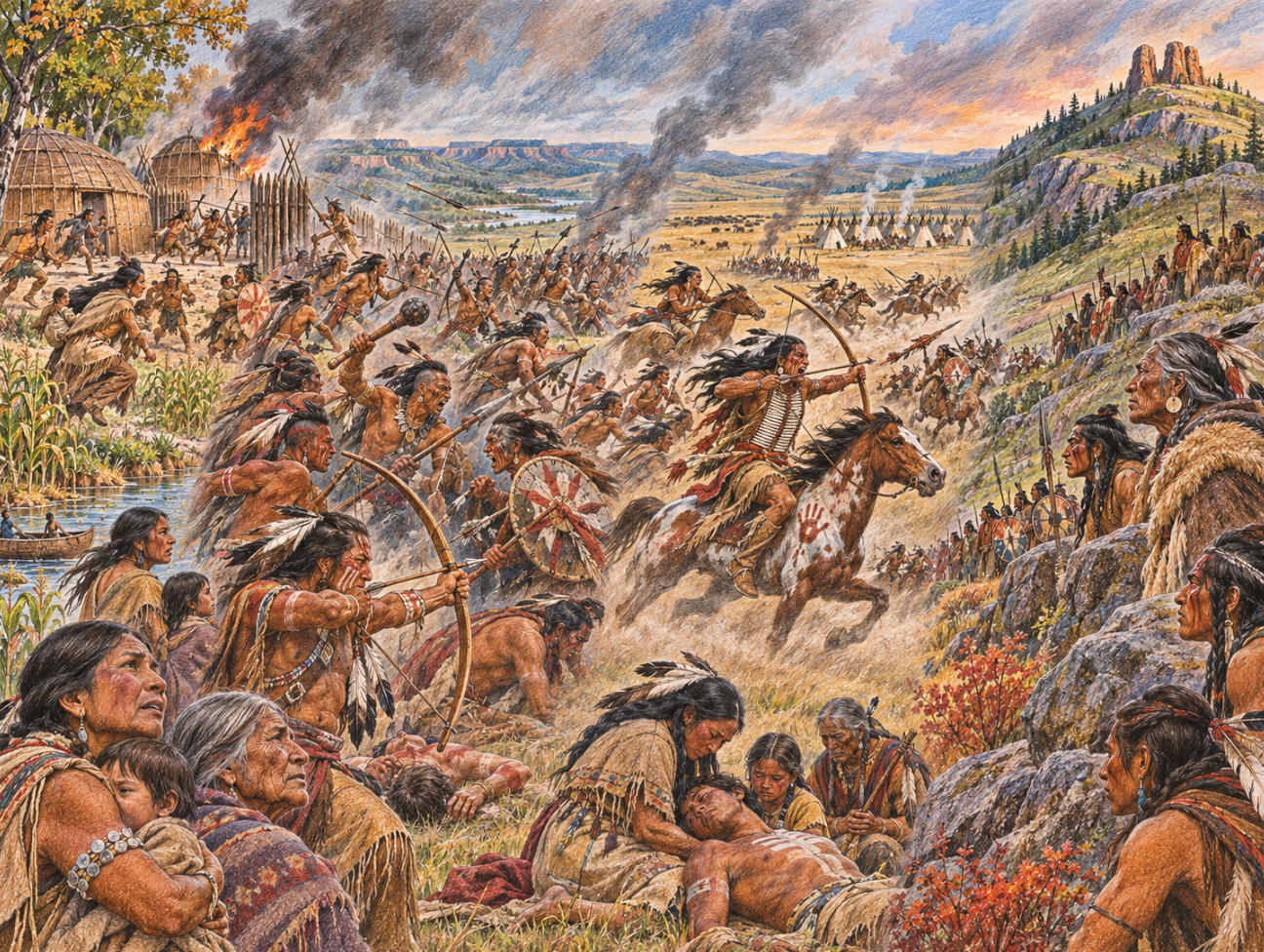
Before anyone rushes to label this an attack on Indigenous peoples, it is precisely the opposite. It is an argument for treating Indigenous peoples as historically significant, intelligent, complex human beings, capable of extraordinary achievements, sophisticated governance, diplomacy, compassion and, like every other civilization in human history, warfare, territorial expansion and brutality.
If we genuinely respect Indigenous history, perhaps we should start by telling all of it.
History did not begin in 1492
July 4, 2026, marked the 250th anniversary of the American Declaration of Independence. Some characterize the occasion as the anniversary of America stealing an entire continent.
A minor inconvenience with that argument is the calendar.
Jamestown, the first permanent English settlement in North America, was established in 1607. The Declaration of Independence was adopted in 1776, some 169 years later. Its purpose was to declare the colonies independent of British rule—not to announce the arrival of Europeans in North America.[1]
That independence did not absolve America of its subsequent treatment of Indigenous nations. But if we are going to spend considerable time lecturing people about history, getting the dates and events right would seem a reasonable starting point.
Europeans did not invent violence
There is a romanticized version of pre-European North America in which Indigenous peoples lived in perpetual harmony with nature and one another until Europeans arrived and introduced humanity to the unfortunate concept of violence.
Archaeology has some rather inconvenient things to say about that.
At Crow Creek in present-day South Dakota, archaeological excavations uncovered the remains of at least 486 men, women and children associated with a massacre dating to approximately 1325. The skeletal evidence revealed extensive violence and mutilation.[2]
This was more than 160 years before Columbus reached the Americas.
No British Empire. No American government. No European settlers responsible for the massacre.
Just human beings doing what human beings, unfortunately, have done throughout recorded history.
This does not define Indigenous civilization any more than the Spanish Inquisition defines every European civilization. But it certainly dismantles the notion that violence was imported into an otherwise peaceful continent.
The Black Hills: Conquest upon conquest
Consider the Black Hills of South Dakota, among the most prominent examples of disputed Indigenous land in America.
The Black Hills are sacred to the Lakota people. Yet, according to the United States National Park Service, the Lakota gained control of the territory following their defeat of the Cheyenne in the late eighteenth century. Other Indigenous nations, including the Kiowa, Crow and Shoshone, also controlled or occupied the region at different points in history.[3]
The United States subsequently recognized Lakota territorial rights under the 1868 Treaty of Fort Laramie, before confiscating the land in 1877. In 1980, the United States Supreme Court upheld the finding that this taking required compensation.
There are two historical truths here, neither of which cancels the other.
The American government violated an obligation to the Sioux Nation. Equally, territorial control of the Black Hills had changed among Indigenous nations before American confiscation.
History, it turns out, has more than one chapter.
Slavery was not exclusively a European institution
Anthropologist Leland Donald, in his extensive academic work on slavery among the Indigenous peoples of the Northwest Coast of North America, documented societies in which slavery was an established social and economic institution.
Captives could be purchased, traded and inherited. In certain societies, enslaved status was hereditary. Historical estimates suggest that enslaved people constituted approximately 20 to 25 percent of the population in some Northwest Coast communities, although the proportion varied considerably between nations.[4]
This included parts of what is now Canada.
None of this excuses the transatlantic slave trade, its extraordinary scale or its racialized brutality. It does, however, establish that slavery was not the invention of Europeans.
Human exploitation has never required a particular skin colour, nationality or passport.
Indigenous empires were real empires
The Comanche established a powerful empire across the American Southwest, the southern Great Plains and northern Mexico during the eighteenth and nineteenth centuries.
Historian Pekka Hämäläinen documents how Comanche power was built through military dominance, commerce, territorial expansion, raiding and the captive trade. Their expansion came at the expense of other Indigenous peoples, including Apache communities, as well as European and Mexican settlements.[5]
Then there were the Aztecs.
When Hernán Cortés confronted the Aztec Empire, he did not succeed through Spanish military power alone. Thousands of Indigenous allies, including the Tlaxcalans, played an indispensable role in the defeat of the empire.[6]
Why would Indigenous peoples assist European invaders against another Indigenous civilization?
Because they had their own political interests, enemies, grievances and ambitions.
They were not a single homogeneous population united by some universal Indigenous identity. They were distinct civilizations and nations pursuing their own interests, just as European, Asian and African civilizations did.
It is rather patronizing to pretend otherwise.
Canada was no exception
In what is now Ontario, warfare between the Haudenosaunee and the Wendat culminated in the devastation and dispersal of Wendat communities around 1649.[7]
European involvement, trade competition and disease contributed to the circumstances of these conflicts, but Indigenous nations were also independent political actors pursuing strategic objectives.
Our Canadian history is considerably more complicated than a morality play featuring two neatly defined groups of permanent villains and permanent victims.
The problem with inherited guilt
If we establish the principle that people living today are personally guilty of territorial conquest committed by their ancestors centuries ago, where exactly does that principle end?
Do modern Italians owe apologies for the Roman Empire? Do Scandinavians inherit responsibility for Viking raids? Are present-day Mongolians personally accountable for the conquests of Genghis Khan? Should contemporary Indigenous nations apologize to the descendants of other Indigenous nations displaced by their ancestors?
Or are we applying a principle selectively because it happens to suit a contemporary political argument?
Throughout human history, territorial boundaries have been established and altered through migration, conquest, treaties, purchase, settlement, alliances and war.
Open a historical atlas. Turn the pages backward. Notice how remarkably few borders remain stationary.
History is not a property registry with one universally agreed original owner and a conveniently identifiable date on which we can reset civilization.
More importantly, moral responsibility is not a genetic condition. It is not something transmitted through DNA.
Understanding history is not excusing it
We should absolutely acknowledge the atrocities committed against Indigenous peoples.
Forced displacement, broken treaties, residential schools, cultural suppression, massacres and the devastating consequences of introduced diseases are documented historical realities.
In Canada, residential schools continued operating into the late twentieth century. This is not exclusively ancient history. Some survivors remain alive today.
Canada also has constitutionally protected Aboriginal and treaty rights under Section 35 of the Constitution Act, 1982. These are real legal obligations, not merely expressions of historical sentiment.[8]
A government can inherit contractual and legal obligations without its citizens inheriting personal guilt.
There is an enormous difference between honouring a treaty and demanding that someone apologize for being born.
We can recognize historical injustice, honour outstanding obligations and work toward better outcomes without assigning collective moral culpability according to ancestry.
Nor should we pretend that people living centuries ago possessed the same institutions, knowledge, values and social expectations that we enjoy today.
Historical context does not make cruelty acceptable. It makes history understandable.
Romanticizing Indigenous peoples is not respect
Perhaps the greatest irony in this entire discussion is that, in attempting to elevate Indigenous peoples to a position of moral purity, some people inadvertently diminish their humanity.
Indigenous civilizations developed sophisticated agricultural systems, extensive commercial networks, complex political structures, remarkable environmental knowledge and enduring cultural traditions.
They also experienced political rivalries, social inequality, warfare and territorial disputes.
Both things can be true.
They were human beings, not mythical creatures inhabiting a historical paradise.
They deserve the dignity of being understood as such.
Respect should not require the sanitization of anyone’s history.
The next time someone says we are living on stolen land
Ask them a few questions.
Which land, specifically? Taken from whom? Under what circumstances? Who controlled it previously? Was there a treaty? Was that treaty violated? Is there an outstanding legal claim? What practical remedy are they proposing?
These are not unreasonable questions. They are the questions anyone genuinely interested in historical justice should welcome.
Where legitimate claims exist, address them. Where governments have broken agreements, hold them accountable. Where suffering continues, find meaningful solutions.
But reducing thousands of years of complex human history to a slogan is not an intellectually serious exercise.
I refuse to believe that reconciliation requires historical amnesia, that respect requires mythology, or that progress requires people to inherit the guilt of strangers who died centuries before they were born.
We cannot change the past. We can learn from it, understand it, acknowledge its injustices and ensure that we do not repeat them.
But to accomplish any of that, we must first have the courage to tell the truth.
All of it. Not just the parts that are politically convenient.


Leave a Reply