
In Washington, your vote gets you a representative. The right connections might get you a meeting. And increasingly, the question isn’t whether money influences American government. It’s how much influence money can buy before anyone calls it a problem.
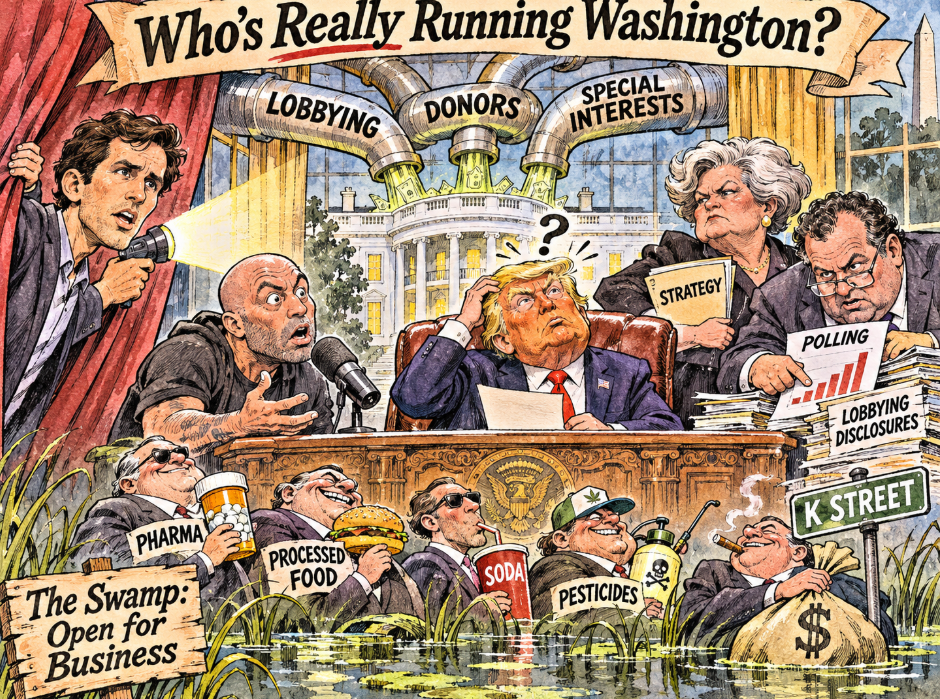
Imagine running a business where your customers pay millions of dollars for access to people they could theoretically contact for free. Now imagine those people control trillions of dollars in public spending, write regulations affecting entire industries, and make decisions capable of creating or destroying fortunes.
Welcome to Washington, D.C.
They call it lobbying. They call it government relations. They call it political consulting, strategic communications, public affairs, and stakeholder engagement. There is a remarkable variety of names for a business whose most valuable commodity is often knowing the right person. And here’s the extraordinary part.
Much of it is perfectly legal.
That doesn’t automatically make it corrupt. But it raises a rather uncomfortable question: At what point does a political system become so financially dependent on organized interests that its decisions can no longer be assumed to reflect the priorities of the people who elected it? Before dismissing that question as a conspiracy theory, consider the evidence.
The Man Who Walked Out of the White House
On November 6, 2026, former Trump administration health adviser Calley Means appeared on The Joe Rogan Experience and described something that should concern Americans regardless of their politics. This is just over-the-top wrong and should have people wanting heads to roll. I am sure this is not unique to the United States. It would not be a reach to think this may be happening here in our own great white north’s backyard.
Means, who had worked alongside Robert F. Kennedy Jr.’s Make America Healthy Again movement, alleged that a small network of politically connected advisers and consultants had accumulated extraordinary influence over White House policy.
He named names!!!!
Susie Wiles, then White House chief of staff. Tony Fabrizio, Trump’s influential pollster. Other political operatives and lobbying firms connected to the administration. – Remember that name.
Means alleged that efforts to reform school nutrition and address ultra-processed foods encountered resistance from advisers whose commercial relationships overlapped with the industries potentially affected.
These are serious allegations. The White House disputes his characterization of its health-policy record, and the publicly available evidence does not establish that anyone accepted payments in exchange for blocking a particular reform. But here is where the story becomes more interesting.
You don’t have to believe everything Means says to discover that some of the relationships he describes are real.
A 2024 investigation by Public Citizen, based on federal disclosures, documented that Wiles had registered to lobby for 42 clients between 2017 and 2024. They included corporations, government contractors, industry associations, and foreign interests. Meanwhile, Tony Fabrizio’s own company website lists past corporate work for PepsiCo, Pfizer, and other major businesses. There’s nothing inherently illegal about that.
But suppose you’re helping develop federal food policy, and someone influential in the political decision-making process has also worked for companies that could be affected by the outcome.
Shouldn’t the public know precisely which relationships are current, what financial interests exist, and how conflicts are managed?
Apparently, that’s a question we still have trouble answering. On the very day Means’s interview appeared, Trump announced that Stephen Miller would replace Wiles as chief of staff on November 9, with Wiles moving into Trump’s political operation. There is no established evidence that Means’s allegations caused that decision. But the broader question doesn’t disappear because somebody changes offices.
It simply moves to another office.
Five Billion Dollars. Just to Talk to Your Government.
Let’s examine the numbers. In 2025, organizations spent approximately $5.33 billion on reported federal lobbying, according to an aggregation of Lobbying Disclosure Act filings. That’s up from approximately $4.60 billion in 2024. A 15.9% increase in a single year.
This isn’t the federal budget. It isn’t election spending. It isn’t the money spent operating Congress. It’s reported lobbying expenditure: money organizations devote to influencing federal policy through a legally recognized process. And it doesn’t capture every form of political influence, campaign fundraising, public-relations activity, or undisclosed political spending.
Now consider Ballard Partners, the lobbying firm once associated with Susie Wiles and former lobbyist Pam Bondi, who subsequently became Trump’s attorney general.
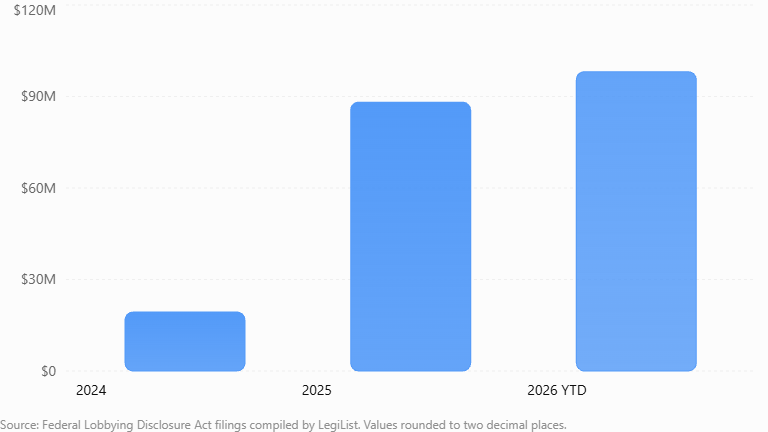
According to federal lobbying records compiled by LegiList, the firm’s reported federal lobbying income changed dramatically:
| Period | Reported lobbying income |
|---|---|
| 2024 | $19.35 million |
| 2025 | $88.15 million |
| 2026, through Q3 | $98.14 million |
From 2024 to 2025, that’s an increase of approximately 355%.
Four and a half times the previous year’s revenue.
That’s not a rounding error. That’s a business transformation. Meanwhile, Continental Strategy, a firm employing Wiles’s daughter Katie, reported approximately $27.6 million in federal lobbying income in 2025 and $35.7 million through the available 2026 filings, according to federal disclosure data.
Let’s be absolutely clear. Those are firm-wide revenues, not payments personally received by either Wiles. They are not evidence of bribery. Nor do rising revenues establish that any particular government decision was improperly influenced. They do, however, demonstrate the enormous commercial value clients place on lobbying firms operating near the centre of political power.
Consider the business proposition.
If hiring the right consultant can improve your access to officials responsible for billion-dollar decisions, what is that relationship worth?
Apparently, quite a lot.
And that is precisely why the next piece of evidence matters.
Scientists Have Actually Measured the Price of Political Connections
This isn’t just something a disgruntled former adviser said on a podcast.
Economists have studied it.
In 2012, researchers Jordi Blanes i Vidal, Mirko Draca, and Christian Fons-Rosen published a study called Revolving Door Lobbyists in the prestigious American Economic Review.
They examined what happened to lobbyists who had previously worked for U.S. senators when those senators left office.
The result?
The lobbyists’ generated revenue fell approximately 24%.
Not because they suddenly forgot how legislation worked.
Not because they forgot their expertise.
But because their former political connection was no longer serving in the same position. The effect was immediate and persistent. It was also greater when the departing senator had held more powerful committee assignments. Think about what that tells us.
A measurable portion of the market value of certain lobbyists appears to come from relationships with politicians who are still in office. The study doesn’t prove bribery. It doesn’t prove any senator behaved improperly. It does, however, provide evidence that access to political power has a measurable economic value.
We have effectively assigned a market price to relationships with public officials. And somehow, we’re supposed to treat questions about that market as unreasonable.
What Happens When the Money Doesn’t Buy a Vote?
Here’s where the problem becomes more subtle. People often imagine political corruption as a crude exchange. A wealthy businessman hands a politician a briefcase of cash. The politician passes a law. Everybody wins, except the public.But that isn’t how much modern political influence needs to work.
Why buy a vote when you can influence what gets voted on?
Why defeat a regulation when you can delay it?
Why publicly oppose a health initiative when you can have an adviser quietly conclude that it isn’t politically worthwhile?
Why confront scientific evidence when you can fund research that changes the debate?
These are mechanisms of influence, not proof that every such decision is improper. Yet they help explain why focusing exclusively on criminal bribery misses much of the institutional picture.
Consider three historical examples.
When sugar helped shape the scientific debate
A 2016 study published in JAMA Internal Medicine examined internal documents from the Sugar Research Foundation.
The researchers found that the industry had funded a 1960s review of coronary heart disease research that emphasized dietary fat and cholesterol while downplaying evidence concerning sugar.
The foundation helped establish the research objectives, supplied material, and received drafts. Its role and funding were not disclosed in the published review. The authors did not establish that the industry dictated every conclusion. But the documented involvement raises an obvious question.
If commercial interests can influence which scientific questions receive attention, might they also affect the evidence policymakers rely upon?
You don’t necessarily need to control the government if you can influence the information government uses.
When pizza became a nutrition-policy controversy
In 2011, the Obama administration proposed stronger school-meal standards. Among the proposed changes was closing a rule that allowed a small quantity of tomato paste on pizza to qualify as a vegetable serving.
Food manufacturers and agricultural interests opposed portions of the reforms. Congress subsequently blocked proposed restrictions on starchy vegetables and preserved the treatment of tomato paste.
The Pew Charitable Trusts documented the dispute, including a survey finding that 78% of voters supported stronger school nutrition standards. To be precise, Congress didn’t legally declare pizza a vegetable. It preserved a rule that could allow pizza sauce to satisfy a vegetable-serving requirement.
Still, consider the absurdity!
The country was debating how to improve children’s nutrition, and the federal government was negotiating the political status of tomato paste. There were legitimate disputes about costs, school flexibility, and implementation. But the outcome also reflected industry opposition to the proposed changes.
That is what political influence can look like in practice: not necessarily a smoking gun, but a regulation altered in the middle of competing pressures.
When the government couldn’t directly negotiate drug prices
In 2003, Congress created Medicare Part D.
The legislation contained a noninterference provision restricting the federal government’s ability to directly negotiate prescription drug prices. For years, critics argued that the restriction weakened federal bargaining power. Supporters maintained that private plans could negotiate effectively and that direct government intervention presented its own problems.
The pharmaceutical industry was a major participant in the surrounding policy debates. The restriction was modified by the Inflation Reduction Act in 2022, allowing negotiations for selected drugs, with the first negotiated prices taking effect in 2026. The Congressional Research Service documented the history.
This case does not prove the original law was purchased by drug manufacturers. But it illustrates how consequential regulatory and legislative arrangements can endure for decades. And it raises a question every taxpayer should feel entitled to ask:
When government adopts a policy favourable to a powerful industry, how do we independently determine whether it was the best public-policy decision or simply the result of the most effective organized advocacy?
The Study That Should Have Made Everyone Uncomfortable
In 2014, political scientists Martin Gilens and Benjamin Page published Testing Theories of American Politics: Elites, Interest Groups, and Average Citizens.
They analyzed 1,779 policy issues, comparing the preferences of ordinary citizens, wealthy Americans, and organized interest groups with policy outcomes. Their statistical analysis found substantial independent associations between policy outcomes and the preferences of economic elites and business-oriented groups. By contrast, average citizens’ preferences showed little independent association after accounting for those other influences.
That finding deserves serious attention.
But here’s something equally important: subsequent researchers challenged the strength of that conclusion. In a 2017 study published in Political Science Quarterly, J. Alexander Branham, Stuart Soroka, and Christopher Wlezien found that middle-income and affluent Americans agreed on nearly 90% of the policy questions examined. On questions where they disagreed, affluent Americans prevailed somewhat more often, but the difference was not statistically decisive.
In other words, the research does not demonstrate that wealthy Americans get everything they want. It does reveal a much more interesting problem.
Political influence is difficult to disentangle from public preferences, especially when different groups want the same thing. But when the interests of ordinary citizens and powerful organized groups diverge, who has the resources to sustain a campaign, hire specialists, secure meetings, and keep an issue alive for years?
And who doesn’t?
That unequal capacity is real, whether or not it determines every outcome.
The Greatest Trick Is Making It a Partisan Argument
Here’s the part that might be hardest for both Republicans and Democrats to accept. This problem did not begin with Donald Trump. It didn’t begin with Joe Biden, Barack Obama, George W. Bush, or Bill Clinton either.
The history of American lobbying, campaign finance, commercial influence over scientific research, and revolving-door employment crosses administrations and party lines. Industries routinely seek influence regardless of which party occupies the White House. And why wouldn’t they?
If government controls regulations, taxation, trade policy, health-care reimbursement, procurement, and market access, companies have powerful economic incentives to participate in the policy process.
That participation can be legitimate. Governments need information from the industries they regulate. Businesses should be permitted to explain the consequences of proposed laws. So should unions, consumer advocates, environmental organizations, and professional associations.
The difficulty arises when some participants have extraordinary resources and longstanding personal connections while others possess neither. This isn’t a particularly convenient problem for partisan politics. It doesn’t fit neatly into a red or blue campaign advertisement.
If an issue spans both parties, blaming the other party won’t solve it. And if the incentives remain unchanged after an election, replacing the politicians may not change the underlying relationships.
One administration leaves. Another arrives. Consultants change their client lists. Former staff members move into private practice. New officials develop relationships that may become commercially valuable when they eventually depart. The revolving door keeps turning.
The Difference Between Illegal and Acceptable
There is an argument worth taking seriously from defenders of lobbying.
Political advocacy is protected activity. Businesses have legitimate interests. Lobbyists may provide valuable technical expertise. And having worked in government does not automatically make someone ethically compromised. All true.
Lobbying firms also lose. Industries face regulations they oppose. Congress sometimes passes legislation despite enormous lobbying campaigns against it. Money matters, but it does not guarantee victory. So the simplistic claim that corporations secretly control every government decision is not supported by the evidence.
But neither is the comforting assumption that whatever remains legally permissible must therefore be institutionally healthy. Those are different questions.
The relevant issue is not whether every lobbyist is corrupt. It is whether the public can adequately see the relationships, understand the financial interests, scrutinize the decision-making process, and establish accountability when conflicts arise.
Federal lobbying disclosures provide useful information, but they do not create a complete record of private meetings, informal consultations, or the internal reasoning behind major policy decisions. And sometimes the most consequential decision is the one that never reaches a public vote.
No legislation to examine. No recorded roll call. No dramatic scandal. Just a proposal that quietly disappears.
What Exactly Are Citizens Paying For?
Americans fund the government through taxes.
They elect representatives, support public institutions, and reasonably expect those institutions to evaluate competing interests on their merits. Meanwhile, organized interests collectively spend billions of additional dollars to persuade those same institutions to adopt their preferred policies. To be fair, those expenditures can produce better policy when they provide accurate information and expose unintended consequences. But it is equally fair to ask whether the system offers comparable opportunities to citizens and groups without extensive financial resources.
Consider a typical citizen concerned about school food, prescription prices, or an environmental regulation. That person might write to an elected representative, sign a petition, attend a meeting, or organize a community campaign. A large corporation may retain legal teams, professional lobbyists, economists, former officials, communications specialists, and political consultants. Both technically have the right to participate.
They do not have equivalent resources with which to exercise that right. And that is the central tension at the heart of this entire discussion.
Democracy counts people equally at the ballot box. The machinery of political influence does not necessarily give them equal weight between elections.
Maybe We’re Asking the Wrong Question
Calley Means might be right about some of the internal resistance he encountered. He might also have misunderstood certain decisions, overstated the role of particular advisers, or attributed motives that cannot be independently established.
His claims deserve investigation, not automatic acceptance. But the public records and academic evidence stand independently of his account. More than $5 billion in annual federal lobbying spending.
Politically connected firms reporting dramatic revenue growth.
A peer-reviewed study measuring a 24% decline in lobbyist revenue when a powerful former employer leaves office. Historical cases in which organized industries helped shape nutrition research, school-meal rules, and major health-care legislation. None of those facts proves that the American government is secretly controlled by a single corporate network.
Together, however, they justify asking whether the political system provides sufficient safeguards against disproportionate private influence. The useful questions are practical.
Should government meeting records be more complete? Should the public be able to identify precisely which clients maintain financial relationships with influential political advisers?
Are existing cooling-off periods and conflict-of-interest rules adequate?
How should regulators distinguish useful technical information from deliberately selective evidence? What mechanisms could make the reasoning behind abandoned policy proposals more transparent?
These are not uniquely Republican questions.
They are not uniquely Democratic questions.
They are questions about how a representative government demonstrates that its decisions were made in the public interest. And perhaps the most revealing question is this:
If political connections are worth millions of dollars to private companies, what, exactly, is being purchased?
Expertise? Strategic advice? Better access? Preferential treatment?
Some of those answers are entirely legitimate. Others would raise serious legal and ethical concerns. The difficulty is that we cannot always tell which is which. And that is why this subject deserves more than an angry podcast, another partisan scandal, or a few days of headlines. It deserves evidence. Disclosure. Independent scrutiny. And a willingness to follow the money even when it leads somewhere politically inconvenient.
Because the American public should not have to choose between believing every allegation of corruption and pretending that financial influence doesn’t matter. There is a considerably more demanding alternative.
Find out who paid whom. Establish who met whom. Trace the decisions. Examine the alternatives. Then let the evidence speak.
After all, a government accountable to the people ought to be able to answer a fairly simple question:
Who influenced this decision, and why?
If that question is too difficult to answer, perhaps the real scandal isn’t what we already know. It’s what the system makes so difficult to discover.
Editorial research note: This article distinguishes disclosed financial relationships, published empirical research, documented legislative outcomes, and contested personal allegations. Lobbying income does not establish bribery or prove that any specific government decision was improperly influenced. All monetary figures are in U.S. dollars. The 2026 lobbying figures are partial-year figures as of the filings available on November 6, 2026.
Ballard Partners: Federal lobbying income
USD millions; 2026 reflects reported filings through the third quarter, not a full year.
And what impact does a dollar of lobbying money get?
This may be one of the most important economic dimensions of the entire lobbying discussion: the potential financial return on political influence.
More importantly, this isn’t merely a theory. I found academic research that has attempted to calculate exactly what you’re describing.
And some of the findings are remarkable.
1. Researchers have measured the financial returns from lobbying
2009 study — U.S. corporate tax legislation
$220 for every $1
Estimated tax savings relative to lobbying expenditure in one historical case
In 2009, researchers Raquel Meyer Alexander, Stephen Mazza, and Susan Scholz published Measuring Rates of Return for Lobbying Expenditures: An Empirical Case Study of Tax Breaks for Multinational Corporations.
They investigated companies lobbying for the 2004 American Jobs Creation Act, which included a tax holiday allowing multinational corporations to bring overseas profits back into the United States at reduced tax rates.
Their findings:
- 93 companies involved in lobbying repatriated approximately $208 billion.
- The researchers estimated approximately $282.7 million in lobbying expenditures.
- The estimated tax savings were approximately $62.5 billion.
- Dividing the estimated savings by lobbying expenditures produced an estimated $220 in tax benefits for every $1 spent.
That’s a 220:1 benefit-to-cost ratio. SSRN
But there’s an important caveat: this was a descriptive calculation. Not every dollar of the tax savings was necessarily caused by lobbying, and firms that did not lobby could also benefit from the law.
A more rigorous follow-up found a smaller, but still substantial, relationship
A 2014 Harvard Business School working paper by Hui Chen, Katherine Gunny, and Karthik Ramanna revisited that same legislation using a more sophisticated statistical method.
Their estimate for the median firm with longstanding political relationships was:
Estimated association
$1 million
Additional lobbying
$32.35 million
Additional tax savings
Historical statistical estimate, not a guaranteed or universally applicable return.
The researchers explicitly noted that this was considerably below the earlier $220-per-dollar estimate, but still consistent with unusually large financial benefits associated with corporate political investment. SSRN
That is much closer to the scientifically defensible argument you’re making.
2. This isn’t limited to corporate tax breaks
A separate study by John de Figueiredo and Brian Silverman, published in the Journal of Law and Economics in 2006, examined university lobbying for federal research earmarks.
Their estimates suggested that institutions represented by members of powerful congressional appropriations committees could receive approximately $11–$36 in additional earmarks for every dollar spent on lobbying.
Universities lacking those politically valuable connections generally obtained much smaller or statistically uncertain benefits. NBER
This is interesting because universities are not pharmaceutical or oil companies. The research suggests that the financial value of political relationships can extend beyond traditional corporate lobbying.
3. Your $1 million in, $100 million out example
The important distinction is whether we’re measuring government money affected, additional business revenue, or actual financial benefit.
Here is a hypothetical example.
| Measure | Amount |
|---|---|
| Lobbying expenditure | $1 million |
| Government contract influenced | $100 million |
| Assumed profit margin on contract | 10% |
| Potential profit from contract | $10 million |
| Profit after lobbying cost, before other relevant costs | $9 million |
In that hypothetical scenario, the company might earn $9 million after its lobbying expenditure, not $100 million.
And even that depends on something crucial: Would the company have won the contract anyway?
If lobbying increased its chances of securing the contract, only the incremental benefit attributable to lobbying belongs in a proper return calculation.
Tax savings are different. If a company gains $100 million in additional tax savings from legislation it successfully advocated for, that benefit may be much closer to the full $100 million, although proving causation remains difficult.
4. This changes how we should interpret those lobbying figures
Consider the $5.33 billion in reported federal lobbying expenditures from 2025 that we discussed.
That number sounds large, but it represents advocacy activity directed at a government making decisions about spending, taxation, regulation, procurement, and financial obligations involving enormously greater sums.
A relatively small policy change can have economic consequences running into billions of dollars over several years.
The scale of the potential financial consequences can dwarf the lobbying investment.
It also helps explain the incentive to spend money on lobbying even when results are uncertain.
A company doesn’t have to succeed every time if an occasional favourable policy outcome carries significant economic value.
But we cannot apply a 32:1 or 220:1 multiplier to all lobbying expenditures and assume that is the total financial return. The studies examined selected circumstances, and lobbying frequently fails to achieve its objectives.
5. The more troubling question is not how much lobbyists cost
It’s how much the decisions they’re attempting to influence are worth.
For our article, I think this deserves its own section, with something along these lines:
The Most Expensive Million Dollars in Washington
When Americans hear that a lobbying firm collected $20 million or $50 million, they understandably think that’s an enormous amount of money.
But they’re looking at the wrong end of the transaction.
The fascinating question isn’t how much money companies spend attempting to influence Washington. It’s how much money they stand to gain from the decisions Washington makes.
We’re talking about government contracts, tax concessions, regulatory exemptions, pharmaceutical pricing, agricultural subsidies, and legislation capable of affecting entire industries.
Economists studying the 2004 corporate tax holiday found that an additional million dollars in lobbying was associated with approximately $32 million in tax savings for certain firms.
Think about that for a moment.
A million dollars is a fortune to most Americans. To a multinational corporation seeking a favourable billion-dollar policy decision, it can be a relatively modest business expense.
And perhaps that’s the question we should have been asking all along.
Are we looking at millions of dollars being spent on lobbying, when we should be looking at the billions of dollars in economic benefits that make spending those millions attractive in the first place?
Not every lobbyist gets what they want. Not every favourable government decision is corrupt. But those facts don’t eliminate the extraordinary financial incentives built into the system.
Sometimes the real story isn’t what someone paid.
It’s what was at stake.
6. One issue I’d push you to investigate further
There’s an even more difficult question behind your observation.
If the potential returns from political influence can be exceptionally large, does that create a competitive disadvantage for businesses unwilling or unable to finance comparable lobbying operations?
In other words, we may not simply be discussing companies influencing government.
We may be discussing a political-economic environment in which maintaining access to government becomes a normal competitive business requirement.
That is a different and potentially more consequential structural problem. It suggests three things worth measuring in a deeper investigation: the proportion of corporate profits dependent on government decisions, the concentration of lobbying expenditures among major firms, and whether political access is associated with systematically different outcomes for competitors.
This return-on-influence argument could become one of the strongest parts of your article, precisely because it can be explored through financial records and quantitative research instead of relying on allegations about individual politicians.


Leave a Reply