
A response to Mel Robbins and Dr. Sasha Hamdani
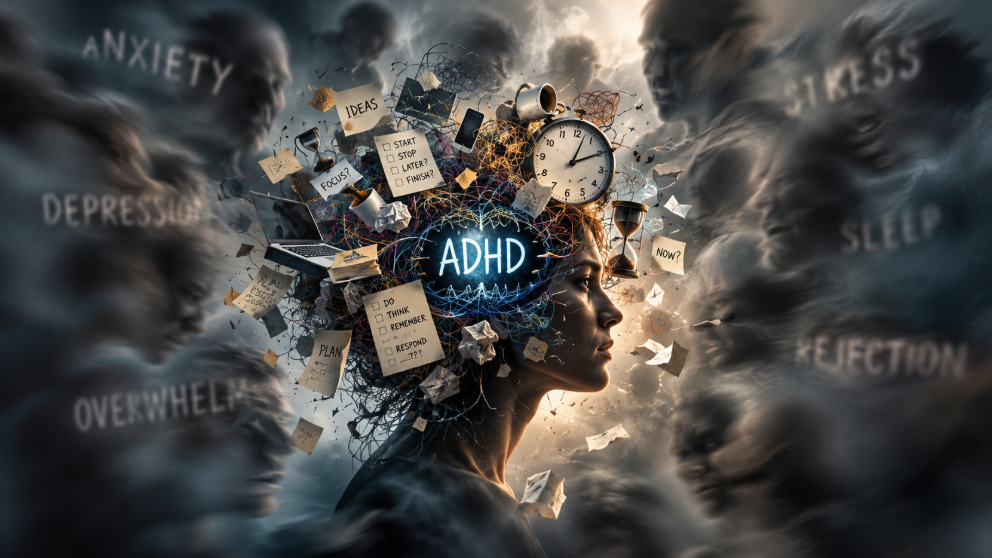
There is an important conversation taking place about ADHD today—and some of it is long overdue.
For decades, ADHD was too often reduced to a stereotype: the hyperactive child who could not sit still, pay attention, or stop interrupting the classroom. That narrow picture undoubtedly caused many people, particularly women and adults with predominantly inattentive symptoms, to be overlooked.
Correcting that misunderstanding is progress.
But there is a point at which expanding our understanding of a disorder can become something very different: expanding the disorder itself.
That is where I believe the recent conversation between Mel Robbins and psychiatrist Dr. Sasha Hamdani deserves much greater scrutiny.
Throughout the discussion, ADHD gradually becomes associated with an extraordinarily broad collection of experiences: anxiety, depression, emotional volatility, rejection sensitivity, sleep problems, appetite problems, perfectionism, overwhelm, relationship insecurity, procrastination, hyperfocus, motivational difficulties and emotional distress.
Many of those experiences may certainly occur alongside ADHD.
Some may be consequences of living with ADHD.
Some may worsen ADHD symptoms.
Some may share underlying psychological mechanisms.
But those statements are not equivalent to saying that these experiences are themselves manifestations of ADHD.
And once those distinctions start disappearing, we have a problem.
When we stretch ADHD until it encompasses almost every form of psychological difficulty, we aren’t necessarily improving our understanding of ADHD. We may instead be erasing the diagnostic boundaries that make the condition meaningful in the first place.
That matters medically.
It matters psychologically.
And it matters to anyone trying to understand what ADHD actually is rather than what contemporary popular psychology increasingly wants it to become.
ADHD already has a definition
Listening to the podcast, you could be forgiven for thinking psychiatry has only just discovered what ADHD is.
Apparently the DSM has been waiting all these years for a podcast.
But ADHD is not clinically defined as “being overwhelmed.”
It isn’t defined as experiencing rejection deeply.
It isn’t defined as depression.
It isn’t anxiety.
It isn’t poor sleep.
It isn’t emotional sensitivity.
The current diagnostic framework defines ADHD around a persistent pattern of inattention and/or hyperactivity-impulsivity that interferes with functioning or development. Symptoms have to persist, cause meaningful impairment, appear in multiple settings and trace back to childhood. The diagnostic criteria also specifically require clinicians to consider whether the symptoms are better explained by another mental disorder.
That last part is extraordinarily important.
Because anxiety can impair concentration.
Depression can destroy motivation.
Sleep deprivation can impair memory and executive functioning.
Trauma can produce hypervigilance and distractibility.
Bipolar disorder can involve impulsivity and enormous changes in activity.
Stress can make anyone disorganized.
That isn’t an inconvenience in the diagnostic process.
That is the diagnostic process.
The job is not merely to find reasons why someone’s experiences could be ADHD.
The job is also to determine why they might not be.
This is where the podcast begins losing me
Dr. Hamdani says ADHD is fundamentally a problem of “regulation.”
That is not an absurd idea.
There is serious research supporting executive-function and self-regulation models of ADHD. There is also considerable evidence that emotional dysregulation occurs much more frequently among adults with ADHD than among people without it.
But notice something rather important.
Common is not universal.
And “commonly associated with” is not the same thing as “diagnostically defines.”
Researchers themselves continue debating whether emotional dysregulation should become a core ADHD criterion.
That’s not a minor technicality.
That’s the whole issue.
If you broaden a psychiatric diagnosis enough, you don’t merely understand existing patients better.
You begin creating a different patient population.
Association is not identity
This distinction gets repeatedly lost in popular psychology.
Someone with ADHD can have anxiety.
That does not make anxiety ADHD.
Someone with ADHD can become depressed.
That does not make depression ADHD.
Someone with ADHD can have insomnia.
That does not make insomnia ADHD.
Someone with ADHD can be extraordinarily sensitive to criticism.
That does not make sensitivity to criticism ADHD.
Someone with ADHD can struggle with eating.
That does not make disordered eating ADHD.
These things can interact. One can aggravate another. ADHD can produce secondary consequences that become emotionally devastating.
Absolutely.
But medicine learned a very long time ago that correlation does not erase categories.
High blood pressure can accompany kidney disease. We don’t rename hypertension “kidney disease.”
Chronic pain can produce depression. We don’t therefore redefine depression as chronic pain.
Apparently in contemporary mental-health discourse, however, once two psychological experiences frequently travel together, somebody starts measuring them for matching T-shirts.
And that is where skepticism is warranted.
One diagnosis does not need to explain everything
One of the more troubling tendencies in contemporary ADHD discussions is the retrospective reinterpretation of enormous portions of a person’s life through a single diagnostic lens.
Maybe the anxiety wasn’t really anxiety.
Maybe the depression wasn’t really depression.
Maybe the emotional instability was ADHD.
Maybe the overwhelm was ADHD.
Maybe the problems with food were ADHD.
Maybe the relationship sensitivity was ADHD.
Maybe the exhaustion was ADHD.
Maybe that inexplicable feeling that something was always “off” was ADHD.
Eventually one has to ask:
Is there anything left that isn’t ADHD?
Because a diagnosis capable of explaining everything eventually explains very little.
Psychiatric conditions frequently coexist.
ADHD does not need to replace anxiety for both to exist.
ADHD does not need to replace depression for both to exist.
A person can have several legitimate psychological conditions simultaneously, each contributing something different to their overall experience.
The fact that their symptoms overlap does not make the diagnoses interchangeable.
The rejection-sensitive dysphoria claim should concern people
This was, for me, one of the weakest parts of the conversation.
Dr. Hamdani states that some component of what is called rejection-sensitive dysphoria, or RSD, occurs in almost everyone with ADHD.
That is an extraordinary claim.
And extraordinary prevalence claims require extraordinary evidence.
RSD is not currently one of the DSM diagnostic criteria for ADHD.
More importantly, the empirical literature around RSD remains limited.
That doesn’t mean people aren’t genuinely experiencing intense rejection sensitivity.
They clearly are.
It means science hasn’t established that “rejection-sensitive dysphoria” is a near-universal neurological phenomenon of ADHD.
Those are radically different propositions.
Yet on a hugely influential podcast, the distinction almost disappears.
And once millions of listeners hear that virtually everyone with ADHD experiences it, guess what happens next?
A neutral text message feels upsetting.
“That’s my RSD.”
Someone criticizes your work.
“ADHD.”
You worry somebody is angry with you.
“RSD.”
You take rejection badly.
“That’s my neurological condition.”
Perhaps.
But perhaps you’re insecure.
Perhaps you had difficult relationships growing up.
Perhaps you’ve experienced trauma.
Perhaps you’re depressed.
Perhaps you’re anxious.
Perhaps someone actually was being rude.
Or perhaps you’re simply a human being, and rejection has hurt human beings since approximately five minutes after we climbed down from the trees.
Not every painful emotion requires its own neurological acronym.
Women absolutely were missed. That doesn’t justify moving the goalposts indefinitely.
One of the strongest points Hamdani and Robbins make is that the stereotypical picture of ADHD—the hyperactive little boy disrupting the classroom—has failed many people, particularly women and people with predominantly inattentive symptoms.
That criticism is legitimate.
Adult ADHD is real. Inattentive ADHD is real. Women can present differently. People can compensate, mask symptoms and remain academically or professionally successful while struggling internally.
Recognizing those people is progress.
But correcting an overly narrow definition doesn’t require embracing an infinitely broad one.
There is a danger of swinging the pendulum from:
“You can’t have ADHD because you aren’t a hyperactive eight-year-old boy.”
to:
“You may have ADHD because you feel overwhelmed, emotionally sensitive, anxious, exhausted and rejected.”
Neither is good clinical reasoning.
One excludes people who genuinely have the disorder.
The other risks including people who don’t.
There is another uncomfortable problem: confirmation bias
Popular mental-health content has a built-in psychological trap.
Present people with a long enough list of common experiences and virtually everyone recognizes themselves.
Do you procrastinate?
Sometimes.
Do you lose things?
Sure.
Do you get distracted?
Obviously.
Do you sometimes become intensely interested in something?
Yes.
Do you occasionally overreact emotionally?
Who doesn’t?
Do you hate rejection?
Welcome to Earth.
Do you ever stay up too late?
Apparently you’ve met the Internet.
Now place all of those experiences under a heading reading “Signs You May Have Undiagnosed ADHD”, and suddenly normal human variability begins looking suspiciously pathological.
This isn’t unique to ADHD.
It’s one of the fundamental problems with psychological self-diagnosis.
Symptoms have meaning because of their severity, persistence, developmental history, context, clustering and functional impairment—not merely because somebody recognizes them.
That is exactly why legitimate ADHD diagnosis requires much more than checking boxes on a podcast.
Emotional dysregulation deserves attention without annexing it
I don’t want the opposite mistake made either.
Emotional dysregulation deserves serious study in ADHD.
There is compelling research showing that adults with ADHD, as a group, experience substantially greater emotional dysregulation than controls.
There are respected researchers arguing that emotional regulation should become a more central component of how ADHD is conceptualized.
Fine.
Study it.
Measure it.
Develop better criteria.
Determine which components are specifically related to ADHD.
Determine which are consequences of ADHD.
Determine which arise primarily from comorbid depression, anxiety, trauma or personality.
That’s science.
But don’t settle unresolved scientific questions by confidently explaining them on a podcast as though the DSM simply hasn’t caught up with TikTok yet.
And Mel Robbins has a responsibility here too
Mel Robbins isn’t presenting herself as the psychiatrist.
But she is doing something equally influential: providing the emotional narrative through which the medical claims are interpreted.
Again and again, personal experiences are raised and then incorporated into the ADHD framework.
Anxiety becomes retrospectively understandable through ADHD.
Emotional overwhelm becomes ADHD-related.
Brain fog gets folded into the story.
Relationship insecurity fits.
Depression fits.
Once enough pieces fit, the audience gets an extremely seductive psychological experience:
“My God. This explains everything.”
That feeling can be enormously powerful.
It can also be enormously misleading.
A compelling personal narrative is not a differential diagnosis.
And “I finally understand my entire life” may be emotionally satisfying while still being clinically incomplete.
Medicine should be particularly cautious when an explanation becomes capable of retrospectively accounting for nearly every difficulty a person has ever experienced.
That’s usually when science should become more skeptical, not less.
The irony
The strangest thing is that Hamdani herself correctly says a proper ADHD assessment should rule out other explanations.
Good.
That is exactly right.
But much of the surrounding conversation pulls emotionally in the opposite direction.
It continually demonstrates how more and more experiences can be included within ADHD.
That’s inclusion.
Differential diagnosis requires exclusion too.
Science asks:
What evidence supports this hypothesis?
And then, just as importantly:
What evidence would prove me wrong?
If every possible symptom reinforces the ADHD explanation, you no longer have a falsifiable clinical concept.
You have a belief system.
ADHD doesn’t need exaggeration to be taken seriously
This is perhaps what bothers me most.
ADHD is already serious enough.
People with ADHD can struggle profoundly with sustained attention, executive functioning, organization, impulsivity, time management and completing tasks.
We don’t need to annex depression.
We don’t need to annex anxiety.
We don’t need every emotional struggle.
We don’t need to tell people almost everyone with ADHD has an inadequately established phenomenon called rejection-sensitive dysphoria.
We certainly don’t need to transform ADHD into an all-purpose explanation for modern psychological distress.
Doing so doesn’t strengthen the legitimacy of ADHD.
It risks weakening it.
Because when everyone recognizes themselves in the diagnostic description, eventually people begin asking whether the diagnosis means anything at all.
And people genuinely living with ADHD should be concerned about that.
My message to Mel Robbins and Dr. Hamdani
Talk about the emotional consequences of ADHD.
Please do.
Talk about women being missed.
Talk about inattentive ADHD.
Talk about executive dysfunction.
Talk about shame.
Talk about how years of struggling can create secondary anxiety and depression.
Talk about emerging research into emotional regulation.
But put the guardrails back.
Tell audiences when something is a diagnostic criterion.
Tell them when something is an associated feature.
Tell them when something is a comorbidity.
Tell them when something is a possible consequence.
And tell them when something remains a hypothesis or contested construct.
Those distinctions may not make for quite as dramatic a podcast.
But they’re the difference between education and oversimplification.
ADHD does not need to explain every painful psychological experience to be legitimate.
Depression does not need to be reclassified to validate ADHD.
Anxiety does not need to be absorbed into a broader neurological narrative.
Several things can be true simultaneously.
The human mind is complicated enough to accommodate more than one diagnosis.
And psychiatry should be sophisticated enough to resist turning one of them into a catch-all.
When everything becomes ADHD, ADHD eventually stops meaning anything.
And people living with the real disorder deserve better than that.


Leave a Reply