
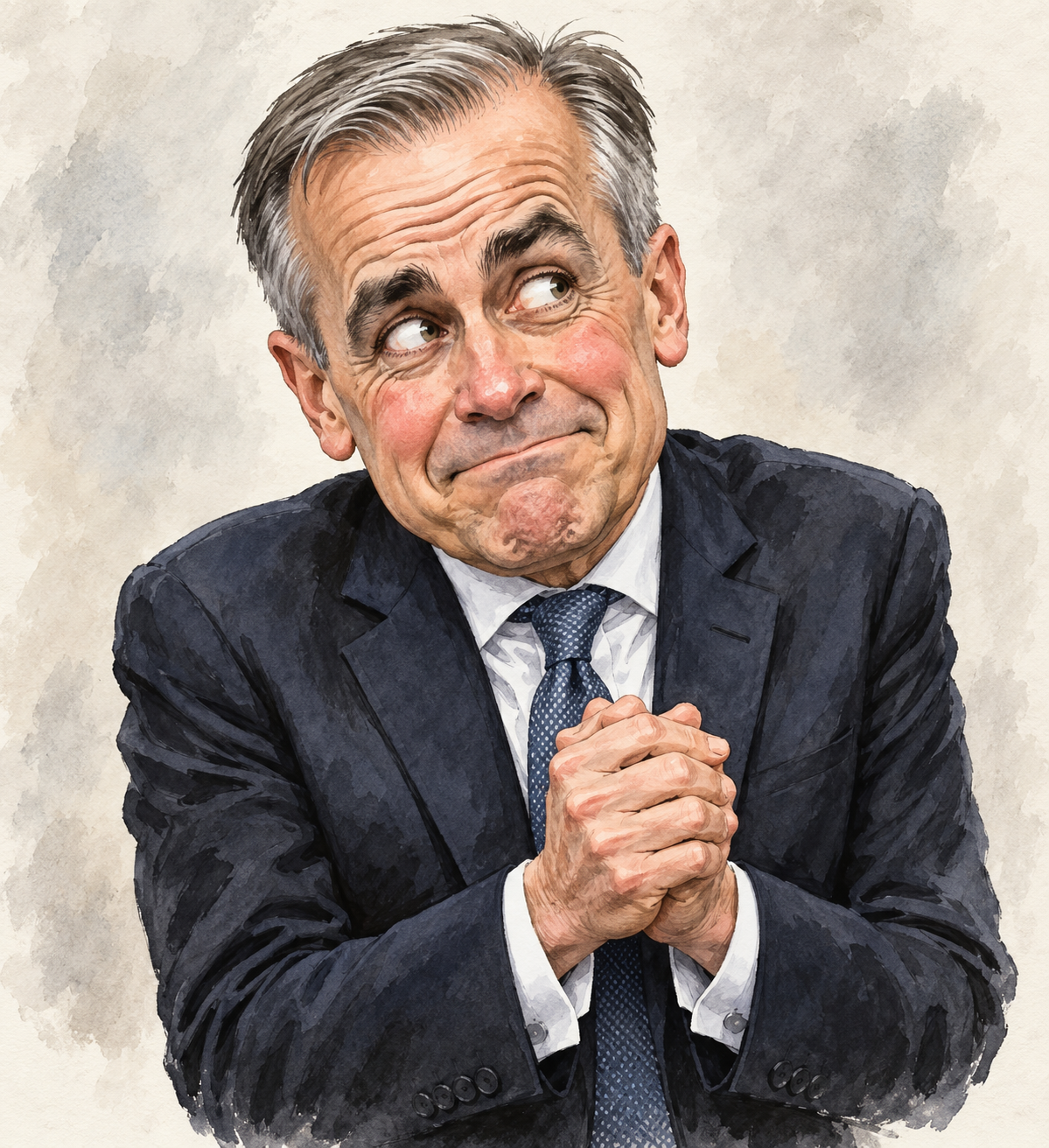
Okay you Elbows Up Tards – Mark Carney made a promise Canadians could understand without an economics degree. In March 2025, he said the proceeds from Canada’s retaliatory tariffs would protect workers. On April 3, his office went further: “Every single dollar” raised from the newly announced auto counter-tariffs would go directly to supporting auto workers. Those words were meant to sound absolute. If the government wants credit for that promise, it should be willing to account for it, dollar by dollar. Source: Prime Minister’s April 3, 2025 announcement.
Now look at the government’s own Spring Economic Update 2026. It reports $9.7 billion in gross revenue assessed from Canada’s countermeasures against U.S. tariffs, $5.5 billion remitted through tariff relief, and $4.3 billion in net revenue assessed as of April 17, 2026. The figures are rounded, and the government says the net amount may change as more remission claims are processed.
That $4.3 billion figure deserves an explanation. It does not, by itself, prove that Carney broke his promise. Remission means forgiving or returning a tariff charge; support for workers and companies can be recorded elsewhere as program spending. Moreover, the 2026 figure covers countermeasures across several sectors, while the April 3 pledge referred to the newly announced auto tariffs. Comparing those two numbers as though they were the same account would be a convenient trick for Carney’s critics. Canadians deserve something more rigorous.
They also deserve something more rigorous from Carney.
How much net revenue came from the auto tariffs covered by his April 3 promise? Which programs received it? How much was actually spent, on whom, and when? A list of general worker-support announcements will not answer a promise about “every single dollar.” Publish a reconciliation that traces the money from the auto tariff to the worker or company support it funded. If some of the money remains unallocated, say so. If the promise has changed, say that plainly, too.
The government is happy to speak precisely when reporting revenue. It can be equally precise when explaining where that revenue went.
A lower EI rate, a higher maximum bill
The same accounting discipline applies to Employment Insurance. For workers outside Quebec, the EI premium rate fell from 1.64% in 2025 to 1.63% in 2026. Sounds like a reduction. But the maximum insurable earnings rose from $65,700 to $68,900. As a result, a worker who reaches the annual ceiling pays up to $1,123.07 in 2026, compared with $1,077.48 in 2025—an increase of $45.59. Employers also pay a higher annual maximum. These are the Canada Revenue Agency’s figures, not a partisan estimate.
That does not mean every worker pays more. It means a headline about a lower rate omits what happens to the maximum annual payment. The government’s spring update also projected EI premium revenue $400 million above its earlier estimate for 2025–26, driven mainly by growth in insurable earnings. A fair account should give Canadians both sides of that ledger. Source: Spring Economic Update 2026, Annex 1.
Better revenue is not the same as better management
The spring update revised budgetary revenue projections upward by an average of $7.2 billion a year over five fiscal years, largely because of stronger personal and corporate income-tax forecasts. It also projected a smaller 2025–26 deficit than the previous budget. That is welcome news as far as it goes. But higher-than-expected tax receipts are not, on their own, proof of exceptional spending restraint. The update also forecasts higher spending. Canadians should be shown what changed on both sides of the books before anyone calls it a triumph of fiscal management. Source: Spring Economic Update 2026, Annex 1.
This is where criticism has to be sharper than the political sales pitch. The claim that an extra $4 billion in tariff revenue plus roughly $7 billion in other revenue explains an $11 billion improvement in the deficit mixes figures from different accounting comparisons. It is a catchy sum, not a demonstrated reconciliation. The real criticism is stronger: when politicians celebrate a better forecast, they should tell us how much came from stronger revenue, how much from spending decisions, and how much may disappear when forecasts change.
Canada’s bargaining position is no excuse for a foggy ledger
Canada is facing serious U.S. trade pressure. That makes clear accounting more urgent, not less. Canadian workers asked to endure a tariff fight should be able to see what protection the counter-tariffs are buying them. Canada’s negotiators need credibility at home as well as abroad.
Carney cannot control what the White House does next. He can control how plainly his government reports its own decisions. Start with the promise he chose to make: every dollar from those auto counter-tariffs would support auto workers. Put the receipts and the disbursements side by side. Show the dates. Show the beneficiaries. Explain any gap.
If the money has reached the people he named, a transparent accounting will vindicate him. If it has not, Canadians have a right to know why. Either way, “every single dollar” should mean something more than a line that sounds good at a microphone.


Leave a comment