
Donald Trump’s tariffs are disruptive and frequently disproportionate. But they did not create Canada’s productivity crisis, trade dependence, border vulnerabilities, protected industries or defence shortfall.
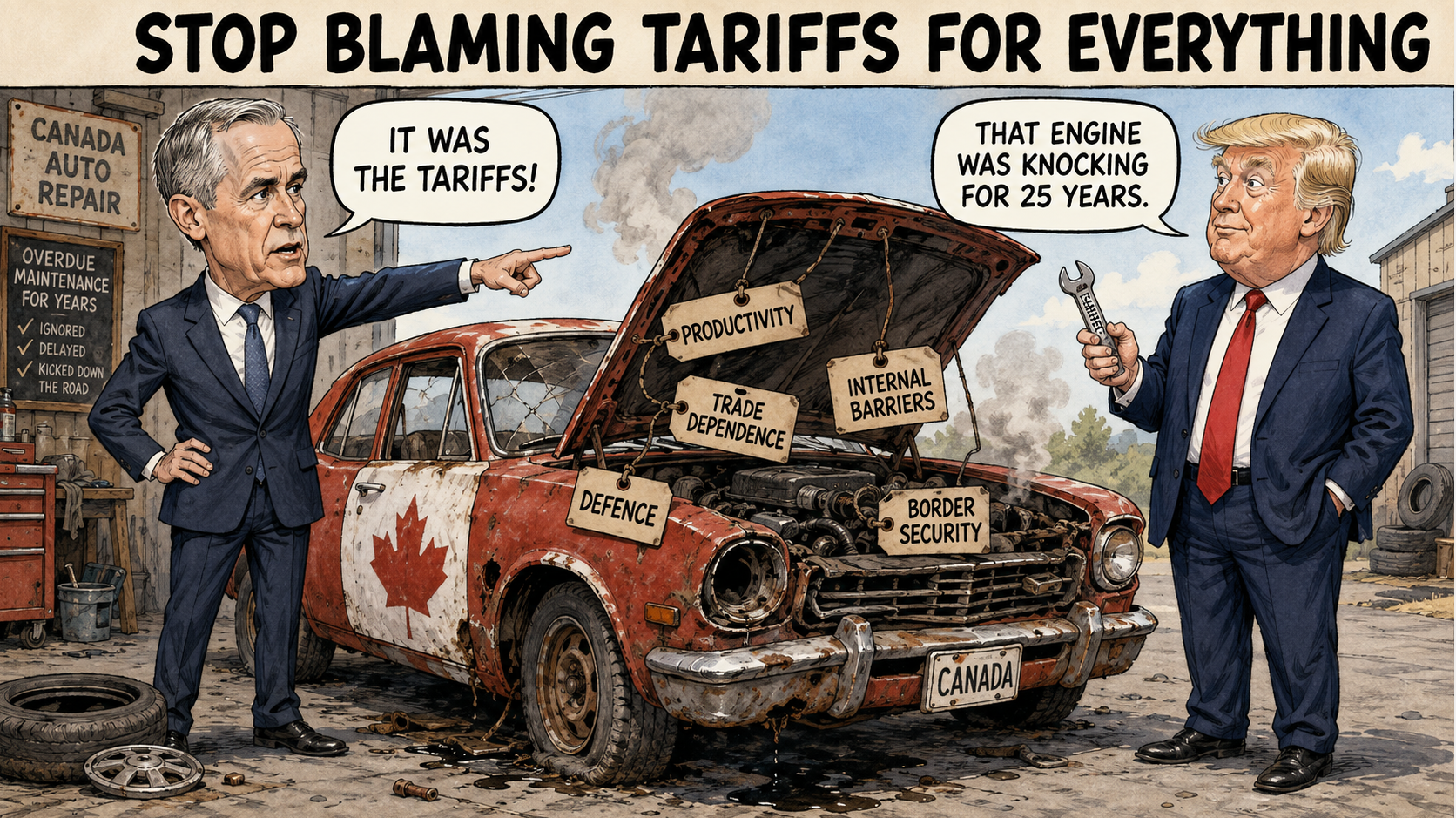
There is a comforting version of the current Canada–U.S. dispute in which Canada was doing everything properly until Donald Trump arrived, slapped tariffs on Canadian products and disrupted an otherwise healthy economic relationship.
In this version, every factory slowdown, lost contract, weak economic forecast and affordability problem can be traced back to one man in Washington. It is the familiar “orange man did it” explanation.
It is politically convenient. It is also analytically incomplete.
Let’s be clear: American tariffs are causing genuine damage. They have reduced demand for Canadian exports, disrupted deeply integrated supply chains, delayed business investment and created uncertainty that neither country needs.
The Bank of Canada estimates that, by the end of 2026, Canadian GDP could be approximately 1.5% lower than it projected before the trade conflict intensified. That is not trivial. Tariffs are taxes on trade, and their costs eventually find their way into businesses, jobs and consumer prices. Bank of Canada
But acknowledging that damage does not require us to pretend that Canada had no role in creating the conditions that made us so vulnerable.
An economic weakness that took decades to develop cannot honestly be blamed on tariffs introduced last year.
The problems started long before Trump
Here are a few facts that place the dispute in perspective:
| Issue | Evidence |
|---|---|
| Canadian productivity compared with the U.S. | Fell from 88% of the U.S. level in 1984 to approximately 71% by 2022 |
| Canadian goods exports sent to the U.S. in 2024 | 75.9% |
| Canadian exporting companies selling only to the U.S. | 65.9% |
| Canadian defence spending in 2024 | 1.37% of GDP |
| U.S. defence spending in 2024 | 3.38% of GDP |
| Fentanyl seized at the northern U.S. border in fiscal 2024 | Approximately 43 pounds |
| Fentanyl seized by U.S. authorities nationwide that year | Nearly 22,000 pounds |
| Canada’s late-2024 border-security plan | $1.3 billion |
None of Canada’s longstanding structural problems began in January 2025.
Canada’s productivity deterioration has been developing for roughly a quarter-century. The Bank of Canada warned in March 2024—before the present tariff conflict—that the country faced a productivity emergency. Canadian businesses were investing too little in machinery, technology, intellectual property and productive capacity.
In 1984, Canadian workers produced approximately 88% of the economic value per hour produced by American workers. By 2022, that figure had fallen to approximately 71%. Bank of Canada
The OECD reached a similar conclusion in 2025. It found that Canadian GDP per person had been weak, productivity gains sluggish and business investment per worker comparatively low. Population growth increased the size of the economy and labour force, but investment in the productive capacity needed to support that growth did not keep pace. OECD Economic Survey of Canada
Trump did not create that problem.
Successive Canadian governments, Canadian businesses and Canadian regulatory systems collectively allowed it to develop.
We placed too many economic eggs in one American basket
In 2024, 75.9% of Canadian goods exports went to the United States. Even more concerning, nearly two-thirds of Canadian exporting businesses sold to no foreign market other than the United States. Statistics Canada
Our geographical proximity to the world’s largest consumer economy made that relationship enormously profitable and efficient. There was nothing irrational about building north-south supply chains.
But dependence and convenience are not the same thing as resilience.
For decades, Canada talked about diversifying trade while continuing to rely overwhelmingly on one customer. We signed agreements with Europe and Pacific countries, but pipelines, ports, regulatory systems, transportation networks and business practices remained heavily oriented toward the United States.
When that customer changed the rules, our lack of alternatives became painfully obvious.
Washington is responsible for imposing disruptive tariffs. But Canada is responsible for allowing itself to become so dependent that a policy change in Washington could threaten entire Canadian industries.
We complain about American barriers while maintaining our own
The idea that Canada has spent decades imposing massive tariffs on everything American is false. Under NAFTA and then CUSMA, most qualifying trade between Canada and the United States crossed the border duty-free.
The overall relationship was not a story of Canada taxing everything from the United States while receiving unrestricted access to the American market.
However, Canada is not an entirely innocent free-trade purist either.
Our supply-management system restricts imports of dairy, poultry and eggs through tariff-rate quotas. Imports within negotiated quotas receive relatively low rates, while products exceeding those quotas can face prohibitive tariffs. Canada and the United States have repeatedly disputed how Canadian dairy quotas are administered. Government of Canada tariff-rate quota information
Canada has defensible reasons for protecting agricultural producers and maintaining food-production capacity. The United States also subsidizes and protects politically important industries.
But we cannot claim that every Canadian protection is principled while every American protection is bullying. Both countries defend sensitive industries when politically convenient.
Canada also maintained significant barriers inside its own borders. Different provincial rules governing transportation, professional credentials, alcohol, construction, procurement and product standards made it more difficult for Canadians to trade with other Canadians.
The federal government has estimated that eliminating internal trade barriers could eventually add as much as $210 billion to Canadian GDP. That is an upper-range estimate rather than a guaranteed outcome, but it illustrates the size of a problem we controlled ourselves. Government of Canada
It should not have required an American tariff crisis for Canada to discover the benefits of a genuinely unified Canadian market.
The fentanyl issue was real—but exaggerated
The original February 2025 tariff order specifically accused Canada of failing to devote sufficient resources to stopping fentanyl, organized crime and illegal border activity. Border security was not an incidental talking point. It was the formal justification for the initial tariffs. White House executive order
The American argument contained a legitimate concern.
British Columbia had become an important entry point for precursor chemicals and a centre of illegal synthetic-drug production. In October 2024, the RCMP dismantled the largest known fentanyl and methamphetamine superlab in Canadian history. It seized 54 kilograms of fentanyl, approximately 5,000 litres and more than 10 tonnes of precursor chemicals, along with methamphetamine, firearms and explosives. The organization was believed to be distributing drugs domestically and internationally. RCMP
Canada’s own financial-intelligence agency reported that the majority of suspected Canadian fentanyl producers operated in British Columbia. It also identified the Lower Mainland and Greater Toronto Area as likely fentanyl-export locations. FINTRAC
Those are not fabricated concerns. Canada had a real precursor-importation, drug-production, money-laundering and organized-crime problem.
Where the American argument became exaggerated was in portraying Canada as a central contributor to the U.S. fentanyl catastrophe.
American border authorities seized approximately 43 pounds of fentanyl at the Canadian border in fiscal 2024—roughly 0.2% of the nearly 22,000 pounds seized nationwide. The DEA has consistently identified Mexican cartels, particularly the Sinaloa and Jalisco New Generation cartels, as the primary suppliers of fentanyl in the United States. DEA
Therefore, both of the following statements can be true:
- Canada was not a major source of the fentanyl entering the United States.
- Canada still had serious border, precursor, organized-crime and drug-production weaknesses that required action.
Canada’s mistake was treating the small percentage entering the United States as though it erased the larger security concern.
The American mistake was taking a genuine but comparatively small cross-border flow and presenting it as though Canada were a major driver of America’s overdose crisis.
Did American pressure accomplish anything?
Canada had not literally done nothing before 2025. It had controlled certain precursor chemicals, conducted investigations, made seizures and participated in North American drug-enforcement initiatives.
But Canada’s own evaluations had already identified weaknesses in detecting synthetic drugs, stopping precursor imports and preventing exports. The response lacked the urgency warranted by the emerging threat.
Then American tariff pressure arrived.
In December 2024, Canada announced a $1.3-billion border plan. In early 2025, it appointed a Fentanyl Czar, expanded surveillance, committed additional intelligence resources, proposed a Canada–U.S. Joint Strike Force, listed several cartels as terrorist entities and promised additional RCMP and border personnel. Government of Canada Border Plan
Some measures were underway before the tariffs took effect, so it would be inaccurate to credit Trump for everything. But it is equally difficult to believe that the sudden escalation, funding and political urgency had nothing to do with American pressure.
Tariffs were an unnecessarily broad instrument for addressing a comparatively small fentanyl flow. Nevertheless, the threat of tariffs clearly concentrated attention in Ottawa.
Defence is where the American argument was strongest
Canada agreed at the 2014 NATO summit to move toward spending 2% of GDP on defence within a decade.
Canada spent approximately 1.01% in 2014. By 2024, it had reached only 1.37%. Over the same period, the United States spent approximately 3.38% of its much larger economy on defence. NATO defence-expenditure tables
The 2% target was not a bill Canada owed to the United States. NATO countries primarily spend defence money on their own armed forces, and U.S. military spending supports American interests around the world.
But the broader burden-sharing criticism was legitimate.
Canada benefited from American military capacity, intelligence, continental defence and NATO deterrence while repeatedly postponing the investments necessary to rebuild its own capabilities. Military procurement became painfully slow. Personnel and readiness problems accumulated. Arctic surveillance and sovereignty requirements grew faster than the resources assigned to them.
Canada eventually reported reaching the 2% benchmark in fiscal 2025–26, following a major spending increase. NATO reported that all members reached the old benchmark in 2025. Government of Canada
Defence spending was not the formal basis of the original fentanyl tariffs. But it unquestionably contributed to a broader American perception that Canada expected privileged economic and security treatment without carrying a proportionate share of the burden.
That perception was not entirely fair—but it was not entirely imaginary.
Tariffs are a problem, not an all-purpose excuse
We should oppose policies that unfairly damage Canadian workers and businesses. We should challenge exaggerated claims about Canada’s role in American fentanyl deaths. We should insist that trade agreements be respected and disputes addressed through evidence and established processes.
But we should also stop using tariffs as an all-purpose excuse for every Canadian economic failure.
Tariffs did not create:
- Canada’s 25-year productivity problem;
- decades of weak business investment;
- our dependence on one export customer;
- interprovincial trade barriers;
- slow infrastructure and resource-project approvals;
- weaknesses in port and border enforcement;
- organized crime and money-laundering vulnerabilities;
- protected sectors that restrict foreign competition;
- or our longstanding defence-spending shortfall.
Those are Canadian problems requiring Canadian solutions.
The mature conclusion is not “Trump is right about everything.” He is not.
Nor is it “Canada did nothing wrong and is simply being bullied.” That is equally inaccurate.
The reality is less emotionally satisfying but more useful: the United States took legitimate grievances, mixed them with exaggeration and addressed them using tariffs far broader than the documented problems justified. Canada, meanwhile, entered the confrontation with serious vulnerabilities that had been developing for decades.
Washington must accept responsibility for the economic damage caused by its tariff decisions.
Ottawa, the provinces and Canadian business leaders must accept responsibility for the weaknesses that made those decisions so damaging.
Blaming Donald Trump may win applause. Fixing productivity, diversifying trade, strengthening our borders, improving competition, removing internal barriers and rebuilding national defence would accomplish considerably more.
It is time Canada stopped asking who can be blamed for exposing our weaknesses and started asking why we allowed those weaknesses to persist.
 marksdeepthoughts.ca
Leave a comment