
The Charming Facade of Anthony Fauci and the Psychology That Shields Him
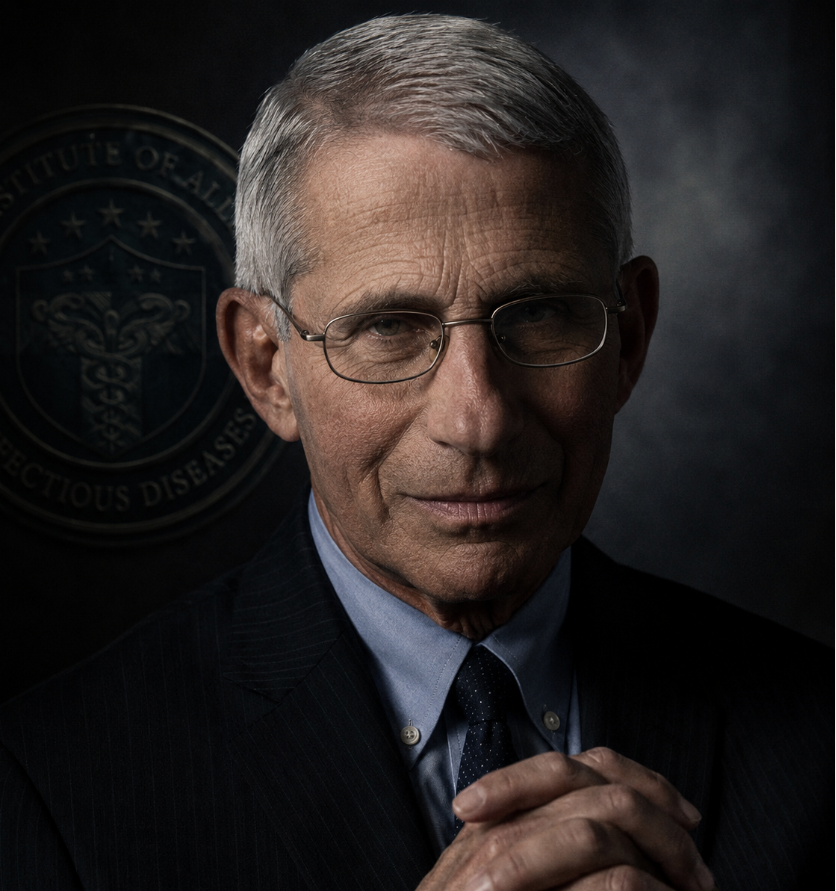
There he sits. An older man, well-groomed, soft-spoken, the very picture of the dedicated public servant and nerdy scientist who spent decades at the National Institute of Allergy and Infectious Diseases. For millions, Anthony Fauci was the steady voice of reason during the darkest days of COVID-19—the face of “keeping America safe,” the trusted expert whose guidance shaped lockdowns, masks, distancing, and the entire national response. He looked harmless. He sounded measured. He seemed like the adult in the room.
That appearance is precisely the problem.
In a recent congressional hearing, the same man invoked the Fifth Amendment over and over: “On the advice of counsel, I respectfully decline to answer based upon my rights under the Fifth Amendment to the Constitution.” Question after question—on masks, the six-foot rule, lockdowns, the origins of the virus, natural immunity, record destruction—met the identical stone wall. Senators pressed him. One narrowed a question strictly to the period covered by a broad presidential pardon. Still the same refusal. The committee scheduled a vote on contempt. Fauci, once the highest-paid federal employee and the public face of pandemic authority, offered almost nothing except the constitutional shield against self-incrimination.
Bret Weinstein, watching the spectacle on the DarkHorse Podcast, did not mince words. He described looking at a monster—the kind of person who, through sophisticated rationalizations, becomes comfortable causing the deaths of innocents. The difficulty, Weinstein noted, is that this particular monster does not look the part. He appears charming, unthreatening, well-spoken. The gap between the polished exterior and the record of decisions that locked down societies, closed schools, dismissed natural immunity, and publicly insisted on a wet-market origin while privately acknowledging otherwise is jarring. It is the same psychological trap that has protected other charismatic figures throughout history.
Consider Ted Bundy. While on trial for a series of brutal murders, Bundy still attracted admiring letters and courtroom attention from women who found his looks and demeanour compelling. The disconnect is a documented human frailty: we are wired to trust faces that signal safety, competence, and familiarity. Psychologists call it the halo effect—attractiveness or an unthreatening appearance colours our judgment of character, making it harder to accept evidence of profound harm. When the evidence points to policies that inflicted measurable damage—developmental delays in children from prolonged school closures, isolation of the dying from recovered family members, recommendations later admitted to rest on “empiric” guesses rather than data—the charming exterior acts as a cognitive buffer. The mind resists reconciling the kindly-looking grandfather figure with the consequences.
The hearing transcript lays out the contradictions in plain view. On March 8, 2020, Fauci told 60 Minutes there was “no reason to be walking around with a mask,” emphasizing that it was not protective and could even encourage face-touching. Weeks later the guidance flipped; the explanation shifted to scarcity of supply for health workers. When pressed on the six-foot rule he had repeatedly urged from the White House podium, Fauci later acknowledged it “sort of just appeared” and was not based on studies. Diary entries quoted in the hearing show him privately urging the closure of New York City schools, bars, and restaurants and telling the president the country should shut down—while publicly claiming he had not recommended locking anything down. On origins, private notes from January 2020 treated the Wuhan wet market as a superspreader event rather than the source; publicly, for years, the market narrative was repeated. Natural immunity—known since antiquity and observable in recovered patients—was downplayed even as recovered workers and family members were treated as ongoing threats. Lab-leak risks and gain-of-function research, areas in which Fauci’s institute played a central funding and oversight role, received the same public minimization.
These are not minor inconsistencies. They form a pattern of statements that diverged from available evidence and private knowledge at the time, with real-world costs measured in closed businesses, disrupted childhoods, and preventable isolation. The Fifth Amendment invocations do not erase the record; they simply refuse to engage it. A broad pardon covering conduct through early 2025 raises further questions about whether the privilege still holds for that window, and whether an opening statement under oath already waived selective silence. New potential offenses—contempt, false statements after the pardon—would fall outside its protection. Yet the institutional machinery appears content to let the procedural theater continue until public attention fades.
That fading is already underway. Mainstream coverage that once amplified every Fauci press conference now treats the darker accounting with conspicuous restraint. The man who was elevated as the indispensable expert can reasonably hope that time, selective memory, and the protective networks around high-level public-health decision-makers will do the rest. Weinstein framed the scene in starker terms: powerful institutional networks that operate with the internal logic of a protected class, rendering ordinary accountability mechanisms—senatorial questions, public outrage—largely ornamental. Fauci’s repeated refusals can be read not only as legal strategy but as a demonstration that the system cannot, or will not, reach him.
History is littered with figures whose ordinary, even appealing, appearances made their actions harder to confront until the record became overwhelming. The human tendency to grant the benefit of the doubt to the familiar face is not malice; it is a cognitive shortcut that once helped us navigate tribal life. In the presence of concentrated institutional power and media incentives that prefer narrative continuity over uncomfortable revision, that shortcut becomes a shield. It allows the public to keep the comforting image of the scientist who “kept us safe” while the documented decisions—policy recommendations later conceded to lack rigorous foundation, public messaging that conflicted with private assessments, oversight of research carrying catastrophic risk—recede into the background.
Fauci does not need to look like a villain for the evidence to demand scrutiny. The monster, if the word applies, is not in the features or the voice. It is in the gap between the trusted persona and the consequences that followed the advice. The hearing did not produce confessions or apologies. It produced a choreographed silence that, precisely because of the benign appearance, many will continue to interpret charitably. That is the psychological mechanism at work. It is also why the record must be kept visible, repeated, and measured against the outcomes rather than the carefully cultivated image. Time may dull attention. It does not rewrite the transcript.


Leave a Reply