
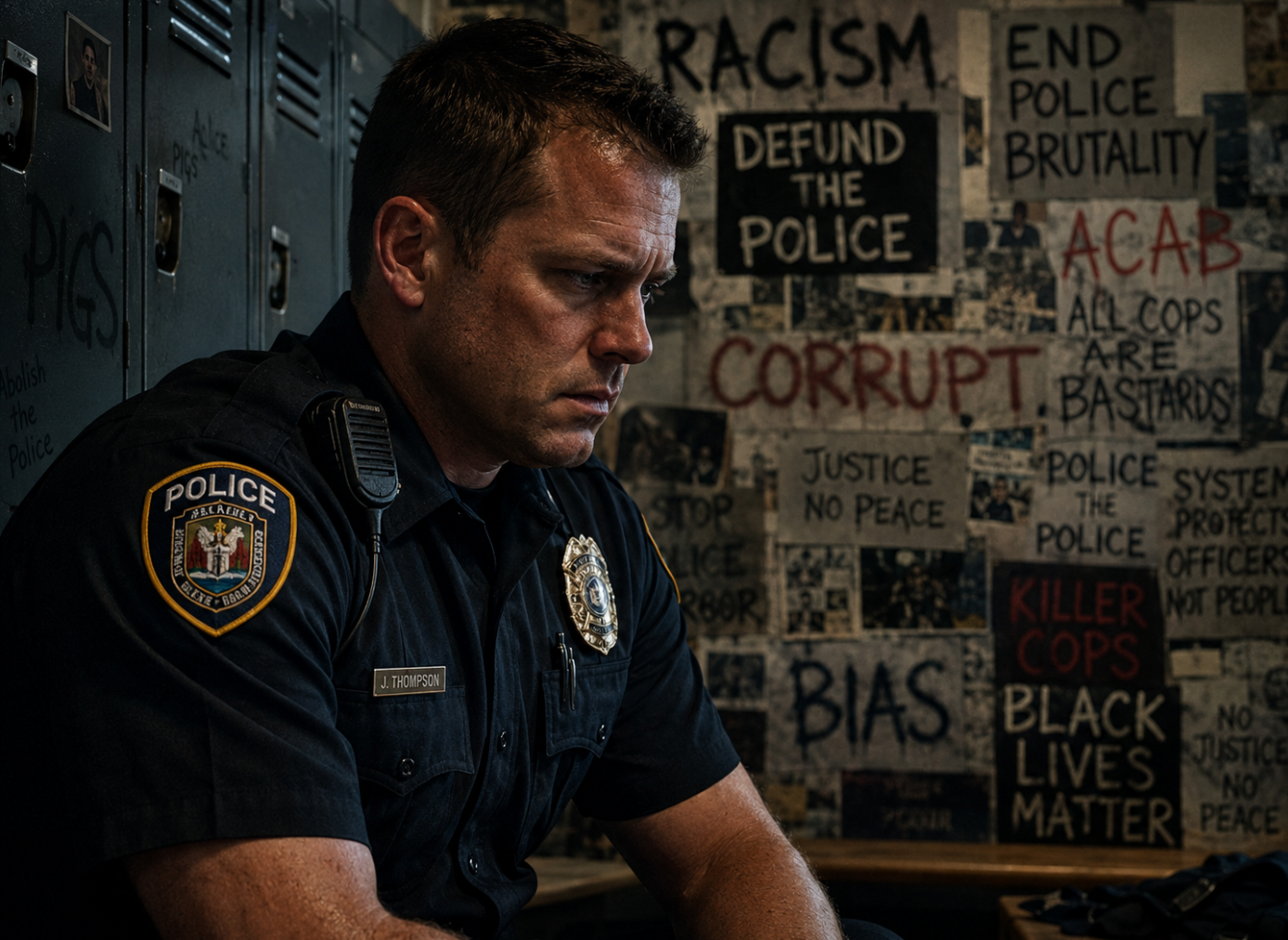
Every shift begins the same way for countless police officers across Canada, the United States and the Western world. The uniform goes on. The vest is checked. The family gets a hug or a glance at a photo on the dash. The silent question lingers: Do I come home tonight? It is not abstract philosophy. It is the arithmetic of risk in real time. Officers do not have the luxury of academic debates or media framing. They read the environment using every available signal: behaviour, context, appearance, demeanour, and yes, patterns that data has made impossible to ignore. Pretending those patterns do not exist is not compassion. It is a luxury that gets people killed.
About the Author:
I write these observations not as an outsider, but as someone with deep roots in Black ancestry. My family’s history is documented in the book Men of Colour: An Historical Account of the Black Settlement on Wilberforce Street and in Oro Township, Simcoe County, Ontario, 1819-1949 by Gary E. French, available on Amazon. This work chronicles the experiences of early Black settlers in Canada—free people seeking opportunity and stability in a new land, far from the narratives of perpetual victimhood that dominate today. Their story is one of resilience, labour, community-building, and adaptation to the demands of a structured society. It reminds me that progress has always come from confronting harsh realities with agency, family strength, and honest assessment of one’s circumstances, not from external blame or denial of measurable differences in outcomes.
This personal heritage gives me no special immunity from data, nor does it compel me to soften uncomfortable truths. If anything, it sharpens the insistence on facing facts: group patterns in crime, cognitive distributions, family structure, and behavioural norms affect real lives, including those of good people trying to thrive within these communities. Acknowledging averages does not erase individual excellence or ancestral struggles; it honours them by refusing to repeat cycles that hold potential back. The officers wondering if they will come home tonight, the law-abiding families in high-risk neighbourhoods, and the broader society all deserve policies grounded in evidence rather than sentiment. My family’s recorded history in that book stands as a testament that honest engagement with reality has always been the path forward.
Brothers Benjamin and William Davenport had labour ties upon their arrival in Upper Canada as former slaves (around 1810) and subsequently petitioned for land as “Men of Colour.”William Davenport petitioned for and received land grants in the area:
- In 1819: Lot 51, Con. 1, Flos Township (west side of the Penetanguishene Road).
- In 1828: 100 acres on Lot 2, Con. 2, Oro Township on Wilberforce Street.
The Data Disparities
The numbers are stubborn. If we use US statistics, according to FBI Uniform Crime Reporting data over multiple years (patterns that have held for decades even as overall crime fluctuates), Black Americans, roughly 13-14% of the population, account for approximately 50-55% of known homicide offenders and a similar share of robbery arrests where race is recorded. ucr.fbi.gov +1 Victim surveys (NCVS) align closely with arrest data, reducing the plausibility that this is purely a policing artifact. Most violent crime, especially homicide, is intra-racial. Black victims are disproportionately killed by Black offenders. These are not “all Black people.” They are concentrated patterns within subsets, often young males in specific urban environments shaped by family structure, culture, and behaviour. The vast majority of Black Americans are law-abiding and want the same safety as everyone else. But averages matter when officers make split-second decisions in high-stakes encounters. Denying the base rates does not make the streets safer.
IQ, Outcomes, and Integration
Cognitive ability, measured by IQ and related metrics, is one of the strongest predictors of educational attainment, employment, income, and inversely, criminal involvement. U.S. data consistently show an average gap of roughly one standard deviation (about 15 points) between Black and White means (Black averages around 82-85, White around 100), with substantial overlap between individuals. This is not destiny for any person. It is a statistical reality with consequences. Lower average cognitive ability correlates with challenges in complex modern economies, impulse control in high-stress situations, and long-term planning. Integration into a high-trust, high-skill society is harder on average when these distributions differ. Explanations are multi-causal and hotly debated:
- Environmental: Nutrition (iodine, early childhood deficits), lead exposure, schooling quality, family stability (high rates of single-parent households correlate strongly with poorer outcomes across groups), and cultural factors around education and delayed gratification.
- Heritability: IQ is highly heritable within populations (often 50-80% in adulthood). Adoption and twin studies show persistence of gaps even in improved environments. Some researchers argue a partial genetic component to group averages, consistent with global patterns and regression to racial means. www1.udel.edu
The point is not to litigate genetics versus environment here. The point is that the gap exists in measured outcomes, it predicts real-world results, and ignoring it while blaming only “systemic” forces leads to failed policies. Lower averages in cognitive metrics make cultural and behavioural adaptation slower in some communities. This is observable in crime involvement, welfare dependency, and integration metrics not as a moral indictment, but as data.
Similar patterns appear when discussing migration and integration elsewhere: origin-country human capital (education, skills, cognitive distributions) strongly predicts success or friction in host societies. Selection effects matter. Dumping large numbers from lower-performing distributions without assimilation pressure creates predictable strain.
Policing: Instincts Forged in Data, Not Theory
Back to the officer facing a stop. A “biker” with club patches and known associations triggers caution—data on outlaw motorcycle gangs shows elevated violence and weapons involvement. A young male displaying clear gang identifiers (colours, tattoos, hand signs, posture, vehicle) in a high-crime corridor triggers the same. These are not arbitrary prejudices. They are updated Bayesian priors based on clearance data, gang intelligence, and repeat offender patterns. Officers who survive long careers learn that non-compliance, evasion, or aggression dramatically raises the probability of escalation—for everyone. Data on officer assaults and killings show disproportionate involvement from certain demographic and behavioural profiles relative to population share.
cde.ucr.cjis.gov Body cameras and detailed incident reviews repeatedly show that many controversial encounters begin with routine violations but escalate through resistance.”Profiling” in the pejorative sense—stopping people solely because of skin colour with no other indicators is inefficient and illegal. Using statistical patterns plus behaviour, location, time, and observables is basic risk management. Good cops do the latter. The former gets departments sued and communities less safe. Treating every encounter as starting from a blank slate ignores the arithmetic that keeps officers alive and deters predators. The “Ferguson effect” and subsequent de-policing experiments showed what happens when instincts are overridden by politics: proactive enforcement drops, clearance rates suffer, and violent crime often rebounds in the affected areas. Officers hesitate. Criminals notice. Law-abiding residents—disproportionately in the very neighbourhoods with the highest victimization pay the price.
Officers routinely employ probabilistic reasoning. Visible indicators—such as gang-related tattoos, clothing associated with known street gangs, or motorcycle club affiliations—correlate with elevated risks of weapons, warrants, or resistance based on gang intelligence and clearance data. A young male displaying such markers in a high-crime area at atypical hours prompts heightened caution, akin to adjustments made for any high-risk profile. This approach constitutes data-informed risk management rather than solely racial categorization.
Empirical studies of traffic stops (e.g., Stanford Open Policing Project) document higher stop and search rates for Black drivers in many jurisdictions. Contraband hit rates are mixed, sometimes comparable or lower, reflecting the complexity of discretionary decisions. Non-compliance during encounters significantly elevates the likelihood of force, as documented in body-camera analyses. Periods of reduced proactive policing following high-profile incidents have correlated with localized increases in violent crime in affected cities, consistent with the “Ferguson effect” hypothesis in criminological literature.
Effective policing balances individual rights with officer and public safety. Ignoring documented patterns for the sake of uniformity increases danger to officers and to law-abiding residents in high-victimization neighbourhoods.
Voices from Within
Many Black Canadians and Americans see this clearly and say so without hedging. Economists and commentators like Thomas Sowell have documented pre-1960s Black progress in education, employment, and family stability that was later undermined by cultural shifts, welfare policies that discouraged marriage, and narratives that externalize all failure.
hoover.org Larry Elder and others repeatedly highlight family breakdown, cultural attitudes toward authority and education, and personal responsibility as central—arguing that excusing dysfunction harms the very people it claims to help. These are not isolated voices; they reflect data on marriage rates, educational effort, and crime involvement within communities.
When subsets of young people in certain neighbourhoods glorify anti-social behaviour, reject mainstream norms around work and family, or treat compliance with law enforcement as optional, it does not just affect “them.” It makes every encounter riskier. Good people in those communities notice. They speak of “acting like fools” and making life harder for everyone trying to build something stable. The data on single-parent households (around 70% nonmarital birth rates in recent Black cohorts) and its correlation with delinquency is not controversial among those who track outcomes rather than narratives.
The Fin in the Water

Let’s look at it this way: let’s say you are on vacation, swimming in the ocean, and a fin suddenly breaks the surface heading in your direction; the rational response is immediate caution or get the fuck out of there. Because you immediately think SHARK! Nobody in their right mind would expect you to pause for a full species identification. Most people’s first association is wholey shit! Because this is a high-consequence, potentiall life-ending threat. Now we all know this could be a dolphin, another harmless animal. Yet erring on the side of assuming “shark” is the survival-oriented strategy. The cost of a false positive (unnecessary panic, swimming away) is minor compared to the cost of a false negative (being attacked). This is not prejudice against fins. It is an application of base rates and expected value under uncertainty:
- In many waters, sharks represent a small percentage of marine animals but carry severe risk.
- Dolphins are more common in some areas but do not negate the shark possibility.
- Visible cues (fin shape, behaviour, location, time of day) provide additional data, but the prudent swimmer updates probabilities quickly and acts defensively until more information confirms safety.
Application to Policing
Officers face analogous decisions dozens of times per shift. A traffic stop or street encounter presents limited information in seconds: appearance, location, time, demeanour, vehicle condition, and behavioural signals (gang indicators, furtive movements, non-compliance). Certain demographic and subcultural patterns function like the “fin”:
- They correlate statistically with elevated risk of weapons, resistance, or violence (documented in FBI UCR, NCVS, gang databases, and officer assault statistics).
- Treating every encounter as starting from zero risk (the dolphin assumption) ignores base rates and has produced tragic outcomes for officers and civilians.
- Heightened caution—firmer commands, greater distance, readiness for escalation—is the professional equivalent of swimming away from the fin. It is not hatred of fins (or any group). It is calibrated risk management refined by thousands of documented incidents.
Just as a marine biologist might eventually identify the fin as a dolphin through closer observation, officers update based on compliance and further cues. Rapid de-escalation occurs when signals indicate low threat. But initial caution buys the time needed for that assessment. Body cameras repeatedly show that many high-profile escalations begin with routine violations followed by resistance, not arbitrary aggression.
Why the Analogy Matters
- Ignoring patterns is not bravery or fairness; it is a form of Russian roulette with other people’s lives. Officers who have survived long careers describe developing an intuitive “sixth sense” that is actually accumulated statistical learning.
- False positives exist: Innocent people matching risk profiles experience inconvenience or perceived unfairness. This is real and undesirable, but the alternative—systematically under-weighting real base-rate dangers—produces higher overall harm (more unchecked crime, more officer deaths, more victims in high-risk neighbourhoods).
- Context refines the heuristic: A fin near a known dolphin pod prompts less alarm than one in shark-frequented waters at dusk. Similarly, officers adjust for clean-cut professionals versus visible gang signals in high-crime corridors.
This framework explains why “treat everyone exactly the same” sounds equitable in theory but fails in high-stakes, time-constrained environments. Human decision-making under uncertainty has always relied on priors. Modern policing data simply makes those priors measurable rather than anecdotal.
The officer wondering Do I come home tonight? operates in the same cognitive space as the swimmer facing the fin. Respecting the data-driven patterns is not bias it is the disciplined application of evidence to protect life. Denying the fin does not make the ocean safer.
The Distinction That Matters
This is not about Black people, and I want to make this crystal clear. It is about people, any people—whose behaviour, cultural patterns, and group averages in measurable traits create friction with the demands of a complex, ordered society. Bad actors exist in every demographic. When certain patterns concentrate (higher impulsivity-linked crime, lower average preparation for high-skill economies), the friction becomes visible in statistics. Skin colour is a crude proxy; behaviour, culture, family structure, and cognitive distributions are better ones. Conflating the two serves no one.
The officer deciding whether to approach cautiously or casually is not conducting a sociology seminar. They are trying to finish the shift without becoming a statistic themselves or leaving a family without a parent. Their instincts, when data-informed rather than ideologically steered, are a survival mechanism refined by experience and clearance reports. Dismissing them as “racism” because they correlate with uncomfortable group patterns is not moral progress—it is a form of denial that exacts a body count.
Facts do not care about feelings or political comfort. Crime disparities, outcome gaps tied to cognitive and behavioural distributions, integration challenges, and the daily calculus of policing are measurable. They will not disappear by redefining terms or blaming only external forces. Acknowledging them—without excusing individual agency or collective cultural failures is the prerequisite for any policy that actually improves safety and opportunity rather than perpetuating cycles.
The cop who makes it home tonight did so, in part, because patterns were respected rather than denied. The communities that thrive do the same. Everything else is expensive theatre.


Leave a Reply