
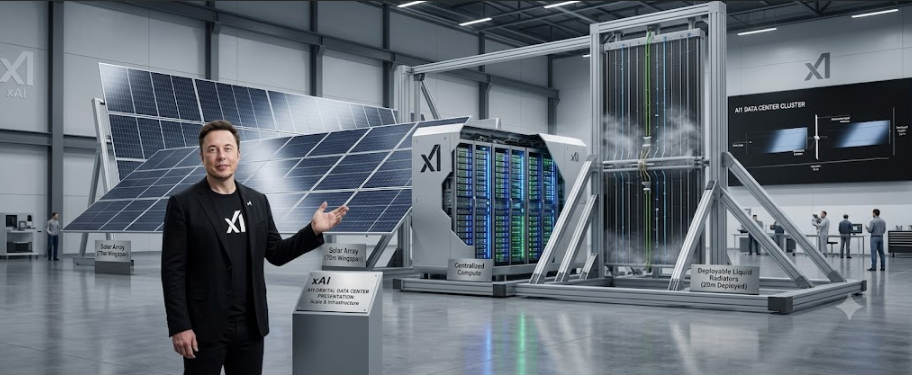
Building terrestrial data centers to power the future of artificial intelligence is rapidly becoming the equivalent of trying to run a modern jet turbine off a 19th-century coal pipeline. The bottleneck isn’t the engine itself; it is the physical limits of the delivery system.
As the demand for AI compute scales toward a projected multi-trillion dollar market, terrestrial tech giants are running headfirst into an insurmountable wall: Earth’s power grid. Ground-based data centers demand massive acreage, drain millions of gallons of water for cooling, and strain local electrical grids to the breaking point. They are sprawling physical eyesores that require navigating municipal zoning laws, utility approvals, and environmental protests.
Elon Musk, however, is playing a completely different board game. By shifting focus to orbital data centers, he is preparing to leave Earth-bound developers in the dust, effectively positioning SpaceX as the ultimate gatekeeper to the next era of AI infrastructure.
The Engineering is Already Here
The most profound takeaway from Musk’s recent strategy update is that putting data centers in orbit is no longer the realm of science fiction. It does not require hypothetical leaps in physics or undiscovered “magic” materials. The foundational technology already exists.
When SpaceX built the Starlink constellation, they solved the hardest initial problems of orbital networking: mass-manufacturing satellites, establishing reliable laser-link communications in a vacuum, and bringing launch costs down to a fraction of historical averages through reusable rockets. Compared to the massive, unprecedented engineering hurdle of getting the first thousands of Starlink satellites operational, deploying orbital compute modules is a relatively straightforward iteration.
SpaceX’s planned AI satellites rely heavily on existing Starlink V3 technology. At peak performance, these individual orbital nodes are designed to handle 150 kilowatts of AI computing—a capacity roughly equivalent to the highest-end Nvidia GB300 server racks used on Earth today.
Escaping the Terrestrial Trap
By moving infrastructure into Low Earth Orbit (LEO), Musk bypasses the three fatal flaws of terrestrial data centers:
- The Energy Ceiling: On Earth, solar energy is interrupted by weather and the day-night cycle. In orbit, solar arrays can harvest unadulterated, continuous energy from the sun with zero atmospheric interference.
- The Cooling Crisis: Terrestrial data centers generate immense heat, requiring massive water diversion or energy-hungry HVAC systems to prevent chips from melting. While the vacuum of space traps heat (meaning radiators are still necessary), the ambient temperature of deep space offers a permanent, scalable heat sink without draining a drop of a local municipality’s water supply.
- The Real Estate Bottleneck: Orbital real estate has no zoning boards, no local resistance to “eyesore” megastructures, and limitless room for expansion.
The Terrestrial Bottleneck
If we break down Earth’s 510 million square kilometers of surface area, the options for a data center vanish rapidly:
- The Water Deficit: As you noted, roughly 71% of the planet is immediately disqualified because it is ocean.
- The Geography Deficit: Of the remaining 29% that is land, roughly a third is covered by deserts, glaciers, and rugged mountains.
- The Infrastructure Deficit: You cannot simply drop a data center in the middle of a usable field. Terrestrial data centers require massive pre-existing infrastructure: high-voltage power transmission lines, high-capacity fiber optic backbones, and millions of gallons of accessible fresh water for cooling.
- The Zoning Deficit: Even if you find the perfect piece of land with water and power, you must battle local zoning boards, environmental impact studies, and local residents who do not want a humming, power-hungry warehouse in their community.
The actual percentage of Earth’s surface that is legally, geographically, and infrastructurally viable for a gigawatt-scale AI data center is practically a rounding error. Tech companies are spending billions fighting over scraps of prime real estate.
The Orbital Canvas
In contrast, Low Earth Orbit (LEO) is a perfectly uniform, unencumbered canvas.
When you move a data center into space, 100% of that expanded orbital shell is functionally usable because the infrastructure requirements fundamentally change:
- No Power Grids: You do not need to hunt for land near a power plant. The power source (the sun) is ubiquitous and constant.
- No Water Lines: You do not need proximity to a river or aquifer. The ambient temperature of deep space provides a permanent, scalable heat sink for liquid radiators.
- No Trenches: You do not need to lay thousands of miles of physical fiber optic cables across varying terrain. The data travels via line-of-sight laser links in a vacuum, which actually transmits light roughly 47% faster than glass fiber optics on Earth.
By moving to orbit, Musk isn’t just gaining the extra 18% of geometric space we calculated earlier; he is moving from a planet where usable real estate is severely restricted to a realm with zero geographical, municipal, or environmental bottlenecks.
Given that SpaceX already controls the vast majority of the world’s payload-to-orbit capacity through their reusable Falcon and Starship programs, how much of an insurmountable moat do you think their launch monopoly creates against competitors who might eventually try to follow them into space?
The Ultimate Gatekeeper
Those still pouring billions into buying up farmland to build massive concrete warehouses are fighting over a finite, deeply regulated resource. Musk is ten moves ahead, recognizing that whoever controls the power source and the physical housing for AI will control the industry.
By utilizing SpaceX’s unmatched launch cadence and pricing advantage, Musk is building a toll road in the sky. When competitors eventually realize they cannot secure enough wattage from Earth’s aging power grids to run their models, their only option will be to lease orbital compute from the one company that already built the infrastructure. In the race for artificial intelligence, the ultimate winner may not be the one with the best algorithms, but the one who completely bypasses the physical limits of the planet.


Leave a Reply