

Why Canada’s $25.8B Foreign Chequebook is Clashing with Domestic Reality
Imagine a family drowning in debt. The collection agencies are calling daily, the credit cards are maxed out, and the roof is leaking. Instead of fixing the roof or paying down the principal, the parents take out a payday loan to help a neighbor buy a car. The neighbor undeniably needs the vehicle, but the parents’ financial foundation is crumbling beneath them.
This is the exact analogy many economists and citizens are applying to Canada’s current fiscal trajectory.
In May 2026, Prime Minister Mark Carney stood at the European Political Community summit in Armenia and committed an additional $270 million for critical military capabilities in Ukraine. This latest pledge brings Canada’s total monetary, military, and multifaceted assistance to Ukraine to over $25.8 billion since 2022.
There is no debate that Ukraine is facing an existential crisis and requires international support. However, from a purely logical and fiscal standpoint, an uncomfortable question must be asked: How can a nation teetering on the edge of a recession, actively cutting its own critical domestic programs, afford to be the world’s bank?
The Home Front: Austerity in the Face of Crisis
While billions flow outward, the government has quietly instituted severe austerity measures at home. A deep dive into recent federal budgets and economic updates reveals a stark contrast between foreign generosity and domestic frugality.
Recent federal financial updates have signaled a deliberate slowdown in healthcare funding. Most notably:
- Health Transfer Reductions: The government signaled a reduction in the Canada Health Transfer growth rate to 5%, placing immense strain on provinces already running historic deficits.
- Direct Budget Cuts: Budget 2025 initiated successively deepening cuts to health, amounting to nearly $400 million a year by the end of the decade.
- Public Sector Job Losses: To balance the books, the government is cutting 40,000 public service jobs over the next four years.
- Seniors’ Care Squeeze: Provincial policy decisions, driven by federal transfer limits, have resulted in hundreds of millions in funding losses across the seniors’ care sector, right as the aging population requires it most.
- The Opportunity Cost of $25.8 Billion

To understand the sheer scale of $25.8 billion, we have to look at what that capital could achieve if deployed within our own borders. When a country spends on its own infrastructure, healthcare, and people, it generates a massive return on investment (ROI) that stimulates the domestic economy.
Here is what $25.8 billion could theoretically accomplish here at home:
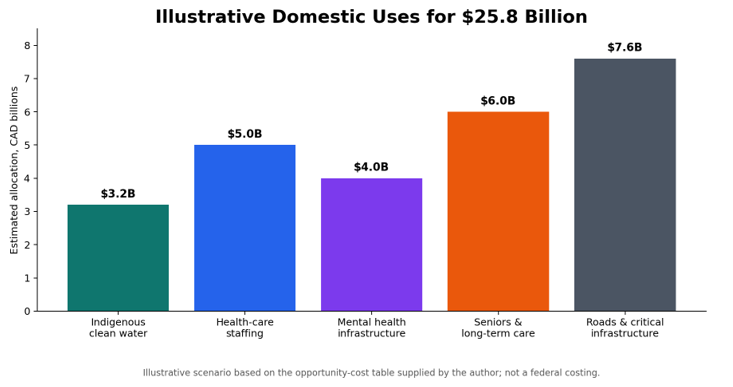
Even after fully funding every single one of those domestic priorities, the government would still have change left over.
The Health-Care Crisis Is Not a Talking Point. It Is a National Failure.
Canada’s health-care system is not merely “under pressure.” That phrase is too polite. It is buckling in front of us.
CIHI reported that 5.7 million Canadian adults did not have a regular health-care provider in 2024. It also estimated that the country would require a 49% increase in family physicians to meet current demand. [6] On the hospital side, CIHI reported almost 32 million overtime hours worked by health-care providers in 2023-24, equivalent to 16,397 full-time positions. [7]
That is not a staffing model. That is slow-motion institutional exhaustion.
Canadians wait for care. Nurses burn out. Emergency departments overflow. Families sit in hallways pretending that a chair beside a vending machine is still part of a first-world health-care system. Then Ottawa announces another international package and expects applause.
The issue is not whether money alone fixes health care. It does not. But anyone who says money is irrelevant to health-care capacity is either not serious or not honest. Doctors cost money. Nurses cost money. Clinics cost money. diagnostics cost money. Training seats cost money. Rural delivery costs money. If Canada can find billions for Ukraine, Canadians are entitled to ask why domestic capacity is treated like a long-term aspiration rather than a national emergency.
Mental Health: The Crisis Everyone Names and Too Few Properly Fund
Mental health has become one of the safest phrases in Canadian politics. Every party supports it. Every campaign mentions it. Every speech includes the right vocabulary: trauma, addiction, wellness, youth, resilience, community care.
Then people try to get help.
That is where the slogans die.
The Canadian Mental Health Association has reported that provinces and territories spend an average of 6.3% of their health budgets on mental health, while arguing that the share should be closer to 12%. [9] That gap shows up in real life as waitlists, unaffordable therapy, crisis-driven care, overburdened emergency rooms, policing pressure, family breakdown, addiction escalation, and preventable suffering.
Mental health is not a soft issue. It is economic infrastructure, public-safety infrastructure, family infrastructure, and workforce infrastructure. When it fails, the bill does not disappear. It moves to hospitals, police, courts, shelters, disability programs, workplaces, and grieving families. So the question is fair: how many youth crisis programs, community treatment beds, addiction supports, Indigenous mental-wellness services, and mobile crisis teams could be built with even a fraction of $25.8 billion?
Clean Water Should Come Before One More Foreign Cheque
The most morally indefensible part of this debate is Indigenous drinking water.
Indigenous Services Canada reported 40 active long-term drinking water advisories on public systems on reserve in 38 communities as of May 16, 2026, affecting approximately 5,542 homes and 349 community buildings. [8]
Read that slowly. Canada is still asking some Indigenous families to live without reliable safe drinking water while presenting itself as a global moral leader.
There is no respectable excuse for that. Not after years of promises. Not after billions in foreign commitments. Not after endless speeches about reconciliation.
A government that can move billions across borders can move clean water through pipes. A government that can help fund foreign stability can finish basic infrastructure for its own citizens. A government that can talk about reconstruction abroad should have the humility to complete construction at home.
The truth is harsh: Canada is better at reconciliation as a speech than reconciliation as infrastructure. And moral leadership is not tested at a podium. It is tested at the tap.
Seniors Are Being Asked to Age in a System That Is Not Ready
Canada is aging, and the country is not ready.
Families know it. Hospitals know it. Long-term care homes know it. Personal support workers know it. Seniors know it most of all.
Home care is inconsistent. Long-term care capacity is strained. Caregivers are exhausted. Seniors get stuck in hospitals because there is nowhere appropriate for them to go. Families try to hold everything together with guilt, unpaid labour, and desperate phone calls.
This is not a surprise. Canada has known for decades that the population was aging. The question was whether government would prepare. In too many places, the answer has been no.
A country that says it is defending human dignity abroad should be willing to defend dignity at home: more home care, more long-term care capacity, better staffing ratios, better wages and retention for personal support workers, more dementia care, more palliative care, and better caregiver support.
The Infrastructure We Pretend Is Someone Else’s Problem
The domestic opportunity cost is not limited to health and social care. Municipal roads, bridges, transit, water systems, housing-enabling infrastructure, northern infrastructure, and regional supply routes all affect productivity, affordability, safety, and national competitiveness.
The boring stuff is usually the important stuff. Water pipes do not produce dramatic press conferences. Sewer systems do not trend. Bridges do not make politicians look visionary unless they collapse. But those systems are what make a country work.
A nation is not strong because its leaders attend summits. A nation is strong because its people can drink the water, reach a doctor, move goods, heat homes, raise children, care for elders, and trust that basic systems will function.
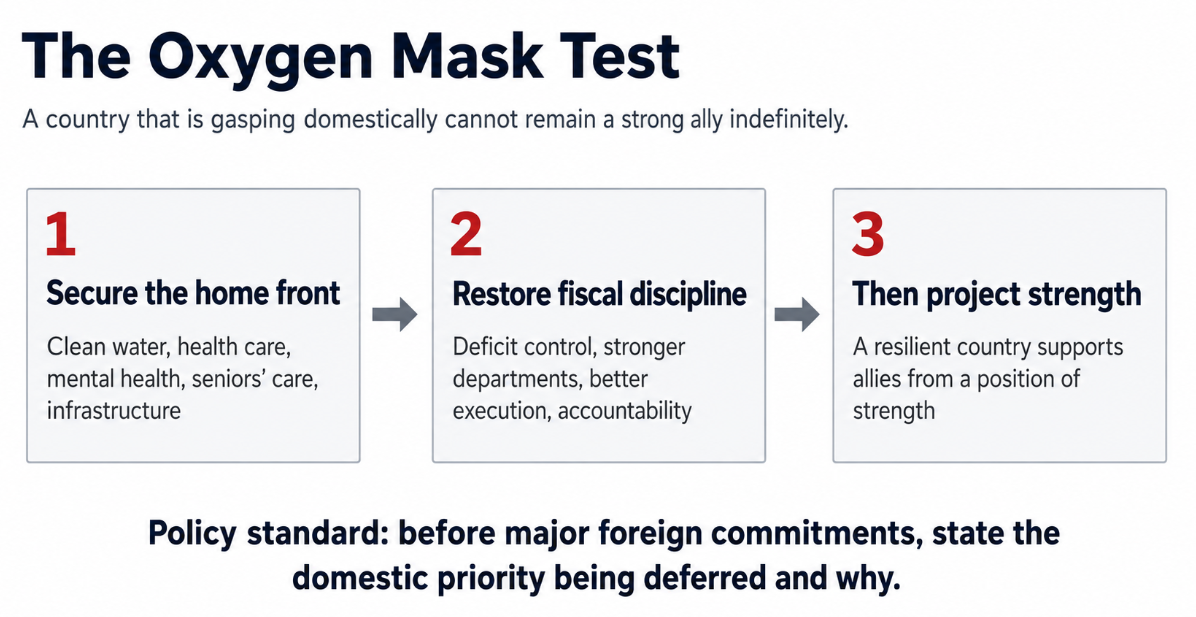
The oxygen-mask principle: Canada can remain a strong ally only if it first restores domestic structural integrity.
The “It’s Not Either-Or” Argument Is Wearing Thin
Defenders of continued large-scale Ukraine support often say, “It is not either-or. Canada can support Ukraine and fix things at home.”
That sounds mature. It also ignores how budgets work.
Every dollar has a destination. Every billion has an opportunity cost. Canada is running deficits, paying debt charges, pursuing spending restraint, and facing major domestic system failures. Under those conditions, pretending there are no trade-offs is not sophistication. It is avoidance.
If Ottawa were delivering clean water, timely health care, adequate mental health access, dignified elder care, reliable infrastructure, and disciplined finances, the case for large foreign commitments would be easier to make. But that is not the Canada people are living in.
People are living in the Canada where they cannot find a doctor. The Canada where emergency rooms overflow. The Canada where Indigenous communities still wait for clean water. The Canada where seniors sit in hospitals because the care system has nowhere to put them. The Canada where mental health support often arrives late, if it arrives at all.
Stop Using Ukraine as a Moral Shield
The laziest response to this argument is predictable: “If you question Ukraine funding, you must support Russia.”
No.
That is not an argument. That is emotional blackmail dressed up as foreign policy.
A Canadian can oppose Russia’s invasion and still question how much Canada should spend. A Canadian can sympathize with Ukrainians and still believe Ottawa has a higher duty to Canadians. A Canadian can support alliances and still demand limits, transparency, and accountability. A Canadian can believe in democracy abroad while noticing dysfunction at home.
Questioning the scale of foreign spending is not treason. It is citizenship.
Canada First Does Not Mean Canada Only
Canada First is often caricatured as isolationist, cold, or selfish. That is nonsense.
Canada First does not mean Canada only. It means Canada cannot be last in its own budget.
It means the federal government’s first obligation is to Canadians. It means Indigenous clean water comes before foreign reconstruction. It means Canadian health care comes before another overseas announcement. It means seniors’ dignity comes before international applause. It means mental health access comes before moral branding.
It means Canada should help where it can, but not at the expense of pretending its own house is not falling apart.
A strong Canada can be a strong ally. A weak Canada becomes a country that borrows money, sends it abroad, neglects domestic systems, and then wonders why citizens lose trust.
Logic Over Emotion
In emergency response, the first rule taught in triage is the “Oxygen Mask Principle”: Secure your own mask before assisting others. If the rescuer passes out from oxygen deprivation, they cannot save anyone.
Canada’s domestic systems are currently grasping for oxygen. The healthcare system is bleeding staff, infrastructure is cracking, and the cost of living has pushed the middle class to the brink. Supporting global democracy is a noble and necessary pursuit, but it cannot be funded through payday-loan-style deficit spending that hollows out the nation’s core.
The sentiment of “Canada First” is not about isolationism; it is about basic structural integrity. A Canada with a booming economy, a robust healthcare system, and a balanced budget is a formidable ally on the world stage. A Canada drowning in debt, crippled by a crumbling healthcare system, and divided by domestic poverty is not.
Before we can effectively rebuild another nation’s infrastructure, we must first ensure our own house is not collapsing.


Leave a Reply