
Infrastructure Is Cracking, Pressure Is Rising, and AI Is Barely on the Radar – 116 budgets analyzed
For the last little while, I’ve been doing something most people would never bother doing unless they were either deeply curious or slightly unwell: digging through Canadian municipal budget material at scale.
In this case, the dataset covered 116 Canadian municipalities, with dozens of KPIs extracted using AI to identify recurring themes, pressures, spending patterns, and strategic concerns. What came out of that analysis was not random noise. It was a pattern. A very clear one.
And the pattern is this:
Our municipalities are under heavy pressure, infrastructure is quietly becoming a national emergency, and the local public sector is still nowhere near ready for the AI era that is already arriving.
That is the story. The rest is detail.
The Big Picture: This Is Not a Collection of Isolated Problems
One of the biggest mistakes governments make is treating local stress like a local issue….It is not.
When municipalities across the country start saying the same things at the same time, that is not anecdotal. That is a signal. And in this data, the signal is hard to miss.
Out of the 116 municipalities reviewed, 92 were tagged as being under “high” overall pressure. That is nearly four out of every five. Not a handful of outliers. Not a few badly managed communities. A broad cross-section of local government all saying, in one way or another, that the system is tightening. The worrying thing is that only 7 of the 116 even mentioned AI.
And when you zoom in on what is driving that pressure, the same themes keep surfacing:
- aging infrastructure
- affordability constraints
- reserve depletion and debt pressure
- service demand growth
- housing-enabling costs
- staffing and operational strain
- climate and resilience needs
- cybersecurity risk
- digital modernization gaps
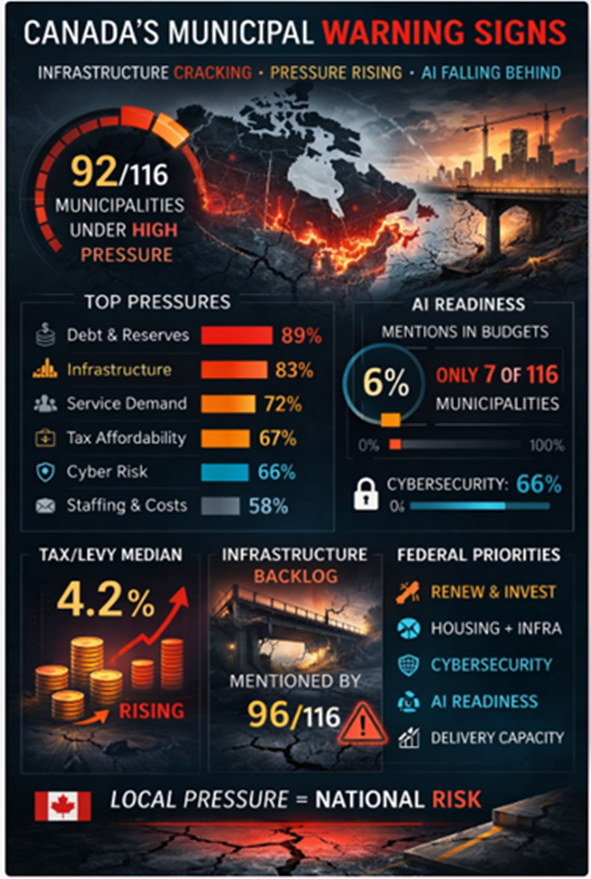
That is not a routine budgeting cycle. That is a stress map.
Infrastructure Is No Longer a Side Issue. It Is Becoming the Issue.
I have been writing for some time that Canada’s infrastructure problem is not some distant policy discussion for think tanks and conference rooms. It is a real, growing, concrete problem that is moving from “manageable backlog” into something much more dangerous.
This municipal analysis only strengthened that view.
Across the dataset, infrastructure renewal, repair, backlog, and asset replacement showed up in 96 municipalities’ key issue summaries. That makes it one of the most persistent pressures in the entire review.
Read that again.
Not two dozen. Not a regional cluster. Ninety-six.
That matters because infrastructure failure is not linear. Things do not politely degrade on schedule and then wait for us to get serious. Roads, bridges, water systems, stormwater assets, transit networks, public buildings, recreation facilities, and core underground services all age in the same fiscal environment. Municipalities can defer replacement for a while, but deferred maintenance is not savings. It is disguised liability.
And eventually that liability shows up all at once.
That is when local government stops planning and starts triaging.
That is when emergency repairs displace strategic investment.
That is when tax pressure rises, service quality drops, and public trust erodes.
At the federal level, this should be understood for what it is: a national productivity issue, a resilience issue, and increasingly a social stability issue.
Because when local infrastructure decays, everything that depends on it gets more expensive, less reliable, and harder to scale.
Housing gets delayed. Businesses absorb higher costs. Traffic worsens. Flood resilience weakens. Water risks rise. Insurance pressures increase. Service delivery becomes less dependable. And sooner or later, politicians begin speaking in slogans because the math no longer works.
Municipalities Are Trying to Hold the Line Financially, but the Room Is Shrinking
Another major theme running through the data was financial constraint.
A large share of municipalities referenced tax increases, levy adjustments, debt concerns, reserve stress, or some version of budget balancing under strain. In the extracted figures, 77 municipalities explicitly cited a tax or levy percentage, with a median of around 4.2%.
That number by itself is not the point. The point is what sits behind it.
Municipalities are increasingly being asked to do more with systems that were designed for less complexity, less growth, less volatility, and frankly, less political theatre.
They are expected to maintain old infrastructure, enable new housing, strengthen climate resilience, modernize IT, improve service access, respond to cybersecurity threats, and deal with wage and procurement pressures, all while trying not to push taxes beyond what residents can tolerate.
That is not a comfortable operating model. That is a squeeze.
And once a system enters a squeeze, its decisions change. Governments stop asking, “What is best?” and start asking, “What can we postpone without something breaking?”
That is not strategy. That is managed drift.
Cybersecurity Is Showing Up. AI Mostly Isn’t.
This part jumped out at me and truly worries me.
A meaningful number of municipalities are at least aware of the digital threat environment. In the dataset, 77 municipalities contained cybersecurity-related language in their IT or modernization narratives. That is about two-thirds of the sample.
So the concern is there. They know digital risk is real. They know municipal systems are vulnerable. They know the old model of “basic IT support plus some backups” is not enough anymore.
But here is the more important finding:
Only 7 of the 116 municipalities explicitly mentioned AI or generative AI.
That is just 6%.
Now, to be fair, absence of explicit mention does not prove total absence of activity. Some municipalities may be exploring AI informally, through vendors, internal pilots, or staff experimentation without using the term in formal budget language.
But even with that caveat, the signal is still weak. Very weak.
And from a federal perspective, that should be concerning.
Why?
Because AI is not some optional gadget that can be safely ignored until 2032. It is rapidly becoming part of administrative productivity, citizen service design, document handling, asset planning, forecasting, fraud detection, knowledge retrieval, and policy support. In plain English, it is becoming part of how work gets done.
If municipalities are not visibly planning for that shift now, then one of two things is happening:
- they are underprepared, or
- they are adopting technology informally without governance, standards, or real operational maturity.
Neither is especially comforting.
The danger is not just “falling behind.” The danger is fragmentation.
A few municipalities will move ahead with tools, vendors, pilots, and policy experiments. Others will lag badly. Some will overbuy. Some will buy the wrong things. Some will do almost nothing. And without broader coordination, Canada could end up with a patchwork of local digital capacity where the quality of public modernization depends largely on municipal size, budget luck, and internal champions.
That is not how you build national readiness.
Housing, Growth, and Infrastructure Are Now One Conversation
One thing that becomes very obvious when you look at municipal budgets carefully is this: housing cannot be separated from infrastructure.
That fantasy needs to go.
You cannot tell municipalities to grow, approve more housing, support intensification, and enable economic development while pretending water, wastewater, roads, transit, stormwater, emergency services, and digital systems are somehow separate files.
They are not.
Growth without infrastructure is not growth. It is backlog in nicer clothes.
And many municipalities are already signaling this tension. They want to enable development. They understand the political pressure around housing supply. But they also know that every new unit, every new subdivision, every intensification corridor, every industrial expansion carries real capital and service consequences.
At the federal level, this means any serious housing agenda has to be more honest about local capacity.
If Ottawa wants faster housing outcomes, then local infrastructure renewal and expansion cannot be treated as an afterthought or left to municipalities to somehow absorb through increasingly strained budgets and modest tax increases.
That is not realism. That is downloading.
What the Federal Government Should Be Seeing in This Data
If I were summarizing the federal lesson in one sentence, it would be this:
Canada’s municipalities are not broadly failing, but many are operating in conditions that make future failure much more likely unless capital, digital capacity, and modernization are addressed in a more coordinated way.
That means at least five things.
1. Infrastructure renewal needs to move from reactive funding to strategic national priority
The country needs to stop treating municipal infrastructure as an endless series of isolated grant applications and start treating it as foundational national capacity.
Because that is what it is.
2. Housing policy must be tied directly to enabling infrastructure
Not rhetorically. Financially. Operationally. Structurally.
If housing targets are serious, infrastructure support has to be equally serious.
3. Cybersecurity should have a minimum municipal baseline
A lot of municipalities know the threat is real, but awareness is not the same as capability. Canada needs a stronger floor for cyber readiness at the local level.
4. AI readiness should not be left to chance
It is striking that so few municipalities explicitly mention AI. That suggests the country is still in the early stages of local public-sector adaptation. This is the moment for shared frameworks, procurement guidance, policy guardrails, and practical use-case support before the space becomes chaotic.
5. Delivery capacity matters as much as money
Funding alone does not solve bottlenecks if municipalities lack staff depth, project delivery capability, technical planning capacity, or digital maturity. The federal government has to think not just in terms of capital allocation, but in terms of local execution.
The Real Risk: Quiet Erosion
The greatest public policy risks are often not the ones that explode overnight.
They are the ones that erode quietly for years while everyone stays busy congratulating themselves for “making progress.”
That is what worries me here.
The municipalities in this dataset are not screaming collapse. They are doing what governments usually do: using careful language, measured framing, and budgetary restraint to describe pressures that are often more serious than the wording suggests.
But if you step back and look at the pattern, the message is fairly blunt.
Local government is absorbing more strain.
Infrastructure pressure is spreading.
Financial flexibility is tightening.
Digital risk is rising.
AI readiness is weak.
And the demand load is not easing.
That combination should not be dismissed.
Because systems do not need to fail dramatically to be in trouble. They just need to become steadily less capable of handling the next wave of demands.
And that, in many ways, is where the warning lives.
Final Thought
What this project really illustrates is not just that AI can work, but that municipal government now has a practical reason to take it seriously. All governments must now fully embrace AI as it saves millions of dollars in salaries and allows the government to operate exponentially better. Case in point, to build this analysis, an AI-assisted workflow located and harvested 2026 municipal budget documents, processed 119 PDFs, extracted and normalized key indicators, identified recurring pressures and patterns across municipalities, and helped produce a detailed federal-level report. A realistic midpoint estimate is that completing comparable work manually would have required roughly 480 hours of skilled human effort. At a conservative compensation level of $90,000 per year, that translates to approximately $20,800 in direct salary cost, and more realistically $26,000 to $29,000 in fully loaded labour once benefits and overhead are considered. So, the harsh reality is, pay a few hours of AI work, or 480 + hours of tax payer’s money.
That matters, because municipalities are under increasing pressure to do more with less. They are being asked to manage aging infrastructure, rising service demands, housing-enabling costs, cybersecurity risk, climate pressures, and growing public expectations, often with limited staffing capacity and little room for inefficiency. In that kind of environment, AI should not be viewed as a novelty or a buzzword. It should be viewed as a force multiplier.
Used properly, AI can help municipal governments process large volumes of documents, detect patterns earlier, support better planning, improve internal productivity, and free up staff to focus on judgment, strategy, and service delivery rather than being buried in repetitive analytical work. It does not replace people. It extends their reach. And at a time when local government is carrying more complexity than ever, that is not merely helpful. It is becoming essential.
Canada has a habit of waiting until problems become undeniable before treating them like priorities. It is one of our less charming national traits.
But the signal coming out of municipal budgets is already clear enough.
These governments are telling us, in spreadsheets, policy notes, and line items, that the foundation is under strain. Infrastructure is not a side story. It is central. Cyber risk is real. Financial room is narrowing. And the AI transition, which is about to reshape administrative work everywhere, is barely visible in the formal planning language of most municipalities.
That should not cause panic.
But it should absolutely end complacency.
Because if the country wants productive growth, housing expansion, resilient services, and a modern public sector, then municipalities cannot remain the forgotten middle child of national policy while carrying the physical and administrative burden of making Canada actually function.


Leave a comment