
The analysis of large, complex legal documents, such as contract agreements, presents a significant cognitive challenge for human lawyers, rooted in the brain’s finite executive function and attentional capacity. This limitation can be conceptualized as a “cognitive field of view”—a metaphorical viewport through which lawyers process and interpret information, constrained by factors such as focus, energy, and environmental distractions. As illustrated in the accompanying diagram, a typical lawyer’s cognitive field of view (represented on the left) is narrow, often missing critical details, including conflicting clauses or subtle inconsistencies within a large contract. In contrast, a well-designed AI tool, such as the “Strategen Engine” (depicted on the right), operates without these human limitations, enabling it to detect even the most nuanced contradictions or overlooked elements with precision and consistency.
Human Cognitive Limitations and Executive Function
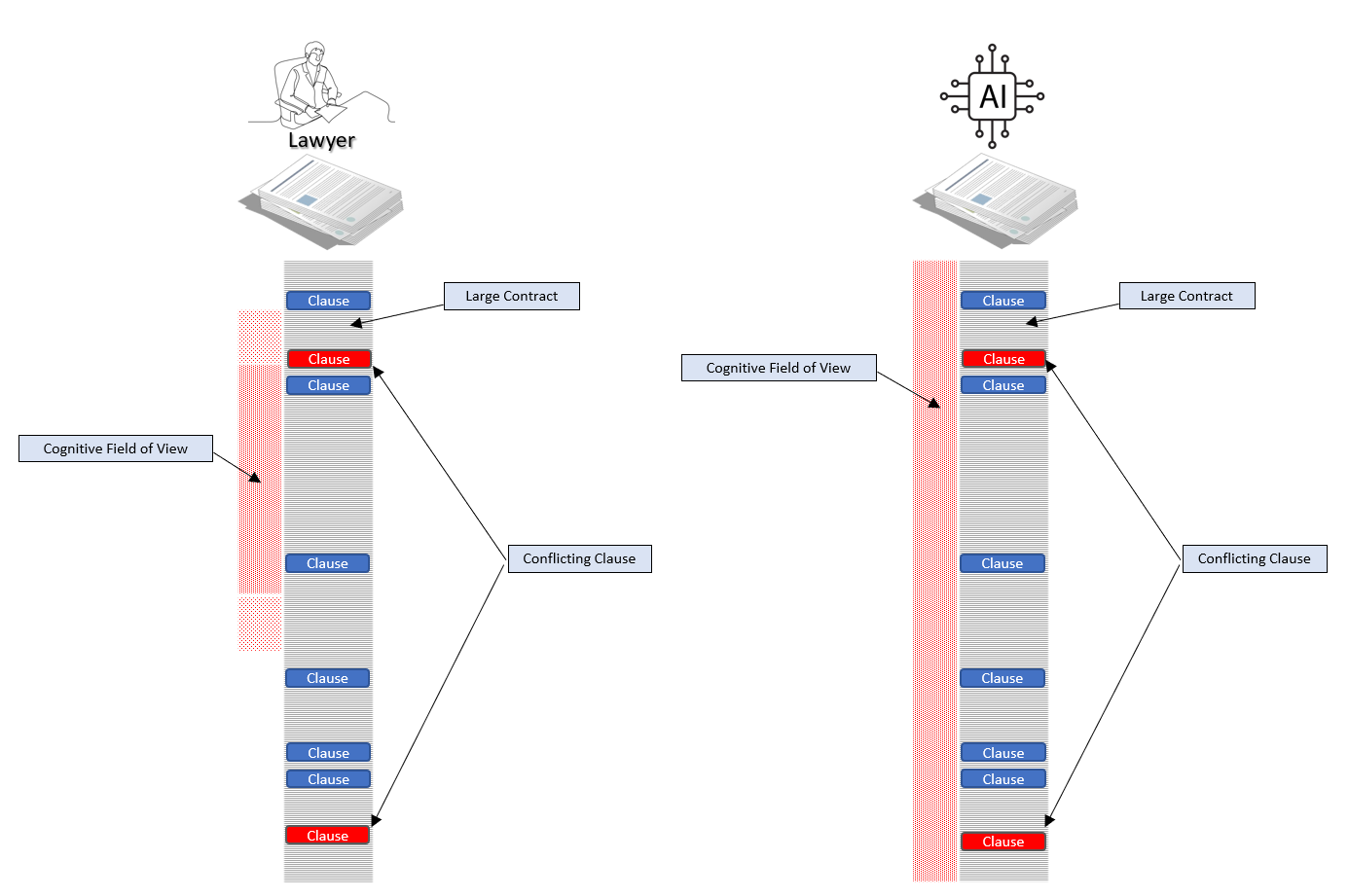
Executive function, encompassing processes like working memory, attention, and decision-making, plays a central role in a lawyer’s ability to analyze legal documents effectively. Research in cognitive psychology, such as studies by Baddeley (1992) on working memory models, suggests that human working memory has a limited capacity, typically holding only 5–9 items at once (Miller, 1956). When faced with a large contract—potentially spanning dozens or hundreds of pages and containing numerous clauses—lawyers must juggle multiple pieces of information simultaneously. This cognitive load is further exacerbated by factors such as fatigue, stress, or environmental interruptions, which can narrow the “cognitive field of view” and increase the likelihood of overlooking critical details, such as conflicting clauses.
For instance, a lawyer reviewing a contract may focus intently on key sections like indemnification or termination clauses but fail to detect a subtle inconsistency between a confidentiality clause on page 15 and a data-sharing provision on page 42. This oversight is not necessarily due to incompetence but rather a natural limitation of human cognition. Studies on attention and cognitive overload, such as those by Kahneman (1973) in his work on attention and effort, demonstrate that sustained focus on complex tasks depletes mental resources, leading to errors or blind spots. In legal practice, where contracts often contain dense, technical language and interdependent clauses, these cognitive constraints create a far greater possibility of missing important elements, potentially exposing clients to legal risks.
The Role of Environmental and Personal Factors
The cognitive field of view is further influenced by external and internal variables. Environmental factors, such as noise, time constraints, or interruptions, can disrupt a lawyer’s concentration, while personal factors—such as energy levels, stress, or even expertise—can modulate their analytical capacity. For example, a lawyer working late hours or under tight deadlines may experience diminished focus, reducing their ability to synthesize information across a large
document. Similarly, less experienced lawyers may lack the pattern recognition skills of seasoned practitioners, further limiting their cognitive field of view. These factors collectively underscore the vulnerability of human analysis to error, particularly in the context of complex legal documents where precision is paramount.
AI’s Unbounded Cognitive Capacity
In contrast, a well-designed AI tool, such as the Strategen Engine, transcends these human limitations by leveraging computational power and advanced algorithms to analyze contracts comprehensively. Unlike the human brain, AI systems are not bound by working memory constraints, fatigue, or environmental distractions. They can process and cross-reference every clause in a large contract simultaneously, identifying conflicting statements, ambiguities, or inconsistencies with unparalleled accuracy. For instance, while a lawyer might miss a subtle conflict between a non-compete clause and an employee mobility provision due to cognitive overload, an AI tool can flag this discrepancy instantly by comparing semantic meanings, legal precedents, and contextual relationships across the entire document.
This capability stems from AI’s ability to operate within a virtually infinite “cognitive field of view,” unencumbered by the executive function limitations that constrain humans. Research on AI applications in legal analytics, such as those by Surden (2019) on machine learning in law, highlights how AI can detect patterns and anomalies that escape human notice, particularly in large datasets like contracts. Moreover, AI tools can be trained on vast corpora of legal texts, enabling them to recognize subtle linguistic nuances or jurisdictional differences that might elude even experienced lawyers. The Strategen Engine, as depicted in the diagram, exemplifies this
potential, offering a stark contrast to the lawyer’s constrained cognitive capacity by identifying conflicting clauses (highlighted in red) with precision and efficiency.
Implications for Legal Practice
The disparity between human and AI cognitive capacities has profound implications for legal practice, particularly in contract review and risk management. While human lawyers bring invaluable judgment, empathy, and contextual understanding to their work, their cognitive limitations create inherent risks of oversight, especially in complex, high-stakes agreements. AI tools, on the other hand, serve as powerful complements, augmenting human expertise by detecting errors that fall outside the cognitive field of view. This synergy could reduce legal risks, enhance efficiency, and ensure more thorough contract analysis, ultimately benefiting clients and the legal profession.
However, integrating AI into legal practice must be carefully managed to address ethical considerations, such as transparency, accountability, and the potential for over-reliance on technology. Nevertheless, the theoretical foundation of executive function and cognitive capacity provides a compelling case for leveraging AI to overcome the inherent limitations of human cognition in analyzing large, intricate legal documents.
References
· Baddeley, A. (1992). Working Memory. Oxford University Press.
· Kahneman, D. (1973). Attention and Effort. Prentice-Hall.
· Miller, G. A. (1956). The magical number seven, plus or minus two: Some limits on our capacity for processing information. Psychological Review, 63(2), 81–97.
· Surden, H. (2019). Artificial intelligence and law: An overview. Harvard Journal of Law & Technology, 33(1), 1–45.

 marksdeepthoughts.ca
Leave a reply to Top 10 AI Contract Review Tools in 2025 – A Comprehensive Buyer’s Guide – My Personal Blog Cancel reply