
The Resource Crunch for the Green Energy Transition
Based on Dr. Simon Michaux’s analysis (Geological Survey of Finland, 2022) and supporting data, achieving net zero by phasing out fossil fuels requires vast quantities of metals for EVs, batteries, wind turbines, solar panels, and grid storage. Known reserves fall critically short for key materials, making a full transition infeasible without massive breakthroughs in mining, recycling, or technology.
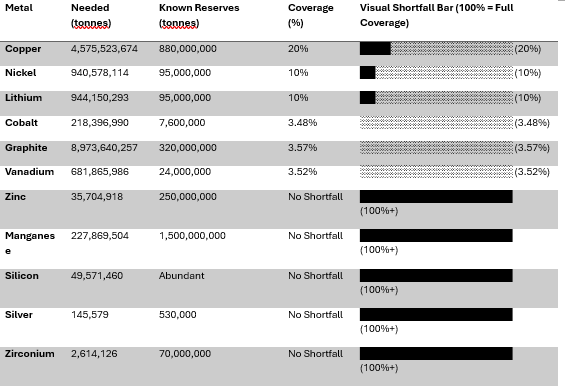
Key Metal Shortfalls – Here’s a breakdown of required vs. available metals for one generation of renewable tech to replace global fossil fuel energy demand:
Why It’s Impossible: The Numbers Don’t Add Up
- Extraction Timelines: Even at peak mining rates, pulling these metals from the ground would take centuries, not the decades targeted for net zero (e.g., by 2050 under IEA scenarios). thegreatclimatecon.com
- Demand Explosion: Copper demand could quadruple by mid-century, requiring over 1 billion tonnes cumulative—far beyond current reserves of 890 million tonnes.
- Battery Bottlenecks: Lithium demand could hit 200 million tonnes by 2050 for batteries alone, vs. 98 million tonnes in reserves.
- Economic Toll: Global subsidies hit $7 trillion in 2023, driving up energy costs via taxes and credits—a massive wealth transfer to corporations without solving the resource gap.
- Broader Context: Flawed climate models ignore natural cycles, and past predictions (e.g., no Arctic ice by 2014) have failed, questioning the urgency.
Conclusions: The math reveals insurmountable barriers: Insufficient reserves, slow extraction, and skyrocketing costs make a full net-zero transition unrealistic. Solutions like recycling, substitution, and efficiency gains help, but they can’t bridge the gap for a complete fossil fuel phase-out. This highlights the need for balanced energy policies beyond hype.
 marksdeepthoughts.ca
Leave a comment