
The transition from “driver” to “passenger” is often compared to the shift from the horse and carriage to the automobile. But that analogy is too small. A horse didn’t have 360-degree infrared vision, and it couldn’t learn from the collective mistakes of millions of other horses in real-time.
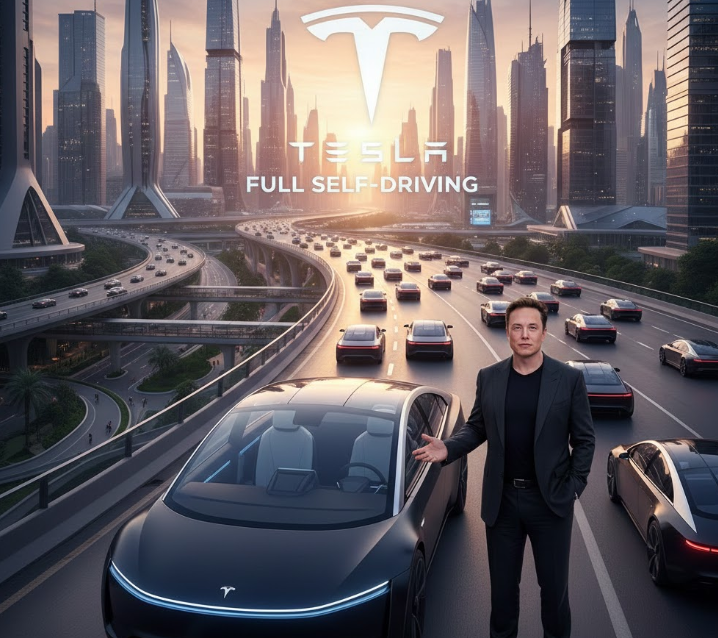
What we are witnessing with Full Self-Driving (FSD) is the birth of a “super-driver”—a hive mind that never blinks, never drinks, and never gets angry. As we move toward 2040, the act of a human gripping a steering wheel on a public highway will likely be viewed as an unnecessary and selfish risk.
The “Trailing Six 9s”: The War on the Outlier
The core challenge of autonomy has moved past the “easy” 99%—navigating lanes and stopping at lights. The real battle is in the “long tail” of probability: the 1-in-a-million events.
To reach 99.999999% reliability, the system must solve for the “trailing tail”—those chaotic edge cases like a trampoline blowing across an interstate or a sinkhole opening during a lightning storm. While a human might freeze or panic, an AI trained on billions of miles of data doesn’t “encounter” an outlier; it recognizes a pattern. By 2026, FSD is already shifting from a collection of “if-then” rules to a single end-to-end neural network that “understands” physics and intent rather than just following a script.
The Economics of Safety: Why Manual Driving Will Become a Luxury
Logic suggests that as the data proves AI is safer than the average human, the financial world will react. We are already seeing the first ripples:
- The Insurance Discount: Some insurers are now offering up to 50% discounts for drivers using supervised FSD.
- Cost Prohibitiveness: Eventually, the “human premium” will become so high that manual driving will be a hobby for the wealthy, much like owning a stable of horses today.
- The Mobility Dividend: For a 63-year-old looking toward the future or a parent of a 17-year-old, the value proposition is clear: you aren’t just buying a car; you’re buying an insurance policy against human error.
The “Dicks on the Road” Problem: A Civilized Highway
The most profound change won’t be technical, but social. Road rage, tailgating, and “brake checking” are human bugs, not features of transportation.
Imagine a highway where every vehicle is part of a silent, digital conversation. Cars could “platoon” inches apart at high speeds, acting as a single aerodynamic unit, effectively tripling the capacity of our current roads without adding a single lane of asphalt. Traffic jams would dissolve because they are usually caused by the “accordion effect” of human delayed reaction times.
The Enthusiast’s Sanctuary
Does this mean the “joy of the drive” is dead? Not necessarily. Just as the advent of the car didn’t kill the horse—it just moved it from the city street to the private trail—the autonomous revolution will likely create Enthusiast Zones.
We may see dedicated scenic routes or private track-highways where humans can still “toss the dice” and feel the mechanical connection to the road. But the daily commute? That belongs to the machines. By removing the “dicks on the road,” we actually make the world safer for the true enthusiasts who want to enjoy a spirited drive without worrying about a distracted commuter in a minivan.
The Final Verdict
In 15 years, your car won’t just be a tool; it will be a high-performance, race-car-reflex-endowed guardian. The choice to drive yourself will shift from a right to a liability. When we can eliminate the “trailing tail” of accidents, why would we ever choose to go back?
Would you like me to find some specific peer-reviewed studies on the projected reduction of traffic fatalities once we reach 90% autonomous saturation?
 marksdeepthoughts.ca
Leave a comment