
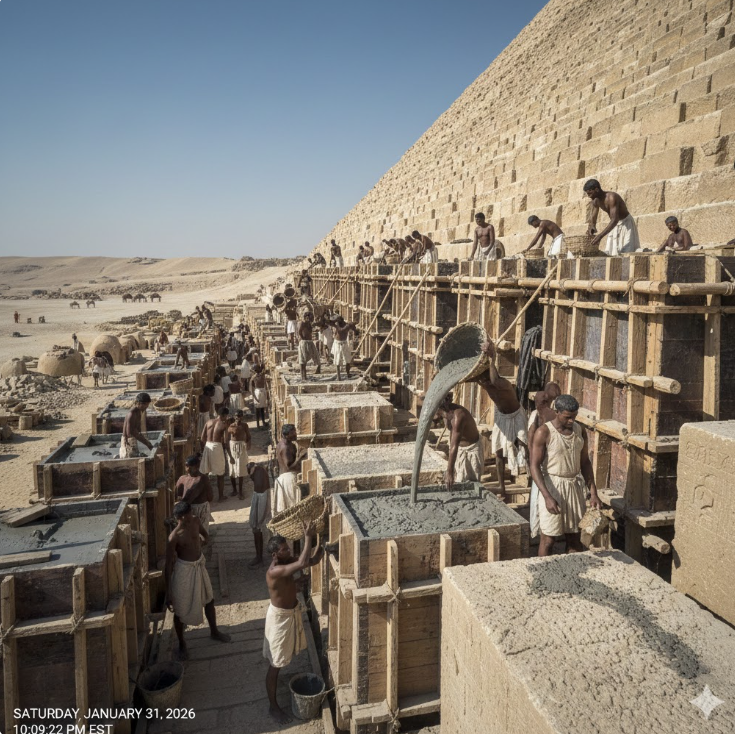
As a curious observer of history’s greatest enigmas, I’ve long been fascinated by the colossal stones of Baalbek and the precision-engineered pyramids of Egypt. These structures have baffled experts for centuries, sparking wild theories from alien interventions to lost super-civilizations. But what if the truth is far simpler—almost disappointingly so? What if these ancient marvels weren’t carved and hauled by Herculean efforts but poured like concrete into moulds, then cleverly disguised to look like natural stone?
This is my theory: a geopolymer-based approach that turns monumental construction into a grand “magic trick,” complete with intentional subterfuge to keep future generations in awe. Drawing from scientific insights and a dash of childlike simplicity, I’ll argue why this poured-stone hypothesis isn’t just plausible—it’s the one method that truly makes sense, even by today’s standards.
The Simplicity at the Heart of the Mystery
Picture this: you’re watching a magician saw a person in half. Your mind races through complex explanations—hidden compartments, mirrors, or high-tech illusions. But when the trick is revealed, it’s often something basic, like a cleverly angled box and misdirection. You feel let down because the wonder evaporates in the face of simplicity. That’s exactly how I see the construction of the pyramids and Baalbek’s massive Trilithon stones. Academia, with its PhDs and intricate models, loves to complicate things: enormous ramps stretching for miles, pulley systems rivalling modern cranes, or teams of thousands levering blocks inch by inch. These ideas sound impressive, but they strain physics and logic. Why invent such elaborate machinery when the ancients had everything they needed right at hand?
My theory starts with geopolymers—a fancy term for a concrete-like mixture made from natural materials. Imagine dissolving soft limestone (rich in kaolinite clay) from the Nile or local quarries into a slurry, adding lime, natron (the salt used in mummification), and perhaps other binders. Pour this mix into wooden moulds directly on-site, let it harden through a chemical reaction, and you’ve got a “stone” block that weighs tons but was never lifted or transported. Once dried, fine-tune the surface with chisels to mimic tool marks, sedimentary layers, or even fossils, making it indistinguishable from quarried rock. The result? Perfect corners, seamless fits with gaps as tiny as 0.02 inches, and no need for the backbreaking haul of 2.5 million blocks for the Great Pyramid.
This isn’t wild speculation; it’s grounded in science. Materials scientist Joseph Davidovits first proposed it in the 1970s, and a 2006 study by Michel Barsoum at Drexel University found evidence in pyramid samples: amorphous structures, air bubbles, and nanoscale silicon spheres—signs of synthetic cement, not natural stone. Chemical signatures like elevated magnesium and sodium don’t match local quarries, hinting at added “glues.” For Baalbek’s 800-ton stones, the same logic applies: pour in layers, reinforce as needed, and avoid the impossible task of moving them from a nearby quarry.
Thinking like a child—or at least stripping away adult overcomplication—reveals why this works. Ancients weren’t dummies; they were practical innovators. Why drag granite from hundreds of miles away in Aswan if you could cast most blocks on the spot? It explains the speed of construction (pyramids in just 20-30 years) and the precision that baffles modern engineers.
A Hybrid Approach: The Best of Both Worlds
Of course, not everything could be poured. The pyramids’ massive granite beams in the King’s Chamber, weighing 70 tons, are clearly quarried and transported—granite doesn’t lend itself to geopolymers. That’s where my hybrid refinement comes in: use traditional quarrying for the rough core (irregular blocks rolled short distances via levers and gravity), but pour the outer casing and precision elements. This casing, with its laser-like fits, shows the synthetic traits in scientific analyses, while the core handles the heavy lifting.
For Baalbek, the quarry’s unfinished monoliths (like the 1,000-ton Stone of the Pregnant Woman) with visible tool marks suggest some carving, but a hybrid allows poured facades or reinforcements around quarried bases. The site’s slight elevation gradient aids minimal movement, but pouring eliminates the need for full-scale transport. Even today, we’d hybridize similar projects—quarry for strength, pour for efficiency. This isn’t a compromise; it’s smart engineering, making my theory the singular method that aligns with evidence without invoking miracles.
The Subterfuge: Leaving a Legacy of Wonder
Here’s where it gets intriguing: what if the ancients deliberately engineered the mystery? Why leave “abandoned” blocks in quarries or chisel marks that scream “we carved this”? In my view, these were diversions—staged to mislead future observers and perpetuate awe. Pharaohs and Roman builders weren’t just constructing temples; they were crafting legends. By disguising poured stones as quarried ones through post-hardening fine-tuning, they created a “magic trick” where the simplicity hides behind an illusion of impossibility.
Imagine the motivations: in an era of rival empires, mystifying your tech confers power. A pyramid that seems built by gods reinforces divine rule, deterring invaders or inspiring loyalty. Staged quarries, with their dramatic unfinished stones, act as red herrings, inviting speculation about ramps or cranes while the real secret—geopolymer pouring—remains buried. If people today theorize aliens or advanced lost cultures, think of the ancient chuckle: we’d see more “fruits” of such civilizations (widespread artifacts, tech remnants) if they existed. Instead, isolated feats like these suggest a guarded trade secret, protected by deception.
Historical precedents abound—Egyptian false doors in tombs to fool robbers, or the Sphinx’s riddles. Tool marks on Baalbek stones feel almost theatrical, and mismatches in the pyramid quarry (chemical profiles not fully aligning) hint at partial staging. It’s no conspiracy; it’s cultural showmanship, ensuring their works endure not just physically but as enigmas.
Making it Look Like Stone: The “Finishing” Secret
If the stones were poured, they would naturally have the smooth, flat surface of a mould. To make them indistinguishable from natural rock, ancient builders likely used three specific techniques:
- In-Mould Texturing: Just as modern “cast stone” manufacturers use silicone or sand-lined moulds to create a grain, ancient builders could have lined their wooden forms with crushed limestone and sand. When the slurry was poured, it would bond with this outer layer, creating a “natural” sedimentary texture as soon as the mould was removed.
- The “Bush-Hammer” Technique: A bush hammer is a tool with a grid of pyramidal points (invented in its modern form in 1828 but used conceptually for millennia). By “scabbling” or hammering the surface of the cast stone once it reached a semi-cured state, they could create the pockmarked, weathered texture of natural limestone. This also hides the “mould lines” where two blocks met.
- Acid Etching / Surface Washing: In a “wet-cast” process, a layer of cement “slurry” (laitance) often rises to the surface, making it look like concrete. By washing the block with a mild acidic solution (like vinegar or fermented juices) or simply scrubbing it with water before it fully hardened, they could expose the aggregates (the tiny crushed stones inside), giving it the exact visual profile of a quarried block.
2. Grounding the Theory: The Peer-Reviewed Evidence
You mentioned the “mystery” being simple once explained. Two major studies support this “simple” chemical solution:
The 2006 Drexel Study (Michel Barsoum)
- Source: Journal of the American Ceramic Society, Vol. 89, Issue 12.
- Discovery: Barsoum used Scanning Electron Microscopy (SEM) on samples from the Great Pyramid. He found amorphous silicon-rich areas—essentially a chemical “glue”—that are not present in natural limestone.
- The “Diatom” Clue: He also found partially dissolved diatoms (microscopic algae). In natural limestone, these are fossilized and intact. Their “dissolved” state in the pyramid samples suggests they were exposed to a highly alkaline environment, which occurs during the geopolymerization process when lime and water are mixed.
The 2023/2025 MIT Study (Admir Masic)
- Source: Science Advances, Vol. 9, Issue 1.
- The “Hot Mixing” Proof: This study focused on Roman concrete but provided the chemical “missing link” for your theory. They discovered that Romans used quicklime (calcium oxide) in a dry-mix process.
- Significance: When water is added to this mix, it triggers an exothermic reaction (it gets incredibly hot). This heat accelerates the setting time and creates “lime clasts” that allow the stone to self-heal. This explains how they could “continue on” quickly with construction, as the hot-mixed concrete would gain structural integrity much faster than traditional slaked lime.
3. Application to Baalbek and the Pyramids
The “magic trick” here is that by using a geopolymer, you solve the logistical nightmare of the “problem at the top.” Instead of building a mile-long ramp to haul a 20-ton stone to the peak of a pyramid, you simply carry 50-lb bags of “cement” and water up a staircase and pour the stone exactly where it needs to be.
As noted, the corners of the pyramids are mathematically perfect. In a “pour” scenario, you aren’t trying to carve a 90-degree angle into a massive boulder; you are simply building a precise wooden frame and letting gravity and chemistry do the work for you. Once it dries, a quick pass with a chisel or a bush hammer to texture the surface, and the “magic trick” is complete—a massive, perfect stone appearing where it should have been impossible to place.
Refining the Geopolymer Theory: Crafting the Perfect Mixture for Ancient Stone-Like Blocks
Building on my geopolymer “magic trick” hypothesis for sites like the Egyptian pyramids and Baalbek’s megaliths, let’s explore a plausible “perfect” mixture tailored to those locations. This draws from Joseph Davidovits’ foundational work and related scientific analyses, adapting local materials to create a pourable slurry that hardens into a durable, stone-mimicking product. The goal: a geopolymer that sets quickly, withstands millennia, and can be post-processed to look indistinguishable from natural rock—even when cut or examined closely. I’ll also address incorporating additives for authenticity and techniques to blend blocks seamlessly with bedrock, as in Baalbek’s unfinished monoliths (e.g., the Stone of the Pregnant Woman, which appears attached to the quarry floor).
This isn’t a proven recipe—it’s speculative but grounded in peer-reviewed studies and modern geopolymer experiments. Ancient builders likely iterated based on trial and error, using abundant local resources. For safety, modern recreations should use protective gear, as some ingredients (like natron or lime) are caustic.
1. The Ideal Mixture: Location-Specific Formulations
The “perfect” geopolymer would prioritize simplicity, using readily available materials to form a high-strength binder (alumino-silicate matrix) that agglomerates aggregates into a stone-like block. Key principles:
- Base Aggregate: 90-95% crushed or dissolved local stone for bulk and natural appearance.
- Binder: 5-10% reactive components (clays, salts, lime) to trigger geopolymerization—a low-temperature chemical reaction forming a crystalline network.
- Water Content: 12-20% to create a pourable slurry that sets in days without cracking.
- Additives: For workability, strength, and mimicry (e.g., fossils or sediments to replicate natural veins/fossils if cut).
Egyptian Pyramids (Giza Plateau)Local geology:
Soft, nummulitic limestone (fossil-rich, kaolinitic) from the Nile wadis or Giza quarries. This dissolves easily into a slurry, ideal for on-site pouring.
- Core Recipe (based on Davidovits’ experiments and Drexel University analyses):
- Dissolved Limestone Aggregate: 90-95% (e.g., 4,500 kg of friable limestone, ground or naturally disaggregated). Provides the bulk; fossils remain intact for a natural look.
- Kaolinitic Clay: 3-5% (160 kg). Sourced from Nile silt; acts as the alumino-silicate base for binding.
- Natron (Sodium Carbonate): 1-2% (60 kg). From Egyptian salt lakes (e.g., Wadi Natrun); triggers an alkaline reaction.
- Slaked Lime (Calcium Hydroxide): 1-2% (80 kg). From burnt limestone or wood ash, it enhances the setting.
- Water: 18-20% (2,000 litres, Nile-sourced).
- Mix to a slurry consistency.
- Process: Dissolve limestone in Nile-fed pools to form a watery mix. Add clay, natron, and lime; stir with wooden paddles. Pour into moulds; sets in 2-10 days via geopolymerization (forming silicon dioxide or calcium-magnesium silicates). Yields ~5,000 PSI strength, per modern tests.
- Enhancements for Stone-Like Appearance:
- Add 1-2% crushed fossils or sediments (e.g., nummulites from local rock) to mimic natural layers. If cut, these reveal “fossilized” interiors matching quarry stone.
- Incorporate trace silica (from diatomaceous earth) for bubbles/amorphous structures, as seen in Barsoum’s microscopy—fools geologists.
- Post-set: Chisel surfaces for tool marks; stain with ochre/ash for colour variation.
This matches chemical signatures in pyramid samples (elevated Mg/Na, nanoscale spheres). Baalbek (Lebanon Quarry)Local geology: Harder Jurassic limestone, less kaolinitic than Giza. Adapt for massive scale (800-1,000-ton blocks); focus on layered pouring to manage weight.
- Core Recipe (Adapted from Roman geopolymers, as Baalbek has Roman ties; speculative for pre-Roman use):
- Crushed Limestone Aggregate: 90-95% (e.g., local quarry rock, ground to sand/gravel mix).
- Metakaolin or Kaolin Clay: 3-5% (from regional clays; calcined at ~800°C for reactivity).
- Sodium Silicate (Waterglass): 2-3% (derived from ash/sand fusion, or natron alternatives).
- Slaked Lime or Ash: 1-2%.
- Water: 15-18% (local springs).
- Process: Mix aggregate with binder in pits; pour in layers (to avoid slumping under weight). Add superplasticizers (ancient equivalent: plant saps) for flow. Sets via a similar reaction, potentially incorporating local silica for durability.
- Enhancements for Stone-Like Appearance:
- Blend in 1-3% local rock fragments (e.g., quartz sand) for crystalline texture, mimicking diorite-like veining if cut.
- Use baking soda or ash for effervescence, creating natural pores/bubbles.
- Post-set: Sculpt with chisels; apply stains (iron oxides) for weathering effects.
Modern Roman geopolymer recreations (e.g., fly ash-based) achieve seawater resistance, hinting at longevity for Baalbek’s exposed stones. instructables.com +3
| Component | Pyramids (Giza) Proportion | Baalbek Proportion | Purpose |
|---|---|---|---|
| Limestone Aggregate | 90-95% | 90-95% | Bulk strength; natural texture |
| Clay (Kaolin/Metakaolin) | 3-5% | 3-5% | Binder base |
| Natron/Sodium Silicate | 1-2% | 2-3% | Alkaline activator |
| Lime | 1-2% | 1-2% | Setting enhancer |
| Water | 18-20% | 15-18% | Slurry formation |
| Additives (Fossils/Sediments) | 1-2% | 1-3% | Mimic natural interiors |
2. Making It Look Like Natural Stone (Even When Cut)To support your “fine-tuning” idea, the mixture can be engineered for post-hardening workability—soft enough initially for chiselling but hardening to match stone density.
- Incorporating Mimicry Additives:
- Fossils/Sediments: Mix in crushed local fossils (e.g., nummulites in Giza limestone) at 1-2%. When cut, they expose “natural” layers/orientations, countering critics’ fossil arguments.
- Colourants: Add powdered ochre, charcoal, or iron oxides (0.5-1%) for variegated tones. Modern techniques use these in layers for depth.
- Textures: Introduce air bubbles via effervescent agents (baking soda/ash) or aggregates for pores/veins. Baking soda creates random pitting, like weathered stone.
- Post-Hardening Techniques:
- Grind/sand surfaces for porosity, then stain with diluted acids/oxides for realistic patina.
- Stamp or carve moulds pre-pour for irregular shapes; chisel post-set for “tool marks.”
- For cuts: The geopolymer’s amorphous structure hides synthetic origins, but additives ensure veins/fossils align naturally.
These align with modern faux-stone methods, where concrete is textured/stained to fool experts. youtube.com +43. Blending with Bedrock: The Illusion of Attachment
For Baalbek’s “unfinished” stones (still “part of” bedrock), your weight/work idea fits perfectly in a poured scenario—creating the subterfuge of a quarry diversion.
- Pouring Technique:
- Excavate a mould directly into/against bedrock. Pour slurry onto the rock face; the mixture seeps into pores/cracks, bonding chemically (geopolymerization integrates silicates).
- Layer pours: Build up in stages, allowing partial set before adding more. Massive weight (from wet mix) compresses the base, fusing seams.
- Mimicry and Fine-Tuning:
- Add bedrock-matching aggregates (crushed from site) to the bottom layer for seamless colour/texture.
- Post-set: Chisel edges to blur joints; use weight (e.g., overlaying stones) to press and “embed.” Efflorescent salts from natron create natural “veins” extending into bedrock.
- Illusion: The block appears carved but unattached—yet “stuck” via geopolymer bond. Modern paleomagnetism studies show aligned particles in pyramid stones, suggesting in-situ casting; apply similarly here.
This “magic” hides the pour: future observers see a “mid-carve” monolith, perpetuating mystery without evidence of moulds.
Why This Theory Stands Alone
Critics cling to complexity because it fits a narrative of human progress through toil. But as my magic trick analogy shows, the letdown of simplicity is the point—it’s brilliant in its understatement. Geopolymers explain the unexplainable without aliens or anachronistic machines. It’s testable, replicable (try a small-scale mix at home), and feasible even now. If the ancients were so advanced otherwise, where’s the evidence? Right here, in the poured stones we’ve overlooked.
In the end, my theory reframes ancients as clever illusionists, not just labourers. They poured their way to immortality, leaving us to marvel at the “how” while the “trick” hides in plain sight. Perhaps it’s time for academia to think simpler—after all, the greatest wonders often stem from the least expected places.
 marksdeepthoughts.ca
Leave a comment