
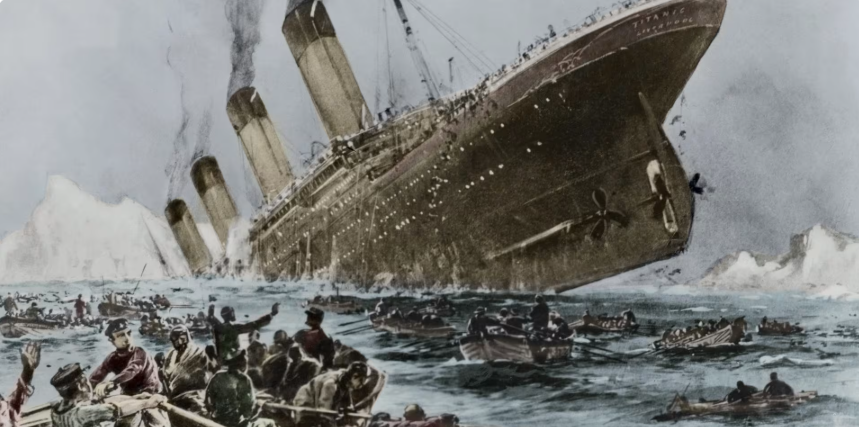
In the vast expanse of the North Atlantic, a drama of unimaginable scale and brutality once unfolded. We often speak of the Titanic in hushed, romanticized tones—the “Ship of Dreams”—but that is a marketing myth. In reality, she was a colossal industrial leviathan, a “gilded eggshell” of steel and hubris, destined to become a tomb for fifteen hundred souls. The movie, although realistic to some extent, perhaps due to ratings, was somewhat absent from the incredible, unforgiving brutality.
Most imagine a peaceful fading into the deep, but the truth of that April night in 1912 was a sickening symphony of violence and a masterclass in human desperation.
A Narrow Escape from Fate.
What most do not realize is that the Titanic’s journey nearly ended before it even began. As she groaned out of Southampton, her sheer mass—displacing some 50,000 tons of water—created a terrifying suction. Like a predator drawing in its prey, she sucked the smaller liner New York toward her hull with such force that heavy-duty mooring lines, thick as tree trunks, snapped like dry twigs with the sound of cannon fire. Had they collided then, the maiden voyage would have been cancelled, and the iceberg would have waited in vain. But fate, it seems, was not so kind.
The Sound of the Sinking
When the iceberg finally struck, it was not a thunderous crash, but a “sharp low reef” hidden beneath the surface that tore half her bottom away. As the ship began to settle, a different kind of horror emerged: the sound. A sinking ship of this magnitude does not go quietly. As the bow dipped, the pressure of the Atlantic became a physical hammer. Windows did not just leak; they shattered inward with explosive force. The interior, once filled with the warmth of chandeliers and four-poster beds, became a soon-to-be tomb of “soaking wet carpet” and “knee-deep water.” The ship was “ripping itself apart.” The sound of timber ripping and steel bending would have been deafening, punctuated by the roar of steam being vented from the boilers—a sound so horrendous that officers on deck had to scream to be heard.
The Stern’s Hidden Horror
Few discussions delve into the grim fate of the Titanic’s stern—the “back half” that rose vertically in the ship’s dying moments before tearing free and plunging. While the bow wreck, discovered in 1985, remains hauntingly recognizable with its railings, anchor chains, and elegant curves intact, the stern lies over 2,000 feet away as a mangled, twisted tangle of steel—barely identifiable as part of a ship. Trapped air pockets in the stern’s lower decks, filled with steerage passengers, cargo, kitchens, and engineering spaces, imploded under the crushing ocean pressure, scattering debris across the seafloor and accelerating its destruction. Furniture, statues, personal belongings, and human remains were hurled outward in violent turbulence as the structure crumpled like paper under extreme force. This violent breakup, confirmed by underwater footage, shattered the long-held myth that the ship sank intact; survivors’ accounts of the stern rising nearly perpendicular before vanishing were once dismissed, yet the wreckage tells a story of unimaginable terror in pitch-black chaos. The stern’s rapid flooding and implosions created a maelstrom of destruction far more brutal than the bow’s gentle descent, leaving a “painful” legacy too horrifying for many to confront openly.
The Agony of the Deep
For those trapped below, particularly in third class or “steerage,” there were no alarms. Many woke to find the icy Atlantic already at their feet, forced to navigate a maze of corridors aboard a vessel that even seasoned crew took days to master.
But for those who made it to the rail, the “Leonardo DiCaprios of the world,” the reality was even more sobering. Striking the water was not a plunge into a pool; it was, as one survivor described, like “a thousand knives being driven into one’s body.” At -2°C, the water is a predator. It induces an automatic, panicked hyperventilation, causing many to drown instantly as they inhale the freezing brine.
Many met their deaths not from the cold alone, but from simple, catastrophic bodily harm as they fell into the ocean from heights that turned the black surface into something indistinguishable from concrete. In the ship’s final, vertical agony—after the breakup—the stern reared skyward, propellers thrashing uselessly in the air. Desperate passengers and crew, clinging to railings or sliding down tilting decks slick with seawater, plummeted from elevations of 50 to over 140 feet. Bodies hurtled downward at speeds of 40 to 60 miles per hour or more, slamming into the water with bone-crushing force. The impact shattered spines like brittle twigs, caved in ribcages, fractured skulls, and ruptured organs in violent, instantaneous trauma. Limbs snapped unnaturally on contact; some were knocked unconscious or killed outright in that brutal millisecond of deceleration. Those who somehow remained conscious after the strike gasped in agony, their broken forms convulsing before the freezing water finished what gravity had begun—seizing hearts in cold shock or flooding ravaged lungs. Few who fell from such heights endured even briefly; the ocean claimed them with merciless efficiency, bodies mangled and lifeless within moments.
The Great Silence
Perhaps the most provocative truth is the behaviour of the lifeboats. We like to believe in the “Birkenhead Drill”—women and children first—and while this was enforced with severe discipline on the port side by Second Officer Lightoller, it led to a tragic irony. Fearing the boats would be swamped by “panicked swimmers,” most lifeboats rowed away from the cries.
Those in the water faced an agonizing progression: first the shock, then the numbness, and finally a “strange warmth” as hypothermia claimed them. One survivor, Eva Hart—who was merely seven years old at the time—spoke hauntingly in later years of the sounds that scarred her forever. She described hearing the people simply drowning, the horrific, indescribable noises they made in their final struggles: gasps, gurgles, cries choked by seawater as panic and cold forced involuntary inhalations of the freezing brine. It was, she said, the most dreadful sound in the world—unimaginable and impossible to convey to anyone who had not been there. And then came the silence that followed, a terrible, absolute quiet as the last voices faded, leaving only the lap of waves against the lifeboats. That dreadful silence, she recalled, was almost worse than the screams themselves, a void that echoed in her memory for the rest of her life, a child’s innocence forever marked by the raw horror of mass death on the open sea.
The Titanic was not merely a tragedy of ice and steel. It was a brutal reminder of our own fragility. We built a titan to conquer the waves, but in the end, it was the cold, indifferent hand of Nature that had the final, silent word.
 marksdeepthoughts.ca
Leave a comment