
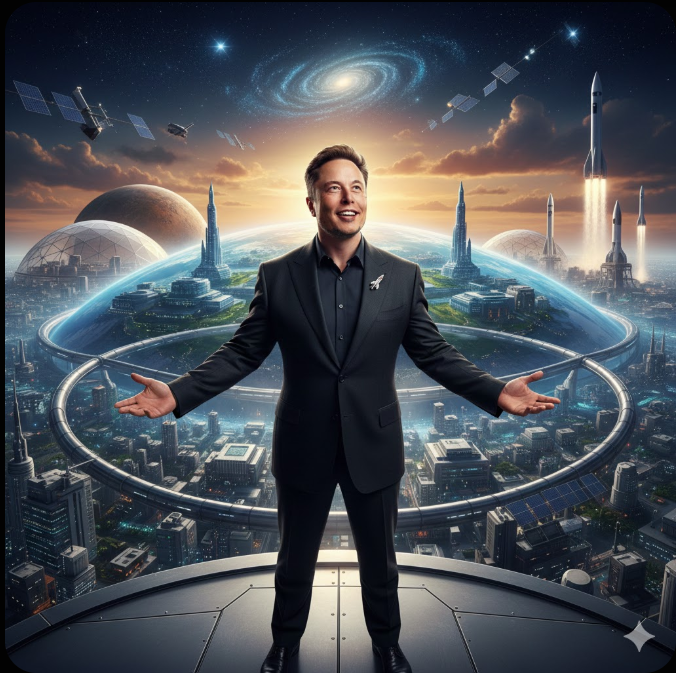
In a world where artificial intelligence is reshaping economies, industries, and even the fabric of human existence, one man stands out not just for his staggering wealth but for his audacious foresight. Elon Musk, the CEO of Tesla, chief engineer of SpaceX, and CTO of xAI, is officially the richest person on the planet as of January 2026, with a net worth soaring to an unprecedented $726 billion—nearly three times that of his closest rival, Google co-founder Larry Page.
forbes.com This fortune, built on groundbreaking ventures in electric vehicles, space exploration, and now AI, positions Musk as a trailblazer in addressing what he calls the “fundamental limiter” for AI supremacy: electrical power.
Musk’s surprise appearance at the World Economic Forum (WEF) in Davos on January 22, 2026, wasn’t just a headline-grabber; it was a manifesto for the future. In a candid conversation with BlackRock CEO Larry Fink, Musk laid out a vision that eclipses his competitors, blending terrestrial renewable energy scaling with extraterrestrial innovation to fuel the AI boom.
As data centers guzzle electricity equivalent to entire countries’ worth of power, Musk is betting big on solar and space to stay ahead of the pack.
The Power Bottleneck: AI’s Achilles’ Heel
The explosive growth of AI is undeniable. By the end of 2026, Musk predicts AI will surpass any single human in intelligence, and within five years, it could outsmart all of humanity combined. But this progress hinges on computing power—and more critically, the electricity to run it. “The limiting factor for AI deployment is fundamentally electrical power,” Musk declared in Davos.
fortune.com He warned that the U.S. could soon produce more AI chips than it can even turn on, due to sluggish grid expansions and regulatory hurdles.
Globally, data centers are projected to consume up to 1,000 terawatt-hours annually by 2030, rivalling the electricity use of major nations. In the U.S. alone, AI-driven demand could add 140 gigawatts (GW) to the grid by then—a 20% spike over current peaks. Yet, infrastructure lags: connection delays stretch to four years, and costs are skyrocketing. Musk highlighted China’s edge, where solar deployment is “tremendous,” boasting over 1,000 GW in capacity—four times the U.S.’s operational solar output.
Musk’s Solar Offensive: Breaking Barriers on Earth
To combat this, Musk is turbocharging solar production. Tesla and SpaceX aim to manufacture 100 GW of solar panels annually each within two to three years, potentially covering 20% of U.S. power needs (around 500 GW total demand).
“It’s really all about the sun,” Musk emphasized, noting that powering the entire U.S. with solar would require just a 100-by-100-mile array of panels. But he’s not mincing words about obstacles. Musk criticized U.S. tariffs on solar imports, calling them “extremely high” and artificially inflating costs.
reuters.com These barriers, he argues, hinder rapid deployment at a time when Big Tech is scrambling for energy. Unlike competitors relying on partnerships with utilities or third-party renewables, Musk’s vertical integration—combining Tesla’s Megapack batteries for storage with SpaceX’s manufacturing prowess—creates a self-sustaining ecosystem.
Leaping into Space: The Ultimate Power Play
Where Musk truly leaves the competition in the dust is his pivot to orbit. “It’s a no-brainer for building solar-powered AI data centers in space,” he said, predicting deployment within two to three years.
youtube.com In space, solar energy is five times more efficient—no atmosphere, no night cycles—and the vacuum provides natural, ultra-efficient cooling. Powered by reusable Starship rockets, these orbital data centers could bypass Earth’s grid constraints, land scarcity, and environmental pushback.
This isn’t pie-in-the-sky; SpaceX is already launching prototypes, and Musk envisions a future where space compute is the “lowest-cost place for AI.”
Competitors like Google are exploring similar ideas (e.g., Project Suncatcher), but none match Musk’s launch cadence or Starlink’s low-latency network for seamless integration.
Ahead of the Pack: Musk vs. the Tech Titans.
While giants like Microsoft, Google, Amazon, and Meta pour trillions into renewables, nuclear deals, and even gas backups, their strategies often depend on external providers—facing delays and emissions risks. Microsoft revived a nuclear plant for 835 MW by 2028; Google eyes SMRs and space tests by 2027. But Musk’s closed-loop empire—xAI for models, Tesla for energy, SpaceX for infrastructure—gives him unparalleled agility.
Add in humanoid robots like Optimus, set for public sales by 2027, which could create abundance by making labour optional, and Musk’s vision extends beyond power to societal transformation.
He even quipped about dying on Mars—”just not on impact.”
Elon Musk isn’t just the richest man; he’s the one redefining the rules of the AI race. By tackling power head-on with solar scaling and space innovation, he’s positioning his companies to dominate an era where energy equals intelligence. As the world grapples with AI’s insatiable hunger, Musk’s forward-thinking blueprint—rooted in sustainability and exploration—proves he’s not just ahead of the pack; he’s charting a course to the stars. In a $726 billion empire built on bold bets, this could be his most transformative yet.
Elon said these very inspirational words at the end of his talk at Davos, “I would encourage everyone to be an optimist about the future…..for quality of life, it’s better to err on the side of being an optimist and wrong, rather than a pessimist and being right.”
 marksdeepthoughts.ca
Leave a comment