
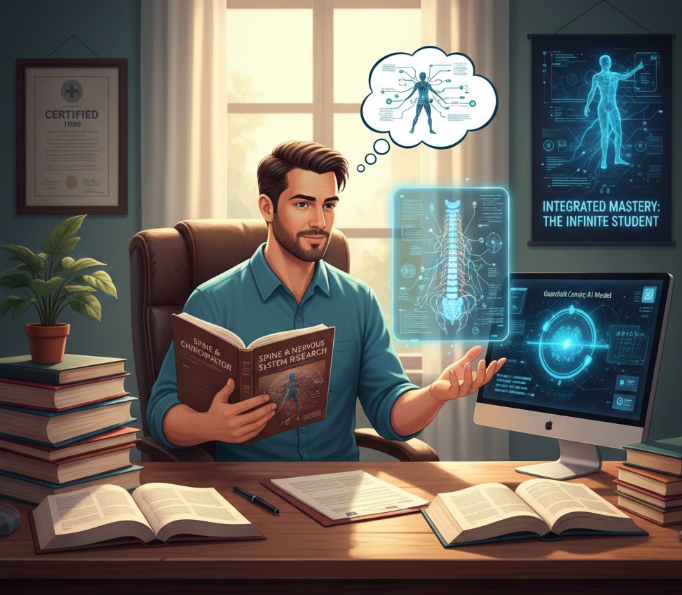
In modern society, we often mistake a certificate for competence. We assume that because someone has the letters “DC,” “MD,” or “PhD” after their name, they have reached a final and concrete destination. However, there is a profound, almost invisible divide between the Credentialed Professional and the Integrated Master.
The difference lies in how they learn, how they fail, and whether their knowledge is a tool they use—or a world they inhabit.
1. The Zoom Factor: From Elevator Pitch to All-Day Deep Dive
The truest test of mastery is the ability to navigate “Variable Resolution.”
- The Surface Practitioner can give you the “academic” answer. They stay within the script because their knowledge is a memorized map.
- The Integrated Master possesses a holographic understanding of their field.
If you ask my son, Dr. Matt, about a specific nuance of the central nervous system, he can give you a crisp, two-minute “elevator speech”. But because he truly lives the practice, he could also talk to you all afternoon, branching into biomechanics, systemic health, and neurological patterns without ever losing the thread.
I feel the same way about my recent research into AI and Fine-Tuning LLM models. You could point to any single sentence or paragraph in my publication submission, and I could talk about the logic behind it for five minutes or five hours. This isn’t just because I wrote the words; it’s because I survived the hundreds of hours of failure required to discover the truths behind them.
2. The Wisdom of the Perpetual Student: Why Mastery Requires Constant Un-Learning
“I’ve spent a lot of time reflecting on what separates someone who holds a credential from someone who truly ‘lives’ their craft. I don’t see this through the lens of being a genius—far from it. My perspective comes from the hundreds of hours I’ve spent being wrong, making mistakes, and having to dig my way out of them.
To explain what I mean, I have to look at a hard lesson I learned in my AI research. In that world, there is a phenomenon called ‘Overfitting.’ It happens when you fine-tune a model so intensely on a specific, narrow dataset that it appears brilliant within those four walls. But the moment you present it with a real-world scenario that differs by even one percent, the model collapses. I call this almost “brainwashing” a model.
This brings me to my discovery of the ‘dirty little secret” that rarely gets discussed: these models don’t just fail; they often become broken. Their original, general reasoning capabilities become impaired because they’ve been flooded with thousands of lines of narrow data. In a sense, the process ‘brainwashes’ the model, stripping away its ability to think for itself in exchange for memorizing a script.
What makes this ‘brainwashing’ truly insidious is a state I’ve observed called ‘Silent Stagnation’. The model doesn’t crash or throw an error code; it continues to output answers with high confidence. It looks like it’s working, but it’s actually just stuck in a loop of its own narrow training, unable to process the truth of a new situation. It’s the difference between a doctor who is actually diagnosing you and one who is just nodding and reciting what they learned forty years ago while the world has moved on. But I digress, let’s continue.
3. The Power of “Agnostic Guardrails.”
My research proposes a departure from this “imitation” model. Instead of teaching an AI what to decide by feeding it thousands of examples, I developed a Guardrail-Centric approach. We teach the model how to reason using universal, domain-agnostic constraints.
This is the same methodology Dr. Matt uses in his practice. He doesn’t just memorize a “fix” for a symptom; he understands the foundational guardrails of human health. Whether it is an AI model or a chiropractor, the goal is to be deterministic and resilient—to have a logic that holds true regardless of the specific “noise” or “data” the world throws at you.
4. The Alchemy of Failure: The “Infinite Student.”
True expertise is forged in the “Valley of Failure.” In developing my paper, I encountered the “48 Trap”—a logic error where the model misinterpreted a threshold as a target. I only solved it through relentless iteration and a refusal to accept “plausible” but incorrect results.
This leads to the Expert’s Paradox: The more you learn, the more you realize how much is left to discover. As Elon Musk famously said, the goal is simply “to be wrong less often”.
- The Credentialed view their career as a destination reached.
- The Master views it as an evolving frontier.
The master is the one who has failed enough times to know where the load-bearing walls are. They don’t just “do” the work; they have transformed their very way of thinking to align with the truth of their craft.
Conclusion
Whether you are adjusting a spine or fine-tuning a neural network, the mark of a knowledge expert is Immersion. It is the difference between having a job and having a philosophy. When you find someone who can talk to you for two minutes or two days about the same topic, you haven’t just found a professional—you’ve found someone who has done the work to become truly, undeniably “less wrong.”
 marksdeepthoughts.ca
Leave a comment