
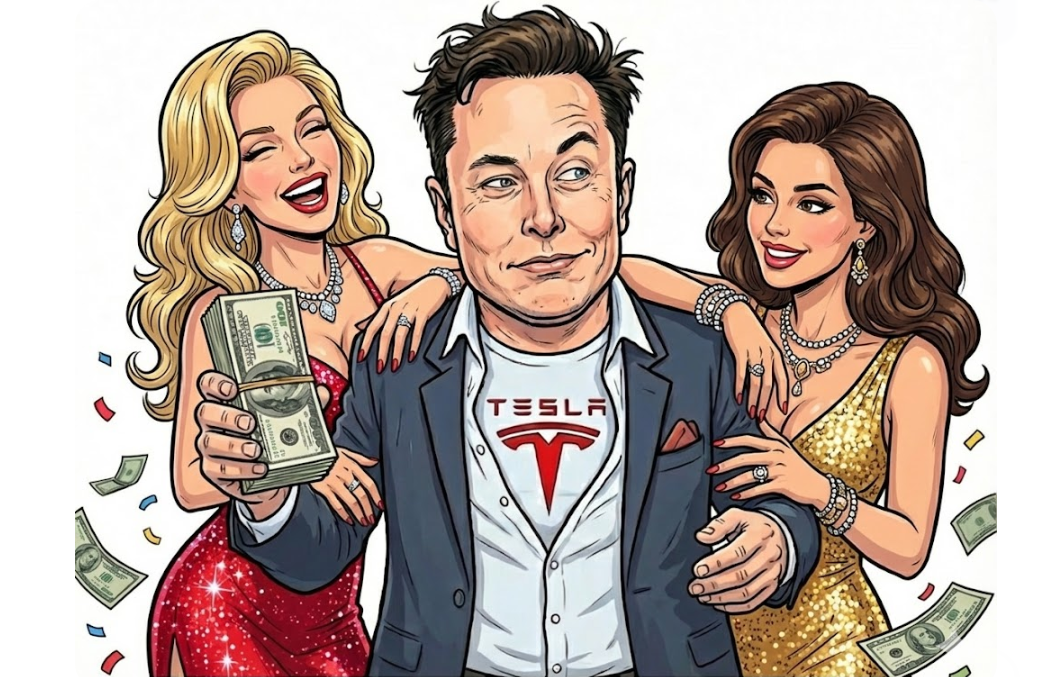
Oh, come on, people. Imagine waking up, snapping your fingers, and a robot rolls in with eggs Benedict, a beachfront villa built overnight, or a Tesla Cybertruck in whatever colour your hangover desires—all for free. No boss, no alarm clock, no 9-to-5 grind. This is the future Elon Musk keeps hyping: “Universal High Income,” where AI and robots create so much abundance that nobody needs to work, poverty disappears, and everyone gets whatever they want. Just this month, he doubled down again, saying saving money will soon be pointless because there will be “universal high income” and sustainable abundance for all. Sounds amazing, right?
Wrong. Dead wrong. As someone who’s watched enough human train wrecks to fill ten seasons of reality TV, I’m here to tell you: This isn’t utopia. It’s the express lane to existential disaster. Unlimited abundance doesn’t liberate us—it cages the human soul.
Let’s start with the seductive pitch. Elon’s vision, straight out of Iain Banks’ Culture novels, goes like this: Solar power becomes essentially free. Asteroid mining floods us with raw materials. Robots build and deliver everything on demand. Perfect recycling means no waste. Costs plummet to zero. Money loses meaning. Work becomes optional. “There will be no poverty,” he insists, and “you’ll have any goods or services you want.” He’s been saying versions of this for years, but in December 2025, he made it crystal clear: Saving money? Pointless. Universal high income is coming.
Fine. Technology might get us there. But humans? We’re greedy, status-obsessed monkeys with zero impulse control. Without hard boundaries, this “genie in a bottle” economy turns into chaos. One guy orders a hundred supercars just to flex. Another demands AI-crafted designer drugs that make fentanyl look like aspirin. And don’t pretend nobody would request weapons or worse. Scarcity doesn’t vanish completely—there’s only one Malibu coastline, one Eiffel Tower view. So who gets the good stuff? Robot cage matches? AI fairness algorithms? Reputation points that smell an awful lot like social credit scores?
Governance becomes the mother of all headaches. Somebody has to program the limits. Governments? They’ll botch it. Corporations? They’ll monetize it. Hackers? They’ll break it for laughs. Chaos guaranteed.
Now let’s get serious—Jordan Peterson serious—about the psychological fallout. We are not built for endless leisure. We are meaning-making creatures, forged in responsibility and voluntary struggle. Viktor Frankl, surviving the Nazi camps, concluded that man’s deepest drive is not pleasure but purpose. Strip away the need to strive, to shoulder burdens, to climb the hierarchy of competence, and you don’t get happy retirees—you get hollowed-out shells.
Meaning emerges when you confront chaos voluntarily, when you take on loads that matter. Remove the load entirely and depression doesn’t creep in; it floods. UBI as a modest safety net for society’s stragglers? That preserves dignity without killing drive. But UHI on steroids—everything handed to you, forever? That’s spiritual suicide. We risk an epidemic of anomie: life reduced to dopamine hits, endless scrolling, and that quiet despair whispering, “Is this it?” Look at lottery winners who implode, or retired athletes who fall apart. Scale that to billions. Wall-E wasn’t science fiction; it was prophecy.
And gatekeepers? Please. Human nature guarantees them. We’re wired for hierarchy. Capitalism isn’t just an economic system—it’s primate politics with spreadsheets. Someone, somewhere, will bottleneck the robots and AI. Early winners—tech titans, superpowers—will demand tribute: your data, your loyalty, your vote. “Want the full unlimited package? Subscribe to our platform.” Open-source efforts like xAI might slow the monopoly, but greed is eternal. The result? A shiny new feudalism: AI lords on top, digital peasants below.
Is there any hope? Maybe—if we grow up fast. Abundance could redirect our energy toward greatness: art that redefines beauty, space exploration that makes Mars a suburb, and philosophical breakthroughs that answer the big questions. The famous Rat Park experiment showed that rats in enriched environments ignored drugs when life had meaning. Give humans real enrichment—freedom plus responsibility—and maybe we thrive.
But that requires a cultural revolution now. We need global guardrails: AI ethics treaties, psychological safeguards, and ironclad anti-monopoly rules. Otherwise, “whatever you want” quietly becomes “whatever they allow.”Elon’s freight train is barreling down the tracks—AI advances like Grok are accelerating it every day. We can still choose the destination. Complacency isn’t just lazy; in this future, it’s fatal.
So tell me in the comments: Is Elon a visionary genius or dangerously naive? Do you fear universal high income more than mass unemployment? Let’s have the debate we’re not having anywhere else.
Because if we don’t wake up, the robots won’t be the problem. We will be.
 marksdeepthoughts.ca
Leave a comment