
For the last two decades, we have been subjected to the most publicized, warned-about, and discussed existential crisis in history: climate change. We are told that the world is on the brink of collapse, that we have mere years to save humanity, and that the only solution is to hand over our economies, our freedom, and our wallets to a political elite promising to dial down the global thermostat.
But when you strip away the fear-mongering and look at the cold, hard financial data, a different picture emerges. It is a picture of a “gravy train” fueled by hysteria, where the costs are astronomical, the results are negligible, and the science is far from settled.
The Definition of Insanity
Let’s look at the scoreboard. Over the last 20 years, the world has poured trillions of dollars into green energy initiatives. Investors have flooded the market with capital, governments have subsidized “Net Zero” dreams, and consumers have been guilt-tripped into paying extra for airline tickets to “offset” their carbon footprint.
And what did we get for this unprecedented spending?
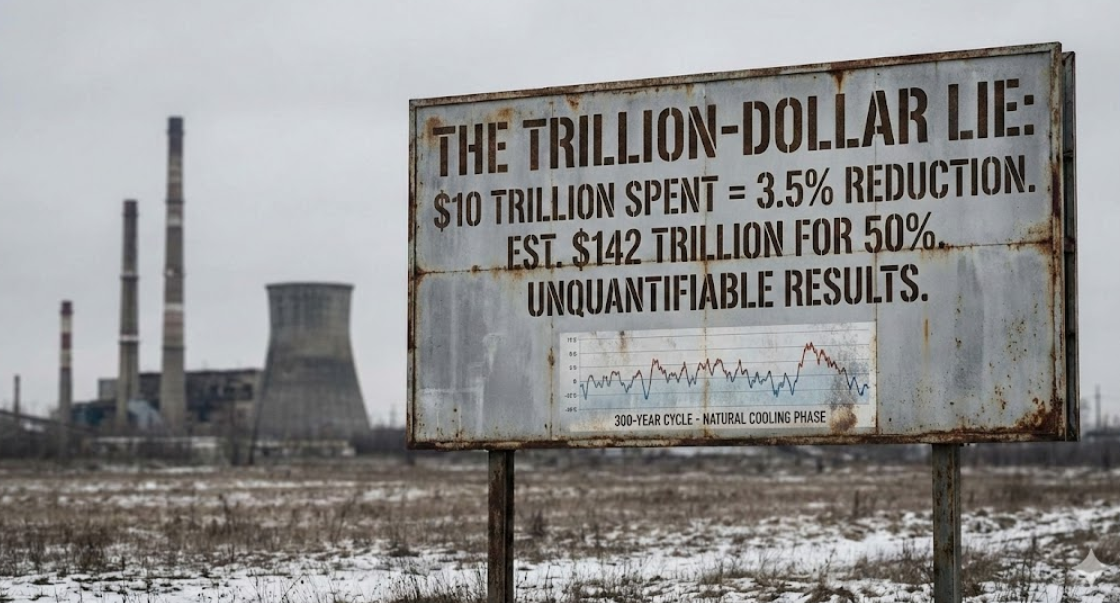
From 1975 to 1995, global dependence on fossil fuels dropped significantly, largely due to the adoption of nuclear energy—a clean source that many modern “green” activists claim to hate. But in the last 20 years? Our dependence on fossil fuels has moved from 85% to 81.5%.
That is a reduction of just 3.5%.
We have spent trillions of dollars to move the needle by barely three percentage points. If this were a business, the CEO would have been fired years ago. Instead, the “experts” are asking for a promotion and a blank check.
The Bankruptcy of Net Zero
If we accept the estimate that we have collectively spent $10 trillion to achieve that measly 3.5% reduction, the math for the future becomes terrifying.
To reach the stated goal of a 50% reduction in fossil fuel reliance—a target governments claim is necessary to save the planet—we would need to extrapolate that spending.
- Current Cost: $10 Trillion for a 3.5% reduction.
- Cost per 1% Reduction: ~$2.85 Trillion.
- Cost for 50% Reduction: ~$142 Trillion.
This is not just expensive; it is economically impossible. Canada, for example, is already overextended, printing money to cover debts that our grandchildren will be paying off. To suggest that we can spend our way to “Net Zero” without completely destroying the global economy is a lie. The global economy simply cannot exist without the extraction, refinement, and burning of fossil fuels.
The 300-Year Context: A Natural Cycle
The arrogance of this spending is matched only by the arrogance of the scientific claim: that we are the sole control knob for the Earth’s temperature.
The reality is that the Earth has been warming since the end of the Little Ice Age, which concluded in the late 19th century. This warming trend began long before the industrial revolution, SUVs, or the “carbon footprint” calculator invented by BP Oil.
Let me explain. In 2004, BP, the second-largest non-state-owned oil company in the world, popularized the term “carbon footprint” and released the first “carbon footprint calculator.”
The Strategy: They hired the PR firm Ogilvy & Mather to promote the idea that climate change was the fault of individuals rather than corporations.
The Motive: This was a form of damage control following massive oil spills. By convincing the public that they were the problem (measuring their own personal impact), BP aimed to deflect blame, protect their shareholders, and avoid stricter industrial regulations.
We are looking at a tiny dataset of human history and screaming “fire” because we lack the perspective of geological time. When we drill into the Greenland ice shelf, we see that over the last 10,000 years, the Earth has actually been on a cooling trend. We are currently in a small warming blip within a larger cooling phase.
To claim that carbon dioxide—a gas that makes up 0.04% of the atmosphere—is the primary driver of this change is to ignore the sun, water vapor (which is ten times more potent as a greenhouse gas), and natural cycles that have governed the planet for billions of years.
The Flawed Models
So why the panic? It comes down to computer models.
Steven Koonin, a former Obama Department of Energy scientist, has pointed out that the models used to predict our doomsday are so inadequate they cannot even reproduce the temperatures of the past. If a model cannot tell you what happened in 1950 based on known data, why should we trust it to tell us what will happen in 2050?
These models failed to predict the lack of warming over the last 15-20 years, a “hiatus” that scientists have been scrambling to explain. Yet, we are basing global economic policy on these broken algorithms.
The ESG Gravy Train
If the science is shaky and the costs are ruinous, who benefits?
Follow the money. The push for ESG (Environmental, Social, and Governance) scores has created a lucrative industry for consultants, banks, and fund managers. It is a “gravy train” where companies can buy a “green” label to distract from their actual practices.
Banks love it because they can charge higher fees for “sustainable” funds that are virtually identical to regular funds. Politicians love it because it gives them a platform for control and new taxes. And the media loves it because “crisis” sells ads better than “steady weather”.
A Reality Check
We need to stop the alarmism. Telling people the world will end in 35 years is the worst possible psychological strategy—it’s like telling someone they have 60 days to live and expecting them to start a diet.
The Earth is greening, with vegetation increasing by 20% due to higher CO2 levels—literally more food for the planet. Polar bear populations are stable. The “climate crisis” is a political narrative, not a scientific reality.
There is no appetite to bankrupt our civilization for a 3.5% statistic. It is time to close the checkbook on the climate alarmists and return to reality. Trust, yet verify.
 marksdeepthoughts.ca
Leave a comment