
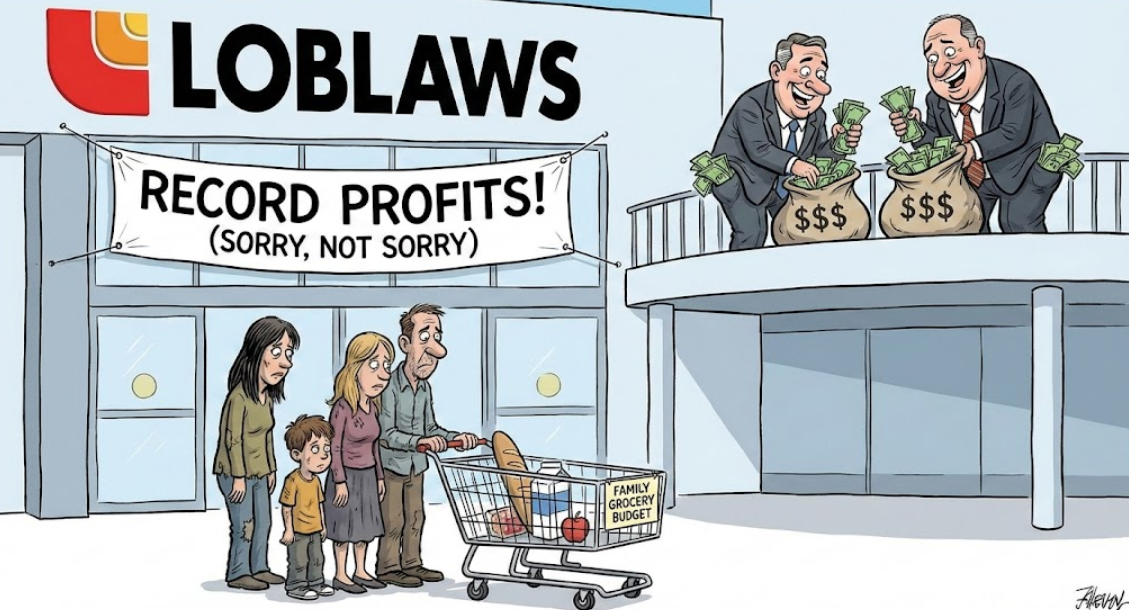
And finally, New Rule: Stop telling me grocery stores have “razor-thin margins.” You know who has razor-thin margins? The single mom in Halton Hills deciding between buying raspberries or paying the hydro bill. That’s a thin margin.
If you’re the CEO of Loblaws, and your net profit has tripled in ten years while the rest of us are treating a block of cheese like it’s a gold brick from Fort Knox, your margins aren’t “thin”—they’re anorexic by choice.
It is time we admit that the Canadian grocery industry is running the polite version of a cartel. We all know the “Big Three”—Loblaw, Sobeys, and Metro. They act like they’re in a fierce competition, but it’s really just three guys in a room agreeing that $9 for a stick of butter is a reasonable ask. It’s like watching professional wrestling: lots of grunting and slamming, but at the end of the day, they’re all riding in the same limo to the bank.
Let’s look at the scoreboard, shall we?
While you were standing in the aisle at No Frills, weeping softly because a bag of romaine hearts now costs more than a pack of cigarettes, Loblaw CEO Per Bank was taking home a compensation package worth $22 million in 2023. Twenty. Two. Million.
Do you know how many bananas you have to sell to make $22 million? Neither does he! He’s not scanning bananas. He’s scanning the horizon for a new yacht.
And let’s not forget Galen Weston. He stepped down as CEO, probably because his back hurt from carrying all that cash, but he still pocketed about $8 million just to be the “Chairman.” That’s $8 million to sit in a chair and say, “Yes, I think we should charge for the plastic bags we used to give away for free. That’s pure profit, baby!”
Then you have Eric La Flèche over at Metro making $6.1 million. And Michael Medline at Empire (Sobeys) raking in nearly $9 million.
These guys are making NBA superstar money to sell us soup.
The “Inflation” Excuse
They love to blame “supply chains” and “inflation.” They tell us, “Oh, it’s the war in Ukraine,” or “It’s the drought in California.”
Really? Because if costs went up, and you just passed those costs along to us, your profit in dollars would stay roughly the same. But it didn’t. Loblaw’s profit didn’t just inch up; it skyrocketed from $600 million to over $2 billion.
That’s not inflation. That’s greedflation.
That is the difference between covering your costs and gouging the customer because you know they have to eat. You can choose not to buy a new iPhone. You can choose not to watch the new Marvel movie. You cannot choose not to eat. They have us by the short and curlies, and they are squeezing.
The “Razor-Thin” Lie
They keep crying about their “3% profit margin.” “Oh, we only make three cents on the dollar!”
First of all, when you sell $60 billion worth of stuff, three percent is a hell of a lot of money. It’s the difference between a “thin margin” and a Scrooge McDuck money bin.
Second, they use that cash to buy back their own stock—$1.7 billion worth in just one year for Loblaw. That pumps up their stock price and makes their investors rich, while you’re at the checkout trying to figure out if you can afford the “Name Brand” mac and cheese or if you have to settle for the orange dust in the generic box.
The Bottom Line
We have food banks in this country breaking records. We have 1 in 4 households facing food insecurity. And meanwhile, the guys running the grocery stores are earning bonuses that could feed a small city.
So, stop gaslighting us. Stop putting out commercials where you look concerned and tell us you’re “fighting inflation for us.” You aren’t fighting inflation; you’re dating it. You’re taking inflation out for a nice steak dinner while the rest of us are eating cereal for supper.
The only thing “Fresh” at your stores is the audacity.
 marksdeepthoughts.ca
Leave a comment