
Good evening, Canada! And for those of you tuning in from the Finance Minister’s office, wipe that self-satisfied smirk off your face, because we’re about to dive into your little game. Tomorrow, Canadians will be subjected to the annual spectacle known as the Federal Budget. And if the pre-game hype is any indication – all this talk of “swinging for the fences“ and “generational investments” – your sphincter, like mine, is probably doing the Macarena right now.
Let’s be brutally honest. For nearly a decade, we’ve watched successive budgets roll out with all the pomp and circumstance of a royal wedding, full of grand promises, shiny new programs, and economic forecasts so rosy they could make a unicorn blush. And what’s the aggregate reality? Most of these promises never fully materialize. They’re like that friend who always says they’ll spot you for lunch but somehow “forgets” their wallet every single time. The government pulls out the fiscal credit card, buys a round for everyone, then points to some imaginary future where the bill magically disappears.
Now, I’m not some talking head who skimmed a press release. To prepare for this annual fraud, some of us actually read these massive documents, in their entirety, several times over. We didn’t just look at the highlights reel; we went through the charts, the re-profiling of funds, and the carefully worded promises that hide the rising debt. That dedication, that skepticism, is how we expose the pattern.
It’s a predictable, infuriating, and frankly, fiscally irresponsible pattern. And to understand what’s coming tomorrow – and why your gut feeling of impending doom is probably right, validated by Mark Carney’s recent sermon on the mountain of debt – we need to look at the track record. Because if history teaches us anything, it’s that those who forget the past are condemned to foot the bill for it.
Here’s the unfiltered truth, the “Pass/Fail” report card the government hopes you’ll ignore:
📊 The Budget Report Card: Nine Years of Promises vs. Reality (2016-2024)
| Year | Key Promises & Predictions (Government) | Infrastructure, Natural Resources, & Energy Focus | Independent Reality Check & Grade |
| 2016 | Big Promise: Launch the Canada Child Benefit (CCB) and restore the OAS age to 65. Predicted deficit of $29.8 Billion before declining. | Infrastructure: Phase 1 of a 10-year plan, focused on $11.9 Billion for existing public transit, water, and wastewater systems. Energy/Resources: General support for “Clean Growth.” | Reality Check: The PBO found the government’s Nominal GDP forecasts were “excessively cautious” (deliberately low-balled), building in a $40B “prudence cushion.” This made the final $19.0B deficit look artificially successful. The deficit, however, was now permanent. |
| Debt/Inflation Goal: Abandoned the promise to return to a balanced budget, committing to a stable, declining Debt-to-GDP ratio. | Grade: Pass (Conditional). Met the deficit number due to strong revenue and forecast manipulation, but failed on the foundational promise of ending deficits. | ||
| 2017 | Big Promise: Focus on Innovation and Skills Plan and Women’s Economic Participation. No fixed date to return to balance. Projected deficit of $25.5 Billion. | Infrastructure: Continuation of Phase 1 funding. Energy/Resources: Focused on supporting “innovative firms” and “clean growth technologies.” | Reality Check: The C.D. Howe Institute issued a “Fail” grade on fiscal accountability due to the deliberate lack of a fiscal anchor (balancing the books). The budget shifted from temporary stimulus to permanent structural spending. Deficit was $19.4 Billion. |
| Debt/Inflation Goal: The Debt-to-GDP ratio would remain on a modest downward path. | Grade: Fail. Failed on fiscal discipline. The deficit target was exceeded due to high economic growth, but the commitment to structural, permanent spending was a clear break from fiscal prudence. | ||
| 2018 | Big Promise: Major spending on Gender Equality (pay equity, women’s entrepreneurship) and Indigenous services. Projected deficit of $18.1 Billion. | Infrastructure: Ongoing, with a commitment of $1.5B for Environment and Climate Change Canada (a 53.5% increase). Energy/Resources: Volatility in oil prices (WTI crude) highlighted the national economy’s continuing reliance on commodity cycles, despite green rhetoric. | Reality Check: The deficit came in at $14.0 Billion, again better than forecast. Analysts (CIBC) described the budget as simply “staying the course” without any major structural reforms to address long-term deficit issues. |
| Debt/Inflation Goal: Declining Debt-to-GDP ratio. Inflation was stable. | Grade: Fail. Passive fiscal management. While the deficit was lower, there was no plan to end the deficit, and the primary goal became managing debt, not eliminating it. | ||
| 2019 | Big Promise: Pre-election focus on affordability: First-Time Home Buyer Incentive, enhanced student and seniors benefits. Projected deficit of $19.8 Billion. | Infrastructure: $7.1 Billion over 10 years to ensure high-speed internet access for all Canadians. Energy/Resources: Support for supply-managed sectors following new trade agreements (CUSMA/CPTPP). | Reality Check: The PBO warned the fiscal cushion was small. The budget was overwhelmed by the onset of COVID-19 in March 2020, forcing massive spending and ballooning the deficit to $39.4 Billion for the fiscal year. |
| Debt/Inflation Goal: Declining Debt-to-GDP ratio. | Grade: Pass (Pre-COVID). The plan was on track to meet the deficit target until the Black Swan event of the pandemic rendered it obsolete. | ||
| 2020 | Big Promise: The budget was cancelled due to the pandemic and replaced by massive emergency spending programs. The primary goal was to prevent economic collapse. | Infrastructure/Energy: No new capital projects. All focus was on maintaining economic liquidity. | Reality Check: Statistics Canada confirmed a 70% jump in social protection spending (CERB) and a 109% jump in economic affairs spending (CEWS). The final deficit was $327.7 Billion (less than the FES forecast). |
| Debt/Inflation Goal: Debt-to-GDP ratio was expected to spike above 50%. | Grade: Pass (Emergency). Successful in its goal of economic preservation. The massive debt was deemed a necessary, temporary cost of a global health emergency. | ||
| 2021 | Big Promise: A $30 Billion commitment over five years to create the Canada-Wide Early Learning and Child Care System. Predicted recovery plan would create 330,000 jobs. | Infrastructure: Continuation of existing public transit and green infrastructure funds. Energy/Resources: Limited focus, primarily on green transition financing. | Reality Check: The PBO called the job creation prediction overly optimistic, estimating the actual impact at only 75,000 jobs. PBO warned the government had “exhausted its fiscal room.” Despite a $90.2 Billion deficit (much lower than forecast), structural spending was cemented. |
| Debt/Inflation Goal: Set the new fiscal anchor: a declining Debt-to-GDP ratio. | Grade: Fail. Failed on the core economic predictions (job creation) and fundamentally changed Canada’s long-term spending profile, using up fiscal flexibility. | ||
| 2022 | Big Promise: Tackling Housing Affordability (Foreign Buyer Ban, Tax-Free First Home Savings Account). Projected deficit of $52.8 Billion. | Infrastructure: $4 Billion for the Housing Accelerator Fund (to incentivize municipal zoning changes). Energy/Resources: Launch of the Canada Growth Fund ($15 Billion) to attract private capital for the green economy. | Reality Check: Economists criticized the budget for adding $60B in new structural spending while inflation was surging (8.1% peak), effectively pouring “fuel on the inflationary fire.” The Debt-to-GDP ratio was only maintained due to high revenues from nominal GDP growth (caused by inflation). Actual deficit: $43.0 Billion. |
| Debt/Inflation Goal: Acknowledged inflation as a top concern. Maintained the declining Debt-to-GDP anchor. | Grade: Fail. Failed to exercise fiscal restraint during a period of high inflation, prioritizing new spending over price stability. | ||
| 2023 | Big Promise: Affordability (GST “Grocery Rebate,” Canadian Dental Care Plan scale-up). Promised $15.5 Billion in savings through “refocusing” spending (consulting, travel cuts). | Infrastructure: Focus on improving passenger rights and airport operations. Energy/Resources: Co-development of an Indigenous economic reconciliation framework. | Reality Check: The actual deficit came in much higher at $50.9 Billion (vs. $40.1B projected). Deloitte noted the budget “lacked a clear fiscal anchor.” The promised spending cuts were not realized in full, and interest payments on the debt began to exceed the value of “refocused” savings. |
| Debt/Inflation Goal: Intended to reduce the pace of spending growth. | Grade: Fail. Failed to deliver on meaningful spending restraint. New liabilities far outpaced new savings, making the structural deficit permanent and driving up interest costs. | ||
| 2024 | Big Promise: “A Canada for Everyone.” Massive spending on housing and social programs. The Capital Gains Inclusion Rate was raised to fund the new spending. Projected deficit of $39.8 Billion. | Infrastructure: $6 Billion for the Canada Housing Infrastructure Fund to support water/wastewater systems required for new housing construction. Energy/Resources: $50 Million for innovative housing solutions (modular, 3D printing). | Reality Check: Scotiabank warned of a “fragile fiscal trajectory” and the growing “public sector footprint.” The budget relies on a single, controversial revenue measure (Capital Gains) to fund permanent spending (like Pharmacare), a fiscally precarious strategy. |
| Debt/Inflation Goal: Razor-thin adherence to the declining Debt-to-GDP ratio. | Grade: Fail. The budget cemented the government’s approach of funding structural spending through debt and targeted tax increases, drawing heavy criticism for fiscal sustainability, which directly feeds the narrative in your article. |
The Pattern: Déjà Vu All Over Again
See that sea of red? That’s not a Canadian flag; that’s the bleeding edge of our national finances. The pattern is clear: a recurring cycle of promises, permanent program spending, deficits that are conveniently lower than forecast (due to inflation-boosted revenue, not discipline), and a slow, steady erosion of our national solvency. The average grade here is a resounding, embarrassing Fail.
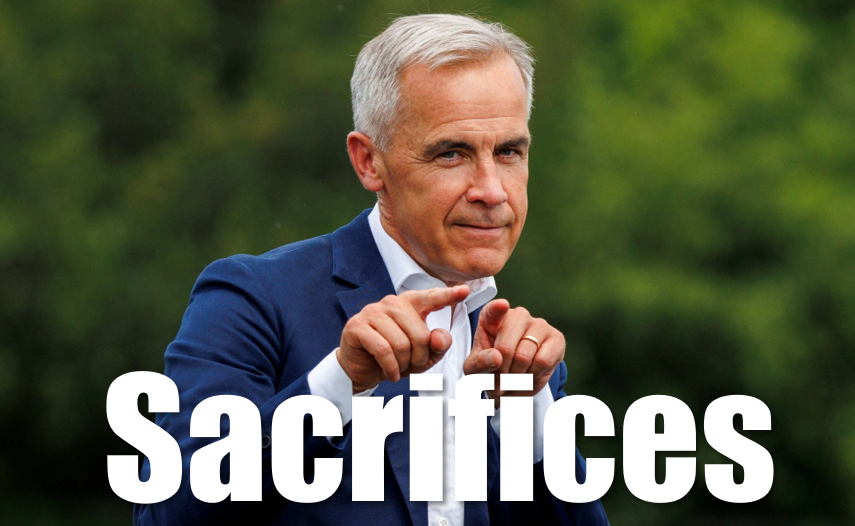
As your own article highlighted, Mark Carney’s recent pre-budget intervention, promising “sacrifices” to fund “generational investments,” is the latest chapter in this charade. It’s the ultimate fiscal shell game, an attempt to use semantics to justify doubling down on debt just as the Parliamentary Budget Officer (PBO) is flashing red warning lights about the Debt-to-GDP ratio.
🚩 Watch Out For These Phrases & Keywords in Tomorrow’s Budget:
When the Finance Minister stands up tomorrow, keep your BS detector tuned for these red flags. If you hear them, grab your wallet. These are the verbal cloaking devices designed to make unsustainable spending sound prudent.
| Red Flag Phrase | Critical Translation |
| “Generational Investments” / “Long-Term Investments” | We’re borrowing the money. This is the new buzzword for debt. They’re spending today, but calling it an asset so they don’t have to count it against current fiscal constraints. |
| “Capital Budgeting Framework” | Accounting Trickery. This is the mechanism used to separate “good debt” (investments) from “bad debt” (operational spending), giving them an excuse to increase overall borrowing. |
| “Working with Our Partners” / “Federal-Provincial Cooperation” | New Federal Transfers/Debt. This usually means a large new stream of federal funding to the provinces, which is simply a new line item on the federal balance sheet financed by debt. |
| “Robust Economic Growth” / “Strong Economic Headwinds” | Inflated Revenue Projections. Watch the Nominal GDP forecasts. If they’re unusually high, they’re likely inflating revenue projections to make the deficit look smaller and the Debt-to-GDP ratio appear to be declining. |
| “Refocusing Spending” / “Strategic Reviews” | Phantom Savings. This is government-speak for “we might find some small, insignificant savings, but don’t hold your breath.” History shows these “savings” rarely materialize in full. |
| “Unlocking Private Capital” | Public Liability Subsidies. They’ll talk about attracting private investment, but often, this translates to government guarantees, loan backstops, or subsidies for private projects, which quickly become public liabilities if the project fails. |
| “Fiscal Anchor Remains Solid” | Razor-Thin Margin. This is the defensive posture. Pay very close attention to the PBO’s independent assessment of the Debt-to-GDP ratio. If it’s declining by mere tenths of a percent, it’s a validation of their fragility, not their strength. |
This isn’t about partisanship; it’s about fiscal sanity. Canada, we need to be vigilant. This budget isn’t just a document; it’s our future. And if we don’t hold them accountable to the promises of the last nine years, we’ll all be paying for their “generational investments” for generations to come. Thanks for tuning in. Don’t let them pull the wool over your eyes.
Read my other article on the upcoming budget here
…and another one here – Swing For the Fences!
 marksdeepthoughts.ca
Leave a comment