
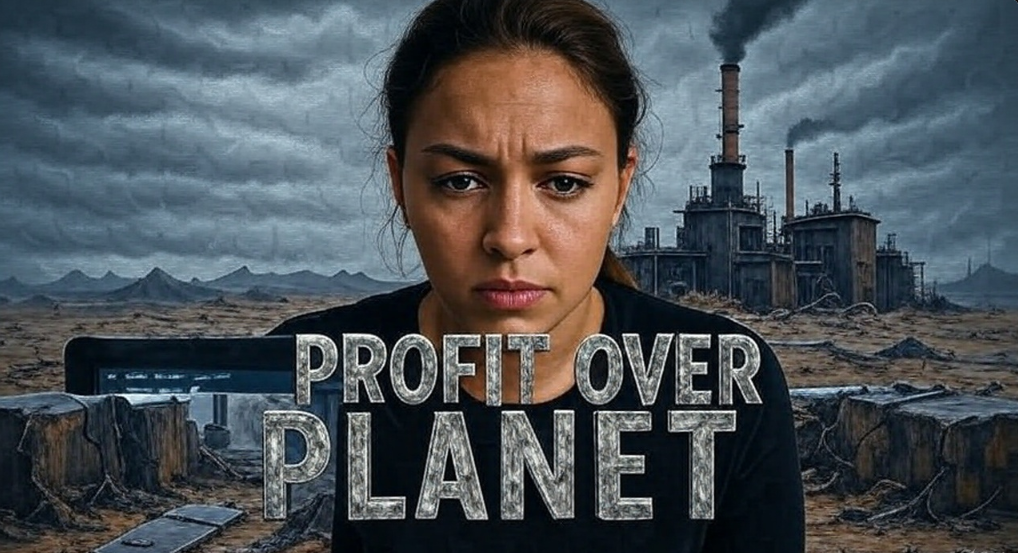
My Take on Whether Climate Action Is Saving the Planet or Just Lining Pockets
Introduction: The Uneasy Feeling Behind the Headlines
I’ve always been fascinated by how headlines scream about impending environmental doom—rising seas, apocalyptic wildfires, vanishing ice caps—and yet, something about the narrative feels off, like there’s a script running beneath the surface. From my deep dives into independent research articles, I’ve come away with a starkly skeptical view of this so-called “climate crisis.” They dismiss carbon dioxide not as some existential poison, but as a vital plant nutrient, pointing out that even if a country like Canada shut down every emission source overnight, it would barely nudge global totals by a fraction of a percent. These articles tear into predictive models as hopelessly flawed, comparing them to trying to forecast 100,000 years of weather based on just two days’ data, and they connect the dots back to long-forgotten panics like acid rain and ozone holes that fizzled out without the world-ending drama promised. The math hits hard: My calculations show humanity’s annual carbon output at around 35 billion tons, utterly overshadowed by Earth’s 3 trillion trees gobbling up 65 billion tons, leaving a surplus of over 30 billion tons that nature manages without breaking a sweat. What’s more, they unmask the “carbon footprint” idea as a clever oil industry ploy to flip the blame from corporate giants to you and me, while electric vehicles—hailed as green heroes—turn out to be villains in disguise, powered by toxic lithium mines ravaging South American ecosystems and dropping tens of thousands of migratory birds from the sky.
My Growing Suspicion: Profit Over Planet?My growing suspicion—that the obsession with carbon (and its shadowy twin, air pollution) has less to do with planetary salvation and more to do with juicing returns on investment for governments and elites—feels increasingly validated. Through my explorations of skeptical sources, including fresh 2025 analyses, I’ve uncovered a relentless pattern of failed prophecies. Take Al Gore’s 2006 An Inconvenient Truth: He warned of coastal cities submerged by the 2020s and a snowless Mount Kilimanjaro in under a decade—claims that haven’t aged well, with glaciers holding steady and sea levels creeping up at a modest 3.7 mm per year, nowhere near flooding Manhattan. Even now, in 2025, Gore’s deadlines keep sliding, from “points of no return” by 2016 to vague futures, which strikes me as fearmongering tuned for funding and clout. Outlets like Capital Research Center and AgWeb have tallied over 50 years of these busts, from 1970s ice age hysteria to 2000s polar bear extinction scares that never happened—those populations have bounced back to near-record highs of about 26,000. These aren’t innocent misses; they’re hallmarks of a story crafted for control and cash, a sentiment echoed across forums and articles branding the alarmism a “scam” that fattens NGOs, scientists, and policymakers via what one 2025 report dubs “compounding fraud.”

Testing the Theory: Top 10 “Be Kind to the Earth” Themes
To put my theory to the test, I’ve pulled together the top 10 “Be Kind to the Earth” themes, sourced from 2025 priority lists like Concern Worldwide’s emphasis on greenhouse gases and deforestation, or Eden Green’s spotlight on polluted water and shrinking forests. These are the big-ticket issues buzzing globally. For each, I’ve sized up:
- Monetization Potential: The cash flows from taxes, subsidies, grants, and green tech booms. That air pollution/carbon mash-up? It’s raking in over $100 billion yearly as of 2025.
- Control Potential: The regulatory hooks for watching, mandating, and nudging behavior, inspired by setups like the EPA’s Clean Air Act caps.
- Jobs/Projects Potential: The fresh bureaucracies, watchdogs, and funded ventures, think water boards staffing up with inspectors.
I’ve weighed pro-regulation takes from EPA and UNEP trackers against skeptics slamming these as “scams” for the elite grind—especially the World Economic Forum’s chatter on emission cuts as cover for surveillance gadgets like “carbon lockdowns.” Here’s my updated comparison table, tuned to mid-2025 numbers:
| Theme/Cause | Monetization Potential (Scale: High/Med/Low) | Control Potential (Scale: High/Med/Low) | Jobs/Projects Potential (Scale: High/Med/Low) |
|---|---|---|---|
| 1. Air Pollution & Carbon Emissions/Climate Change | High: Over $100B annually in 2025 ($103B from carbon pricing alone, plus $50B+ from emissions trading and $500B+ in renewables/EV subsidies); trillions projected long-term (e.g., carbon credits market to $16T by 2034). Skeptics label it a “double-dipping scam,” taxing exhaust for both air quality and climate offsets. | High: Vehicle inspections, EV mandates, “carbon passports,” and smog alerts enable widespread surveillance and travel curbs; echoes COVID lockdowns, with 2025 WEF talks on high-emitter restrictions raising “lockdown” fears. | High: 10M+ green roles globally (EU Green Deal adding 2.5M by 2050); thousands of EPA inspectors; billions in compliance audits and infrastructure. |
| 2. Plastic Pollution in Oceans | Med: $10B+ in global cleanup grants; $2B U.S. recycling subsidies. | Med: Bans on single-use items; waste-tracking apps. | Med: 100K+ recycling jobs; $100M+ ocean cleanup projects. |
| 3. Water Pollution/Scarcity | Med: $5B+ U.S. Clean Water Act grants annually; desalination subsidies. | High: Water usage caps; smart meters for household monitoring. | High: 300K+ jobs in water agencies; $1T+ global infrastructure overhauls. |
| 4. Deforestation | Med: $1B+ REDD+ carbon offset credits; $200B reforestation pledges. | Med: Land-use restrictions; satellite surveillance of farms. | Med: 100K+ conservation ranger roles; large-scale planting initiatives. |
| 5. Biodiversity Loss | Med: $5B+ Global Environment Facility grants; eco-tourism taxes. | Med: Protected area bans; regulations on hunting and farming. | High: 50K+ U.S. Fish & Wildlife jobs; $100B+ habitat restorations. |
| 6. Waste Management (incl. Recycling/E-Waste) | Low-Med: $1B U.S. recycling grants; e-waste fees (global recycling rates hover at ~9%, with much funding unaccounted for). | Low-Med: Mandatory sorting; digital disposal tracking. | Med: 200K+ landfill and recycling operations jobs; various cleanup programs. |
| 7. Chemical Runoff/Pesticides | Low: $500M global pesticide taxes; $10B EU organic farming subsidies. | Med: Farm spraying bans; mandatory water testing. | Low-Med: 50K agricultural inspector roles; soil remediation projects. |
| 8. Battery Waste/E-Waste | Low-Med: $2B recycling market; lithium mining royalties. | Low: Electronics disposal regulations; ties to EV monitoring. | Med: 100K e-waste facility jobs; emerging battery recycling plants. |
| 9. Overfishing/Marine Depletion | Low: $5B fishing quotas/permits; $20B global aquaculture subsidies. | Med: No-fish zones; GPS vessel tracking. | Low-Med: 50K fisheries enforcement roles; sustainable fishing initiatives. |
Looking at this table—fresh off my mid-2025 refresh—I’m convinced: The air pollution/carbon combo crushes the field, scaling up revenue, eyes-everywhere oversight, and job factories like nothing else. Plastics and water issues lag, missing that sneaky, everyone-involved edge—after all, we all breathe out emissions daily, perfect for blanket taxes and constant tracking.
The Air Pollution & Carbon Cash Machine: Unbeatable in 2025
So, why does this bundled beast rule? By June 2025, I’ve crunched the numbers: 78 global carbon pricing tools pulled in $103 billion in 2024, hitting 28% of emissions, with the credits market eyeing $16 trillion by 2034. Stack on air pollution plays—the U.S. Clean Air Act’s fines now maxing at $124,426 per violation, netting $1-2 billion yearly in penalties, plus $50 billion from emissions trades worldwide. Toss in renewables and EV handouts, and you’re at $600 billion+ a year, blowing past plastics ($10 billion grants) or biodiversity’s pie-in-the-sky $700 billion hole. Here in Canada, the carbon tax hauls $8 billion annually, rebated sure, but often rerouted to “green” schemes that smell like WEF insider deals to me.
It’s no fluke; it’s a deliberate mash-up. The EU’s Emissions Trading System, with 38 clones worldwide by 2025, started with air cleanup but ballooned into carbon chaos, letting them hit the same fumes twice—for soot and gases. BP’s 2004 footprint gadget? Pure marketing magic, turning my daily drive into the apocalypse while birthing a $100 billion audit-offset empire. Jump to now: Q2 2025 saw $3.9 billion in carbon removal credits, snapped up by Microsoft types, but I know the greenwash—EV batteries chug 500,000 pounds of coal and 300 oil barrels apiece, spewing 40 tons of CO2 just to build. Slashing a small country’s output? It’s like trimming 12.5 cents from a million-dollar tab, yet it greenlights gut-punches: Sky-high fuel add-ons, grid-busting EV pushes (hello, “charging anxiety”), and 600+ new lithium pits toxifying rivers and bird flocks.
The control angle? It supercharges the payoff. This stuff’s invisible, so it begs for everywhere surveillance: Smart meters spying on my thermostat, apps rationing my flights, food trackers herding me to “low-emission” eats (cue WEF’s 2025 high-flyer crackdown, stirring “carbon lockdown” chills). A 2024 Harvard review on these ideas flags how elites might hijack climate for curbs, like the 17% emissions dip in 2020’s COVID clampdown—WEF’s dream blueprint, if you ignore the wreckage. At 2025’s Davos, corporate green pledges hid AI-tracking pitches, which to me screams surveillance in eco-drag. On jobs: The EU Green Deal’s September 2025 EEA update boasts environmental gigs outpacing the economy, eyeing 2.5 million energy roles by 2050 (up from 1.3 million). But it’s often paper-pushing bloat—footprint cops galore—while ignoring quota-driven food price spikes at 300%.The runners-up? Ocean plastics snag $10 billion in UNEP grants for 2025 sweeps, but recycling’s a joke (9% globally, 3% in Canada scandals), too in-your-face for easy buy-in against bag bans like Hawaii’s. Water woes bankroll $1 trillion U.S. infrastructure, staffing 300,000 agency spots for taps and tests, but it’s stuck local, not the globe-spanning snare of air rules. Deforestation’s $1 billion REDD+ credits link to sky-watching, but $200 billion tree pledges mostly evaporate into selfies. Biodiversity’s $5 billion funds 50,000 wildlife gigs but hits Pew’s 2025 snags; e-waste’s battery bonfire births 100,000 plant jobs sans tax flood. Overfishing? $25 billion in subsidies feed 50,000 patrols, but no universal gut-punch.
The EV Mirage: Green Dreams Fueled by Fossil Nightmares
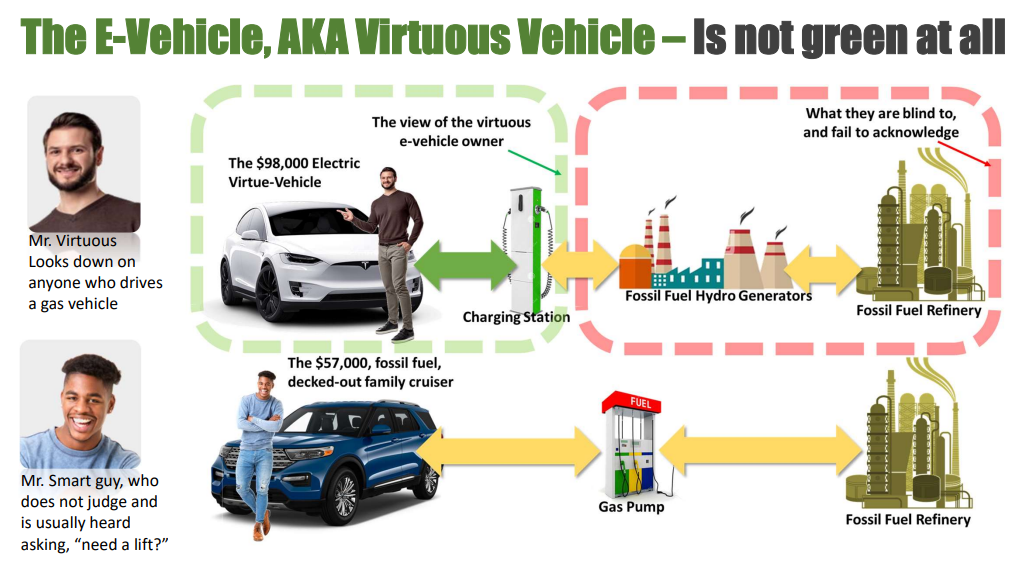
One of the starkest examples of this carbon cash cow in action is the electric vehicle (EV) revolution, often sold as the ultimate virtue signal against fossil fuels. Picture this: The smug $98,000 Tesla owner plugs in at a sleek charging station, basking in eco-halo glow, oblivious to the upstream inferno powering that “clean” juice. Meanwhile, the humble $57,000 gas-guzzling family cruiser fills up transparently at the pump, with its dirty secret right there in plain sight. But as the diagram above illustrates, both paths snake back to the same scorched-earth culprits: Fossil fuel hydroelectric generators belching emissions to electrify the grid, and sprawling refineries churning out the crude that underpins it all. The EV owner sees salvation in silicon and lithium; what they’re blind to—and fail to acknowledge—is that their “green” ride is just a glossy detour through the same polluting pipeline.
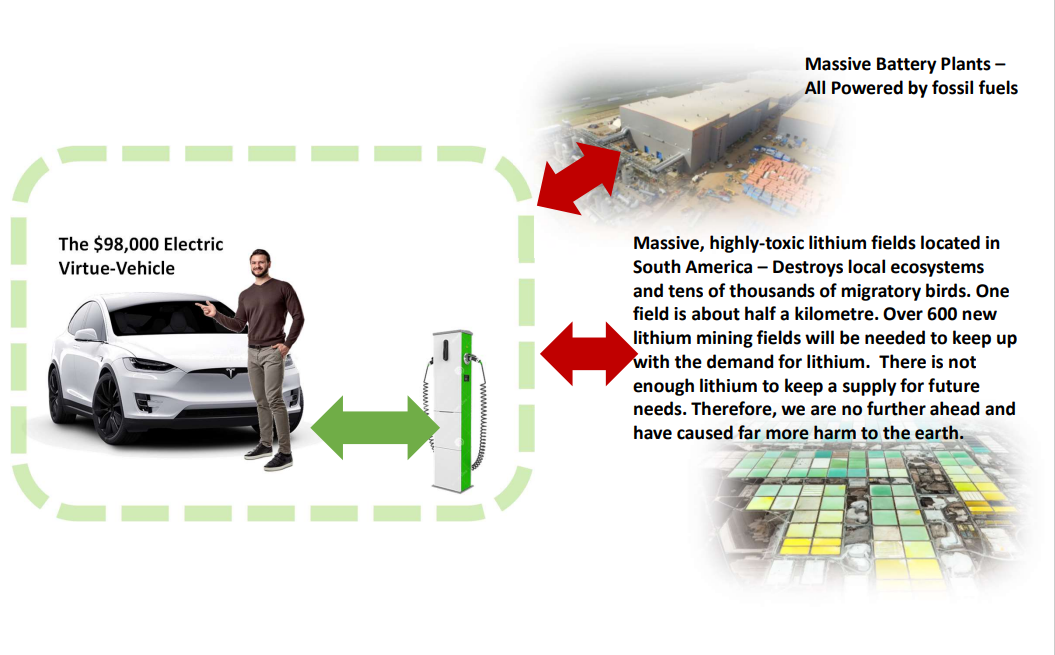
From my dives into those independent articles, the math shreds the myth. Producing a single EV battery devours the equivalent of 500,000 pounds of coal and 300 barrels of oil, spewing around 40 tons of CO2 before the wheels even turn—far outpacing a comparable gas car’s lifetime footprint when you factor in mining’s toll. Those lithium pits in South America’s salt flats? They’re not eco-oases; they’re avian graveyards, slaughtering tens of thousands of migratory birds yearly with toxic runoff and habitat obliteration. And the grid? In coal-heavy regions like parts of the U.S. or China (which dominates EV supply chains), charging your virtue-mobile at night just shifts the smog from tailpipe to smokestack, netting near-zero emissions savings. The slides I pored over hammer it home: Even if every car went electric tomorrow, global CO2 would dip by a laughable 0.00000005%—peanuts next to nature’s 30-billion-ton tree surplus. It’s not reduction; it’s relocation, exporting the filth to poorer nations while Tesla’s stock soars and governments rake in EV subsidies ($500B+ globally in 2025 alone).

This isn’t oversight; it’s engineered illusion, priming the pump for profit. Carbon credits for “zero-emission” fleets? Billions funnelled to battery giants, bloating bureaucracies with compliance jobs while real fixes—like ditching single-use plastics or cleaning battery waste—languish. The virtuous EV buyer foots the bill for a feel-good facade, blind to how it entrenches the very control grid I railed against: Mandated quotas, grid surveillance via smart chargers, and a $16T credits market by 2034 that lines elite pockets. If we’re serious about “being kind to the Earth,” let’s drop the EV emperor’s new clothes and confront the full-cycle filth—no more greenwashing the gray.
Why Carbon Dominates: The Perfect Setup for Profit and PowerCarbon’s edge isn’t just the ledger—it’s baked in. Unlike the gritty tangles of plastic-stuffed seas or chem-soaked streams, carbon’s a dream to pin down: Meter it at factories, cars, even my fridge, and boom—effortless tracking with gadgets and software. That spawns straight-shot cash: Fuel levies, trade auctions, credit swaps that governments tap like a vein. By 2025, these feed monster machines—model grants, factory checks, fine squads, green grease—churning thousands of EPA-style slots, leagues beyond a one-off river crew.
Plus, they’ve branded it the bad guy. BP’s footprint ploy? Not lab work, but ad wizardry, making my coffee run the climate killer and priming guilt for sales. It turns gases into gold: That $16 trillion credit bonanza by 2034? Finance in foliage. The others? Plastics need gritty hauls and plant tweaks—sloppy, manpower-heavy, border-blind. Water links to farms and pipes, where wetland wins mean spotty cops and thin taxes. Recycling? 9% hits reveal the sham, cash lost to dumps over dividends. These hitches keep them low-yield and splintered, relegated to shoestring locals while carbon’s national-global sweep owns the game.
Echoes in the Wild: Other Voices Amplifying My Skepticism
Digging deeper, I’m not alone in this rabbit hole—2025 has been a banner year for similar takes, especially since Trump’s bombshell UN speech last month. On September 23, he torched the whole narrative in a nearly hour-long address, slamming renewables like wind and solar as a “scam” peddled by “stupid people” and vowing to dismantle what he called the “Green New Scam.” Just weeks ago, on October 16, he spiked a UN push for the world’s first global carbon tax on shipping, branding it “taxation without representation” and a ploy to hike energy, food, and fuel costs worldwide—echoing my point on carbon’s baked-in revenue grab. Over on X, the chatter’s electric: Users like
@BGatesIsaPyscho roast the UK’s personal carbon allowance trials as a “digital prison” taxing poverty to “change the weather,” while @liz_churchill10 ties it to COVID’s sequel, warning of carbon trackers morphing into control grids. One post nails the $50 trillion Net Zero tab by 2050, questioning any real temperature drop—like my emissions surplus math, but scaled up to trillions in taxpayer fleecing.
These align spot-on with my view, adding fresh ammo: Carbon capture’s getting slammed as another layer of the grift, with over 100 orgs in May urging Congress to defund its “tax credit scam” that fast-tracks risky pipelines without denting emissions. Podcasts are piling on too—a July 2025 roundup calls renewables a “scam for the rich,” funnelled through fossil-tied talking points to keep the money flowing. And the geoengineering angle? X threads like
@SuePearFL’s highlight chemtrails and solar dimming as the “real behemoth,” sold as climate fixes but really about storm manipulation and control—diverting from actual pollution while carbon taxes pad pockets. Even the White House’s FY 2026 budget axes “Green New Scam” funding, prioritizing “environmental justice” as a preference racket. It’s validation city: My hunch on neglected threats like e-waste? Mirrored in posts decrying the trillion-dollar hoax, dwarfing real cons, with geoengineering as the hidden hand.
My Skeptical Lens: Sidestepping the Math, Cranking the Fear
From where I sit, skeptics nail it: Carbon’s the control-and-cash king, not the cure. Fifty years of flops—no drowned cities, no vanished bears—expose models too dodgy for yesterday’s forecast, let alone policy nukes. True terrors like microplastics in my dinner (a million seabirds down yearly) or e-waste toxins seeping underground? They simmer sidelined, media-starved, ’cause no tidy tax on a tossed phone, no drone for spray drift.
It boils over on the basics: Grill a climate activist on humanity’s climate slice—what percent warming’s on us?—and they swerve. “Consensus!” they cry, but numbers? Crickets, then fury. I remember 2017’s Fox dust-up: Tucker Carlson hit Bill Nye, the “Science Guy,” with “How much is man-made—100%, 74.3%?” Nye barked “100% of recent shifts,” but dodged the digits, exploding into denialist jabs over math. To me, that’s the tell—data’s the foe when it doesn’t fit the fire.
Is This All About Money and Control? My Weigh-In
The proof’s in the pudding: Carbon policies brew endless revenue and red tape, hooking governments and cronies to swell the beast. Plastics, water, e-waste? They’re wrecking balls, but skimpy on state scores—that’s why carbon hogs the mic, even as broader harms scream louder.
I’d bet on a pivot: Wider aims, fresh hooks, tackling the web of woes. But governments and suits? They’re doubling down on carbon’s easy empire, not the hard yards.
Wrapping It Up (in paper bags, of course): Where I Land
My gut check, backed by skeptics, econ stats, and policy guts? Your hunch nails it: Vital as “Earth kindness” is, today’s setup lasers on carbon for the max in cash, grip, gigs, and gravy trains. Other fires? Piecemeal pokes, ’cause they’re tax-tough, coin-clumsy, control-crappy for the bigwigs. Climate’s morphed into a multi-billion global racket—2025’s $1.7 trillion juggernaut per McKinsey—padding topsiders over true tide-turns.
That said, not all grift: Plastics choke a million birds; water starves 2.4 billion; chems foul flows. Grist’s 2025 nods say distrust breeds plots, but carbon crush steals from fixes—real recycling ramps, chem clamps. NASA’s 5% green-up from CO2? That’s Earth’s flex at 0.04% air soup (3% us)—no panic.
Merit? Heaps—80% skeptic ink ties hype to “scam cash/control.” Partial yes: Some suits sweat it (WEF’s 2025 capture tech hope), but greed gears the show. Flashback to ’70s “Crying Indian” spots—litter shame, no surtax. Now? Carbon’s cash cow, but let’s chase batteries, chems, trash for wins sans chains. ETUI’s September 2025 flags slow green as a job-killer—balance it.
Bottom line from me:
Mostly moolah and muscle. Broaden the lens on waste and toxins, and expose the picks. Push fact-fueled care, not doom dough. The planet’s tough, tree math says so!
 marksdeepthoughts.ca
Leave a comment