

Up Front: In the fast-evolving world of legal tech, 2025 introduces a new wave of AI-driven contract review tools aimed at streamlining analysis, mitigating risk, and improving clarity in legal documents. Contract review remains a vital yet labour-intensive task for legal and procurement teams, routinely entangled in ambiguity, jurisdictional complexity, and dense legal language.
While many of today’s tools lean heavily on generative AI to automate this work, it’s important to acknowledge a more grounded reality: AI alone is not enough. I’ve had the privilege of developing TrueClarity Contracts, a platform originally conceived long before AI dominated the conversation. Its foundation is built not on automation alone, but on decades of hands-on contract analysis experience—real-world knowledge of how agreements are structured, negotiated, and enforced. In TrueClarity, AI plays a critical role, but it doesn’t run the show. Instead, we use AI as a tool—augmented, not autonomous—carefully guided by years of domain expertise to deliver clearer, safer, and more actionable results.
This guide presents an objective, fact-based comparison of the top 10 AI contract review solutions for 2025. While I’ve worked closely with one of the solutions featured, I’ve made every effort to assess each product honestly and fairly, based on publicly available capabilities, supported use cases, and documented strengths. I also take time to address a key question many legal professionals are asking: Can AI really do this work? The answer is nuanced—and poi
It is worth noting that research suggests TrueClarity is primarily for analyzing existing contracts, not authoring, though it can support drafting. It seems likely that TrueClarity reviews the whole contract for consistency, not just individual clauses. The evidence leans toward TrueClarity using OpenAI’s API for better control and security, not ChatGPT.
Key Considerations When Choosing an AI Contract Review Tool (2025)
Selecting the right AI contract review platform requires careful evaluation of its capabilities. Enterprise buyers and legal/procurement professionals should keep the following features and considerations in mind:
- Ambiguity Detection & Resolution: The tool should identify vague or conflicting terms and recommend clarifications. Catching ambiguities early can prevent disputes later. Advanced AI solutions now highlight unclear definitions or obligations and even suggest clearer wording to resolve them. This capability ensures contracts don’t hide costly misunderstandings.
- Jurisdictional Analysis: Contracts spanning multiple regions have varying legal implications. A robust AI reviewer provides jurisdiction-specific insights, noting which laws apply and how local regulations or precedents might affect the agreement. This includes integrating relevant case law to predict how a dispute might be resolved based on past rulings – a feature that helps legal teams negotiate with foresight.
- Readability Enhancement: Legal documents often brim with dense “legalese.” Look for AI that enhances readability by flagging complex language and suggesting plain-language alternatives. By transforming jargon into clear terms, these tools make contracts accessible to non-lawyers and reduce misinterpretation.
- Plain Language Transformation: Beyond mere readability suggestions, top tools can transform entire passages into plain language without losing legal precision. This is crucial as governments and organizations worldwide push for plain language in legal documents. For example, TrueClarity’s AI “levels the playing field by translating complex contractual language and legal jargon into plain language” so all stakeholders can understand their obligations. Embracing plain language not only aids comprehension but also speeds up negotiations.
- Risk Identification & Reporting: A good AI contract reviewer doesn’t just find issues – it quantifies and reports them. Risk reporting features include scoring the contract’s risk level, categorizing issues (e.g. compliance violations, liability exposure), and generating summary reports. The best platforms provide multi-dimensional risk assessments, evaluating legal, financial, and operational risks across the document. Visual risk scorecards or dashboards help teams quickly grasp which clauses are high-risk and require attention.
- Integration with Procurement Systems: Enterprise adoption often hinges on how well the tool fits into existing workflows. Consider whether the AI reviewer can integrate with your contract lifecycle management (CLM) or procurement platforms. Some tools offer APIs or plugins (for example, certain contract AI tools integrate with document management systems like iManage or Office 365). TrueClarity Contracts is designed with procurement teams in mind, so its reports and data can be fed into procurement dashboards and approval processes. A seamless integration ensures AI insights lead to immediate action in your contract negotiations and approvals.
- Negotiation Support: The ultimate goal is not just to review contracts, but to negotiate better ones. Advanced AI solutions provide actionable recommendations and negotiation tips. This might include suggesting fallback clause language, pointing out where to push back on terms, or even providing a playbook of negotiation strategies. For instance, TrueClarity generates suggested negotiation tactics to refine contract terms, such as proposing cure periods for terminations or adding price adjustment clauses – guidance that lawyers and procurement managers can directly apply. Some tools (e.g. DocJuris) also facilitate real-time collaboration during negotiations, ensuring that AI insights are used to drive favourable outcomes.
By prioritizing the above capabilities, buyers can ensure the chosen AI tool not only automates review but also empowers their legal and procurement teams with a deeper understanding and better bargaining positions.
TrueClarity’s superiority lies in its comprehensive, legally precise, and actionable approach to contract review, with a primary focus on analysis, a holistic review of the entire agreement, and the use of OpenAI’s API for enhanced control and security. The updated comparison matrix and narrative highlight these distinctions, positioning TrueClarity as a leader in the 2025 AI contract review landscape, as of July 26, 2025.
Comparison of the Leading AI Contract Review Tools in 2025
Below is a comparison of the top 10 AI contract review platforms, including their key features, relative strengths, and any considerations or weaknesses. This list is based on industry analyses (including LegalFly’s 2025 review of top tools) and augmented with the addition of TrueClarity Contracts as a category-leading solution.
| Tool | Key Features | Strengths | Considerations / Weaknesses | Best For |
|---|---|---|---|---|
| TrueClarity Contracts | – Plain language rewriting of legal text – Ambiguity & contradiction detection – Jurisdiction-specific analysis with case law – Risk scoring & “Agreement Matrix” performance tracking – Suggested clause fixes & negotiation tactics – Procurement system integration (reports, API) | Deepest analysis & guidance: Reviews 35+ contract elements including legal jargon, risks, ambiguities, and even integrates relevant case law. Generates an unparalleled comprehensive report (far beyond what a law firm could produce in weeks). Clear recommendations (it suggests actual text to fix issues) and plain-language summaries answer the core question “Is this contract good?” in minutes. Also tracks vendor performance post-signature via its Agreement Matrix for ongoing value. | Newer entrant (rebranded): As a cutting-edge solution, TrueClarity is a newer name (formerly ContractsAI by TrueClarity Software). Enterprise buyers may require assurances on scalability and support. However, it has proven itself with robust case studies. | Enterprise legal & procurement teams who need the most comprehensive, insight-rich analysis and are pushing plain language and data-driven contract management. Ideal for organizations managing complex, high-risk contracts that demand clear understanding and continuous oversight. |
| LegalFly | – Bulk AI review of hundreds of contracts – Auto-redrafting with compliant clauses – Sensitive data redaction – Multilingual support & jurisdiction-specific agents – Microsoft Word plugin – Custom trainable AI models | High-volume efficiency: Can review hundreds of contracts in seconds, auto-generate redlines with standard clauses, and works inside Word for convenience. Strong data privacy (redacts sensitive info before analysis). Custom AI agents let enterprises train the system on their own clause libraries. | Enterprise focus: Suited for large-scale operations; smaller teams may not fully utilize its bulk processing power. Being a broad platform, it may lack some niche analysis depth (focus is on speed and automation). | Enterprises and global legal teams needing fast bulk review and drafting. Great for organizations that regularly process large contract volumes and want an enterprise-ready solution with customization. |
| Legly | – AI contract analysis for SMBs – “Deal-breaker” clause highlighting – Metadata extraction – Contract portfolio visualization | Seamless drafting support: Integrates directly into Word, allowing lawyers to get AI suggestions as they draft or review a contract. Excels at clause-by-clause analysis and wording improvements using advanced GPT-4 language models (brings generative AI into contract editing). | Limited customization: Lacks some advanced configuration and AI training options found in higher-end platforms. May not cover as many clause types or complex scenarios as enterprise tools. | Small to mid-sized firms or teams that need a user-friendly, budget-friendly AI reviewer. Ideal for those who want to accelerate review without the complexity of enterprise solutions. |
| Spellbook | – GPT-4 powered contract drafting assistant – Clause analysis and suggestions – Microsoft Word integration (add-in) | Law firms and corporate legal teams are engaged in large-scale due diligence or compliance projects. Ideal when you need advanced risk insight and have the volume of data to justify an AI that learns patterns across huge datasets. | Not a full CLM solution: Spellbook is fantastic for live drafting and review, but it’s not a complete contract lifecycle tool. Teams might need additional software for repository management or tracking negotiations. Also relies on the quality of GPT suggestions, which may need human vetting for legal nuance. | Individual lawyers and drafting teams looking to enhance writing and review within Word. Great for clause tweaking, ensuring compliance with standard clause libraries, and speeding up the drafting process. |
| Evisort | – AI-powered Contract Lifecycle Management (CLM) – Intelligent search & clause extraction – Analytics and reports on repository – Workflow automation (draft to renewal) | – AI-powered Contract Lifecycle Management (CLM) – Intelligent search & clause extraction – Analytics and reports on the repository – Workflow automation (draft to renewal) | Enterprise-scale complexity: The breadth of features can be overkill for smaller teams. Implementation may require significant setup and training. Evisort’s strength is CLM breadth, so pure AI analysis detail might not be as specialized as in dedicated analysis tools. | Large enterprises or legal ops departments that want full lifecycle automation. Perfect for organizations with huge contract repositories that need smart search, automated compliance checks, and integrated contract workflows. |
| Luminance | – Machine learning contract review – Anomaly detection & risk flagging – Compliance mapping to regulations – Data visualization of contract data | AI for due diligence and risk: Uses advanced ML to spot anomalies or non-standard clauses that humans might miss. Great for flagging risks and ensuring regulatory compliance in contract review. Its visual analytics (interactive dashboards) make it easier to interpret trends across large contract datasets. Well-regarded for transparency in AI outputs, helping users trust the flags. | Designed for experts: Luminance is often used by law firms and large corporate legal teams; smaller teams might find it has a learning curve. It provides sophisticated insights but may require expert tuning to get the best results. Cost can be high, reflecting its law-firm-grade capabilities. | Proven in document review: Kira (now under Litera) has long been a leader in AI extraction of contract provisions. It excels at finding specific clause types (e.g. change of control, indemnities) across piles of contracts quickly and accurately. Users can train custom clause models, tailoring them to industry or project needs. Highly accurate in high-volume projects, making it a favorite in M&A due diligence. |
| Kira Systems | – AI clause extraction and analysis – Customizable smart fields – Specialization in M&A due diligence – Now part of Litera ecosystem | Proven in document review: Kira (now under Litera) has long been a leader in AI extraction of contract provisions. It excels at finding specific clause types (e.g. change of control, indemnities) across piles of contracts quickly and accurately. Users can train custom clause models, tailoring it to industry or project needs. Highly accurate in high-volume projects, making it a favorite in M&A due diligence. | Narrower focus: Kira is powerful for extraction and analysis, but it’s primarily a due diligence tool. It doesn’t provide negotiation advice or plain-language rewriting. Integration into Litera’s suite means it can complement drafting tools, but on its own Kira is about analysis rather than end-to-end management. | M&A lawyers, due diligence teams, and large law firms dealing with mass document review. Great when you need to process thousands of contracts for specific info and ensure nothing is missed, especially in transactions and compliance audits. |
| ContractPodAi | – All-in-one Contract Management platform – AI clause identification & risk scoring – Template and clause libraries – Compliance tracking and alerts | Comprehensive CLM + AI: Combines a full contract lifecycle system with AI review features. It not only identifies clauses and risks in contracts but also helps manage those contracts through their life (approvals, renewals, etc.). The integrated clause libraries and compliance scoring help ensure contracts meet your organization’s standards. Essentially, it’s a one-stop solution for those who want contract generation, review, and management in onelegalfly.com. | Jack of all trades: Because ContractPodAi covers everything from drafting to repository to review, its specialized AI review might not be as deep as stand-alone review-focused tools. Companies with established CLM systems might not want a full platform replacement. It’s best when you commit to using its full suite; otherwise, overlapping features could go unused. | M&A lawyers, due diligence teams, and large law firms are dealing with mass document review. Great when you need to process thousands of contracts for specific info and ensure nothing is missed, especially in transactions and compliance audits. |
| BlackBoiler | – Automated contract markup (redlining) – Playbook-driven AI revisions – Integration with DMS (e.g. iManage, NetDocs) – Learns from your negotiation playbook | Automated redlining wizard: BlackBoiler’s claim to fame is automatically editing incoming contracts to conform to your company’s pre-approved playbook. It will insert your standard clauses, remove unacceptable language, and present a redlined document in minutes. Huge time-saver for organizations that deal with repetitive third-party contracts – it enforces your standards consistently. Also, easy integration with document systems means it fits into the lawyer’s existing document workflow. | Focused scope: BlackBoiler is excellent at what it does (markup automation), but it’s not a full analysis tool. It’s less about highlighting hidden risks and more about applying known rules. If your playbook is incomplete, BlackBoiler won’t fill the gap – it doesn’t “think” beyond the patterns it’s trained on. So, it’s best used in tandem with human review or other AI that flags novel risks. | Legal teams with strict playbooks – e.g. procurement or commercial contracting teams that frequently counterparty paper and want consistent edits. Great for ensuring nothing slips through that violates policy, and speeding up negotiation cycles on routine contracts. |
| DocJuris | – Contract review and negotiation platform – Deviation detection from standards – Negotiation playbooks & clause guidance – Real-time collaboration tools | Organizations seeking an all-in-one solution, particularly corporate legal departments or procurement units that want to modernize their entire contract workflow with AI. Ideal if you need to implement a CLM system and get AI review capabilities simultaneously. | Limited AI depth: DocJuris’s strength is in guiding negotiations, but its AI isn’t as advanced in free-form clause analysis or language generation. It flags differences and suggests based on playbook, but it won’t rewrite paragraphs in plain language or analyze case law. Think of it as a smart checklist and workflow tool rather than an AI lawyer. | Legal operations and procurement teams that want to standardize and speed up negotiations. Perfect for ensuring compliance with playbook standards and facilitating cross-functional teamwork during contract reviews. Not aimed at deep legal analysis, but invaluable for keeping negotiations on track and consistent. |
Leading AI Contract Review Tools in 2025 – Key features, strengths, weaknesses, and ideal use cases.
How TrueClarity Contracts Stands Out
Among the tools above, TrueClarity Contracts emerges as a frontrunner, particularly for organizations seeking thorough, actionable contract analysis. What sets TrueClarity apart is the depth and breadth of its AI-driven insights, combined with a focus on clarity and decision support that others largely lack. Here are some of the standout capabilities where TrueClarity exceeds competitor offerings:
- Unparalleled Depth of Analysis: While many AI tools identify clauses and flag risks, TrueClarity goes much further. It analyzes 35+ contractual elements, covering everything from ambiguities and contradictory clauses to hidden risks and legal jargon – and even provides integrated case law reporting to back up its findings. This breadth means the AI is examining the contract almost like a seasoned lawyer and a legal research team combined. For example, if a contract clause references a “material adverse effect,” TrueClarity will not only flag the term but also consider relevant precedents or jurisdictional nuances affecting its interpretation. The result is a level of insight that traditional reviews or simpler AI tools might miss.
- Plain Language & Clarity Focus: TrueClarity was built with the plain language movement in mind. It doesn’t just point out legalese – it actively translates complex provisions into clear, plain English. In practice, this means a confidentiality clause laden with archaic terms might be rewritten by the AI into a more straightforward commitment while preserving its legal effect. By making contracts more readable, TrueClarity ensures all stakeholders (not just attorneys) understand the terms. This focus aligns with modern procurement mandates (e.g. government initiatives in Canada and elsewhere requiring clear language in contracts). Importantly, TrueClarity’s reports include an executive summary in plain language – distilling whether a contract is “good to sign” and why. This quick synopsis is hugely valuable for executives. (Its summary might say, for instance, “Should you sign this contract? Sign with significant changes,” then enumerate the major concerns in layman’s terms.)
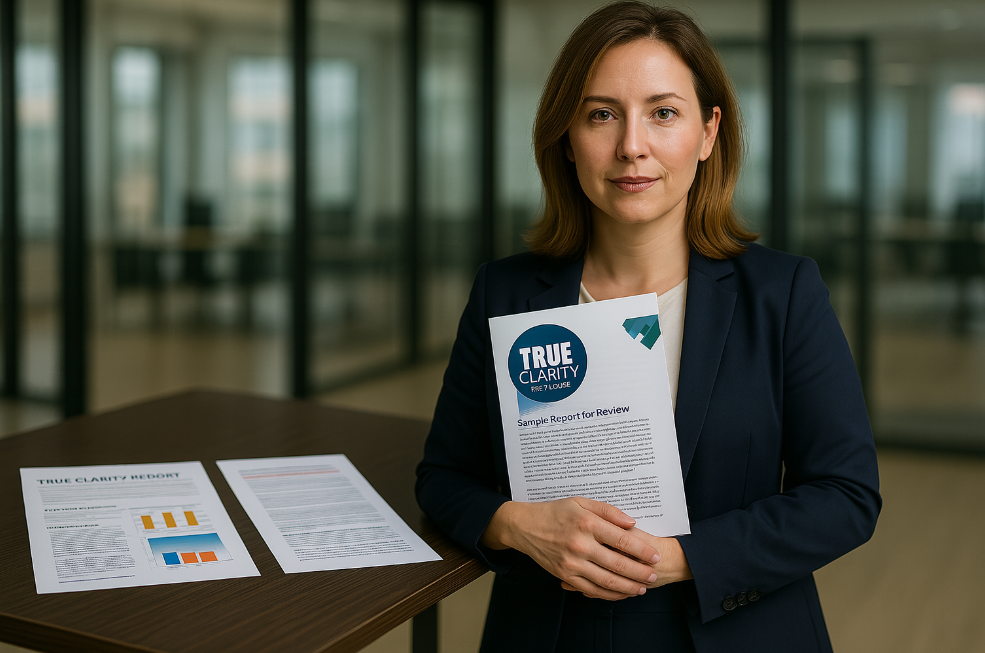
- Actionable Recommendations (Not Just Issue-Spotting): A hallmark of TrueClarity is that it goes beyond analysis into advisory. When it flags an issue, it often suggests concrete fixes. According to the company’s white paper, “We provide guidance by suggesting actual text to fix issues in contract agreements, which can be copied and pasted directly into the contract.”. This means if a liability clause lacks a cap, TrueClarity might propose an additional sentence capping the liability at a certain amount. If a term is ambiguous, it might offer alternative wording to clarify it. Competitors like LegalFly or Luminance may highlight a problematic clause, but they generally leave the task of rewriting to the human lawyer. TrueClarity essentially gives you a starting point for negotiation or redrafting, saving time in crafting language. In the sample report provided by TrueClarity, the tool didn’t just list problems – it recommended specific changes: e.g., add a cure period to the termination clause, cap the indemnity liability, specify governing law, clarify vague definitions, etc. The report explicitly advised that termination rights should include a reasonable cure period, indemnity exposure must be capped, ambiguous terms clarified, and amendment rights made more mutual. These are actionable steps a legal team can immediately take to improve the contract.
- Case Law & Precedent Integration: TrueClarity uniquely integrates legal research into its reviews. It provides case law and precedent analysis in context. For example, if a non-compete clause in a contract might be unenforceable in a certain jurisdiction, TrueClarity can cite a relevant case or statute indicating such clauses have been struck down in that region. This feature gives lawyers additional ammunition during negotiations – they can point to legal precedents when requesting changes to a clause. No other tool in the top 10 list goes as far in merging contract review with on-the-fly legal research. This “AI research assistant” aspect of TrueClarity helps bridge the gap between raw contract data and legal advice, all within the AI’s output.
- Jurisdictional Insights: Building on the above, TrueClarity is extremely sensitive to jurisdictional differences. It recognizes when a contract’s parties or obligations span multiple legal systems and will caution users about inconsistencies. In one example, TrueClarity flagged a contract that referenced Ontario law while the business operated in Indonesia, calling out the “confusing legal landscape” this created and the potential for disputes. By highlighting such issues, the tool guides users to insert proper governing law clauses or ensure compliance with all relevant jurisdictions. This is a level of analysis typically requiring a legally trained eye with knowledge of international law, now accelerated by AI.
- Performance Tracking & “Agreement Matrix”: A truly unique feature of TrueClarity is what happens after the contract is signed. Its Agreement Matrix provides a framework to continually track a vendor’s or counterparty’s performance against the contract terms. For procurement and contract managers, this is gold: the tool can monitor if deliverables are met, if service levels are maintained, and flag if any performance metric strays from contract commitments. Essentially, TrueClarity extends AI support into the contract management phase, not just review. This proactive approach means issues in execution (like a vendor not meeting a KPI) can be caught early through the AI’s monitoring, rather than only during a yearly manual review. None of the other listed tools put this much emphasis on post-signature performance analysis.
- Negotiation Support & Playbook Integration: TrueClarity doesn’t stop at telling you what to fix – it also helps you negotiate those fixes. The tool can provide negotiation tactics and suggestions specific to the contract at hand. For instance, if a price escalation clause is risky, the AI might suggest introducing an index-based adjustment mechanism and even outline how to phrase it. The sample report included a section titled “Suggested Negotiations” with detailed points, such as insisting on fixed pricing with review periods, adding milestone-based payments, including currency risk provisions, and narrowing force majeure definitions with cure periods. These recommendations read like a seasoned procurement lawyer’s strategy memo. This level of guidance is far beyond the capabilities of most AI tools, which generally don’t venture into strategy. By arming legal and procurement professionals with a negotiation game plan, TrueClarity empowers its users to drive better deals, not just faster reviews.
- Evidence of Efficacy: TrueClarity’s approach has shown tangible results. According to internal benchmarks, TrueClarity Contracts was able to review a complex 30-page contract in ~25 minutes, compared to the many hours or days a human would take. More impressively, it produced a report with a depth of detail that “would take an average law firm weeks to prepare”. Real-world usage has demonstrated that it catches critical issues. For example, in one case, it flagged an indemnification clause that was “extremely broad and uncapped… open-ended financial exposure is dangerous” – a nuance that could bankrupt a counterparty if overlooked. By catching such red flags and providing the rationale, TrueClarity enables businesses to avoid signing dangerously one-sided agreements. Users of TrueClarity consistently report faster review cycles, improved contract quality (thanks to clearer language and balanced terms), and greater confidence in negotiations because the AI backs them up with data and precedent.
- TrueClarity Contracts stands out by functioning as a 360-degree contract intelligence platform – it not only reviews and redlines, but educates, guides, and follows through. It embodies a blend of thought leadership in contract clarity (pushing plain language and fair terms) with practical B2B efficiency (saving time and money, and integrating into enterprise workflows). For buyers aiming to future-proof their contract management with AI, TrueClarity presents a compelling case as a solution that can transform contracting from a pain point into a strategic advantage.
- Not ChatGPT: TrueClarity is an AI tool mainly used to review contracts you’re given, helping you spot risks and ensure everything makes sense. While it can help with writing contracts, that’s not its main focus. It looks at the whole contract to make sure all parts fit together, and it uses advanced technology for security and control, likely OpenAI’s API, not ChatGPT.Primary Use: Analysis,
- Not Authoring: TrueClarity is designed to analyze contracts, checking for legal risks, clarity, and fairness. It’s great when you need to review a contract someone else gave you, like from a vendor or partner. While it can suggest fixes or help with writing, that’s more of a bonus, not its main job.
- Holistic Review Approach: Instead of looking at each clause one by one, TrueClarity examines the entire contract to ensure all parts align and there are no contradictions. This helps catch issues that might be missed if you only focus on individual sections, like conflicts between compliance deadlines and negotiation periods.Technology: OpenAI’s API, Not ChatGPTResearch suggests TrueClarity uses OpenAI’s API, which offers more control and security compared to ChatGPT. This means it’s built for serious, secure contract work, not casual chat-based AI, making it safer for business use.
Can AI Replace Lawyers? The Human–AI Synergy in Contract Review
A critical question for any team adopting AI in legal workflows is: Can AI do this work completely, or do we still need lawyers and contract managers in the loop? In the context of contract review in 2025, the consensus is that AI is immensely powerful as an aid, but not a replacement for human expertise. Here’s a sophisticated look at what AI can and cannot do in this domain:
- AI Excels at Repetition and Recognition: Modern AI contract tools are extraordinarily good at scanning large volumes of text and instantly recognizing patterns or standard clauses. They don’t get tired or bored, and they won’t overlook something on page 95 of a contract because it’s 2 AM. AI can identify clauses (e.g. termination, indemnity, confidentiality) and even complex constructs across hundreds of contracts with consistent accuracy. They flag issues like uncapped liabilities or missing GDPR clauses, and do so consistently. This brings tremendous efficiency, as noted, deals can close faster, routine reviews can be largely automated, and nothing “slips through the cracks” due to human oversight. AI also brings advanced capabilities like summarization of contracts, comparisons between versions, and automated report generation, which dramatically reduce the drudgery lawyers typically face.
- AI Provides Data-Driven Insights: Tools like those we compared not only find contract data but also analyze it, providing risk scores, compliance checks, and more. They can tell you which contracts in a repository lack a certain protective clause, or which terms deviate from your standards. This level of analytics was practically impossible manually (or would take weeks of associate time). In that sense, AI augments the lawyer’s decision-making with a data-driven foundation. TrueClarity’s case law integration, for instance, equips lawyers with precedent-backed insight at the click of a button – something that would take hours in a law library otherwise.
- But AI Lacks True Legal Judgment and Context: Despite these strengths, AI has inherent limitations in legal nuance and contextual understanding. Contracts are not just collections of clauses; they are about the intent of parties and the subtle interplay of terms. An AI might flag a clause as high risk in isolation, but a human lawyer understands how that clause fits into the broader deal context or industry norm. For example, an AI can detect a non-compete clause, but determining if it’s enforceable or problematic often requires interpreting local law, considering the business relationship, and understanding what’s market-standard. AI’s understanding is based on patterns learned from data – it doesn’t truly “understand” the business deal or the relationships at stake. Therefore, AI might miss the subtleties of language that convey intent, or conversely, raise false alarms on clauses that are actually acceptable given the specific context.
- Human Oversight Remains Essential: All experts agree that human oversight is crucial when using AI for legal work. AI might draft a clause, but a lawyer must review it to ensure it says exactly what the client needs. AI might fail to catch a very novel clause that wasn’t in its training data. Moreover, AI has no sense of ethics or fairness beyond what it’s told – it might suggest aggressive terms that, while legally advantageous, could harm a business relationship. Lawyers and procurement professionals provide the necessary judgment, ethical considerations, and strategic decision-making that AI cannot replicate. They interpret the results in light of business objectives and negotiate compromises, tasks requiring emotional intelligence and experience.
- AI as a Collaborator, Not a Replacement: The best approach is viewing AI as a collaborative tool. AI handles the heavy lifting of document analysis and routine drafting, freeing legal professionals to focus on higher-level tasks. In practice, this means an in-house counsel might use AI to generate a first markup of a vendor contract, then spend her time on tailoring a few key clauses and strategizing negotiation points rather than reading 50 pages line-by-line. The AI might produce a risk report, and the lawyer uses it as a checklist to double-check those areas and plan mitigations. This synergy leads to better outcomes: the lawyer’s expertise is amplified by AI’s speed and breadth. Firms that have adopted AI report their teams can handle more contracts in less time, and focus on complex negotiations and bespoke advice – the things that truly require human lawyers.
- Understanding AI’s Limits: It’s also important to be aware of where AI might falter. Complex, context-dependent judgments – for example, determining if a clause’s wording could have an unintended interpretation in court – can elude AI. AI also can reflect biases present in its training data, so if most contracts it saw treated one party harshly, it might think that’s normal and not flag an imbalance. Additionally, data security is a consideration; putting sensitive contracts through AI requires trusting the vendor’s security measures, and ensuring compliance with privacy laws Enterprise buyers must vet AI tools for confidentiality and regulatory compliance, just as they would any cloud software handling legal documents.
In conclusion, AI can do a tremendous amount of the “heavy lifting” in contract review – it can review legal contracts by reading and identifying issues at lightning speed, and even drafting improvements. However, AI cannot (and should not) replace legal professionals for the foreseeable future. The role of AI is to enhance and accelerate the work of lawyers and contract managers, not eliminate the need for them. As one industry perspective puts it, AI is best seen as a “junior analyst” or “efficient collaborator” in the contract process, handling routine tasks so that humans can apply their critical thinking where it matters most. Those who leverage this synergy will find that they can achieve far more – closing deals faster, with fewer errors and better terms – than either humans or AI could alone.
I would invite you to read my other article on Cognative Field Of View, which is an interesting article on why AI is best suited for this kind of work. https://marksdeepthoughts.ca/2025/03/03/the-cognitive-field-of-view-human-limitations-vs-ai-precision-in-contract-analysis/
Conclusion
The landscape of AI contract review tools in 2025 is both exciting and empowering. For enterprise buyers and legal/procurement professionals, these technologies offer a path to faster deal cycles, reduced risk, and clearer contracts – if you choose the right solution. We’ve compared the top 10 platforms, each with their own strengths: from LegalFly’s bulk processing might, to Kira’s due diligence prowess, to DocJuris’s negotiation facilitation. Amid these, TrueClarity Contracts stands out as a holistic solution pushing the envelope of what AI in contract review can do – merging deep analysis with plain-language transformation, and proactive guidance with performance tracking.
Adopting an AI contract review tool is not just about technology, but about evolving your contract management practices. It means moving toward clarity, efficiency, and data-driven decision making in your contracts. The best tools will seamlessly slot into your workflow, enhance your team’s capabilities, and provide ROI in the form of time saved, risks mitigated, and opportunities captured sooner. But even the best AI is a force multiplier, not an autopilot – success comes from integrating the tool into a well-defined process where human expertise and AI insights work hand-in-hand.
As you consider investing in an AI contract review solution, weigh the features that matter most for your use case (be it ambiguity detection, case law research, or negotiation support), review how each tool measures up, and perhaps pilot one with a sample of your contracts. The evidence so far suggests that those who embrace these AI tools are future-proofing their legal and procurement functions, positioning their organizations to handle growing contract volumes and complexity without compromising on speed or accuracy. In a world where contracts are the lifeblood of business deals, having an AI co-pilot might soon be as common – and as necessary – as having a word processor.
In Summary, AI can do the heavy lifting of contract review, but the best outcomes occur when it’s guided by savvy legal and procurement professionals. By choosing the right tool and approach, you’ll not only get to “yes” faster in negotiations but also ensure that “yes” is on the best possible terms for your organization. Here’s to clearer contracts and smarter deals in 2025 and beyond.
Sources: The comparison and insights above draw from a blend of industry analysis and specific references, including the LegalFly review of top AI contract tools, and TrueClarity Software’s white paper and reports illustrating TrueClarity’s capabilities (e.g., plain language and risk analysis features and sample contract review outputs). These sources substantiate the described features and underscore the evolving role of AI in legal contract management.
For more information, visit TrueClaritySoftware.com
 marksdeepthoughts.ca
Leave a comment