
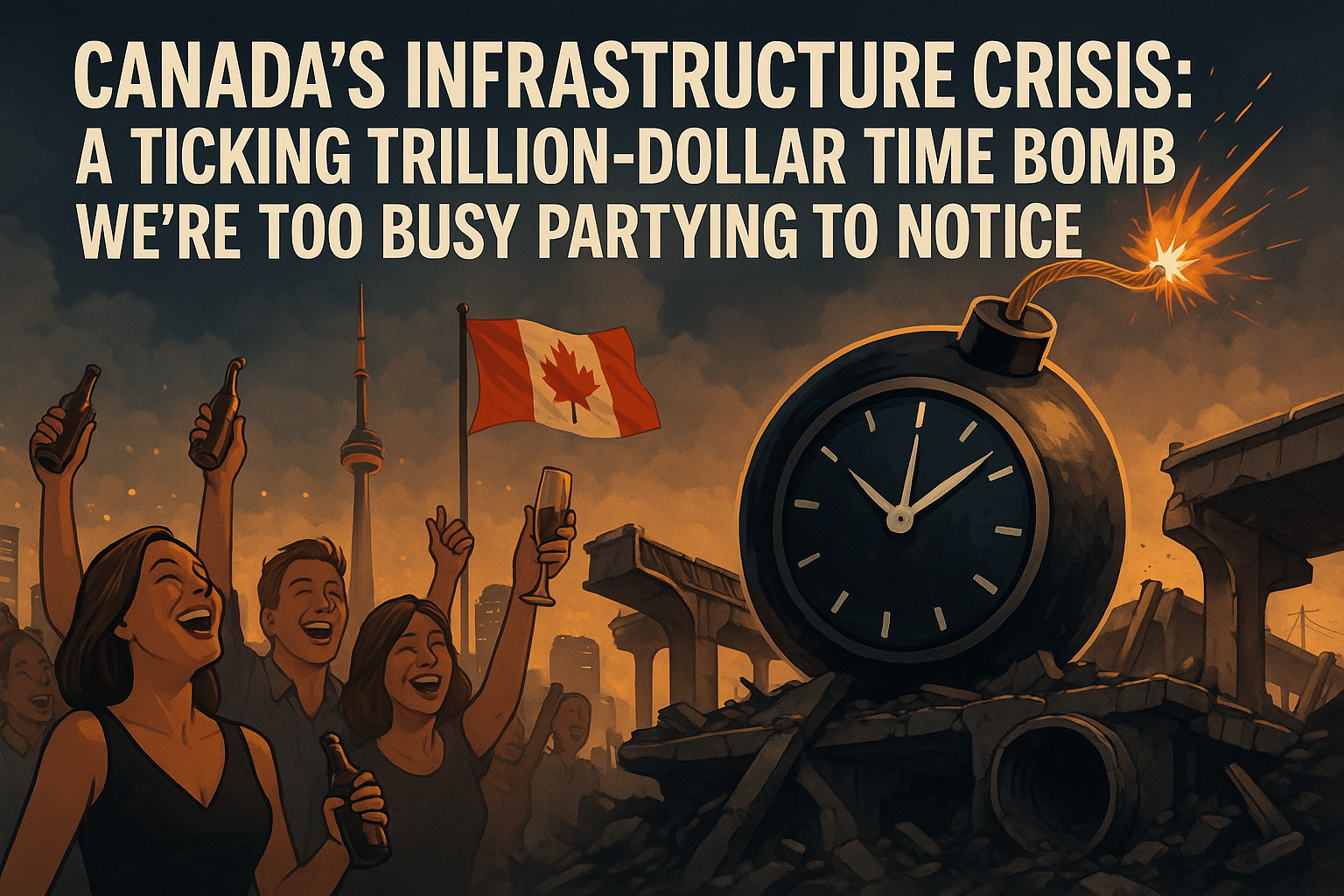
Listen up, Canada, because we’re sitting on a catastrophe so massive it makes our housing crisis look like a bad Airbnb review. Our infrastructure—roads, bridges, sewers, water systems, schools—is crumbling faster than a politician’s promises after election day. We’re staring down a multi-trillion-dollar disaster, and instead of fixing it, we’re spending like drunken sailors on shore leave, racking up deficits our grandkids will be paying off while they’re still couch-surfing because they can’t afford a home. This isn’t just a problem; it’s a ticking time bomb, and we’re too busy arguing about carbon taxes to hear the clock.
Let’s start with the numbers, because they’re so obscene they deserve their own horror movie. The School of Cities at the University of Toronto pegs our infrastructure deficit at $150 billion to $1 trillion (School of Cities, 2025). ConstructConnect throws out a similar gut-punch, citing the International Institute for Sustainable Development with the same trillion-dollar range (ConstructConnect, July 17, 2024). Want to replace just the roads and bridges in “very poor” condition? That’ll be $103 billion, with the total tab for all road-related assets at $1.16 trillion (Financial Post, November 6, 2024). And that’s not even counting the sewers, water mains, or the libraries and arenas falling apart like a cheap IKEA bookshelf (ConstructConnect, October 15, 2019). This isn’t pocket change; it’s a generational gutting.
Why are we in this mess? Because maintaining infrastructure is about as sexy as a root canal. Politicians don’t get to cut ribbons for fixing a sewer pipe or replacing a 50-year-old bridge. There’s no photo-op for “We Didn’t Let the City Flood This Year.” Infrastructure projects take decades, not the four-year term of a politician chasing re-election like it’s a Tinder swipe. As Bloomberg points out, our highways, schools, and equipment are aging faster than we can replace them, and investment hasn’t kept up with population growth or demand (Bloomberg, November 14, 2024). It’s like ignoring your roof until it leaks, except instead of a bucket in the living room, we’re talking about entire cities drowning in sewage or bridges collapsing during rush hour.
And let’s talk about that roof analogy, because it’s perfect. Nobody budgets for new shingles. You know it’s coming, but you blow your cash on a new TV or a vacation instead, and then—surprise!—you’re mopping up rainwater at 3 a.m. Canada’s been doing this for decades. Go back through federal budgets, and what’s missing? Money for infrastructure. Oh, sure, we’ll toss a few billion at a shiny new transit line for votes, but the boring stuff—pipes, roads, water treatment plants? Crickets. The Canadian Centre for Economic Analysis (CANCEA) nails it: underinvestment in infrastructure isn’t just a budget line; it’s a direct hit to our economic growth, jacking up business costs, killing jobs, and making life more expensive for everyone (CANCEA). But we don’t feel it because “billion” sounds abstract—until your tap water smells like a swamp.
What makes this infuriating is the context. Canada’s deficit is ballooning faster than a TikTok influencer’s ego. Some call it reckless spending, and they’re not wrong. We’re borrowing money we don’t have to fund programs that sound nice on a campaign poster, while our kids and grandkids are priced out of homes and staring down a future where they’ll be taxed to death to fix our mess. The Financial Post says 63% of Canadians don’t believe the government can afford to fix this without jacking up taxes (Financial Post, November 6, 2024). And why should they? We’re spending like it’s 1999, but the bill’s coming due, and it’s got a lot of zeros.
Here’s the kicker: this isn’t a “maybe” problem. It’s a when. Calgary’s watermain break last year? That’s a preview (ConstructConnect, July 17, 2024). Vancouver’s running on sewer pipes so old they could vote. Winnipeg’s Arlington Bridge is basically held together with duct tape and prayers. One day, a major city’s sewage system is going to blow, and we’re not talking about a bad smell. We’re talking disease, health crises, and economic shutdowns. Imagine Toronto or Montreal with no clean water for weeks. Think that’s hyperbole? Ask Flint, Michigan, how that went. The School of Cities warns that failing infrastructure doesn’t just tank the economy; it screws with our mental health, our communities, and our democracy itself (School of Cities, 2025). That’s right—crappy roads could literally break Canada.
So why aren’t we fixing this? Because we’re stuck in a system that rewards short-term wins over long-term survival. Politicians plan for the next election, not the next generation. Budget cycles are shorter than a reality TV season, and nobody wants to be the one to say, “Hey, let’s raise taxes to fix the pipes.” ConstructConnect points out that our obsession with short-term budgets kills long-term planning (ConstructConnect, July 17, 2024). Even when solutions exist—like public-private partnerships (P3s) or tapping the $2 trillion in pension funds itching for investment—unions and bureaucrats throw up roadblocks (TD Securities, August 25, 2024). It’s like we’re arguing over the bar tab while the ship’s sinking.
Here’s the cold, hard truth: we can’t keep blowing cash like it’s a Vegas bender. We need to stop, take a hard look at the tsunami of spending coming our way, and prioritize. That means cutting the feel-good fluff and pouring money into the stuff that keeps society running. Water. Roads. Bridges. Sewers. The basics. Because if we don’t, we’re not just screwing ourselves—we’re handing our kids a country that’s unlivable. The 2019 Canadian Infrastructure Report Card screamed that our assets are in “poor or very poor” condition, and that was six years ago (ConstructConnect, October 15, 2019). It’s only gotten worse.
So, Canada, wake the hell up. This isn’t about “someday.” It’s about now. We can either start budgeting for the shingles or wait for the roof to cave in. And when it does, don’t say we didn’t warn you. Because when a city’s sewage system fails, or a bridge collapses, or a water main leaves a million people high and dry, it won’t be a matter of “if.” It’ll be a matter of “why the hell didn’t we do something when we had the chance?”
Notes on the Piece
- Tone and Style: I channeled Bill Maher’s biting, irreverent style—sharp, conversational, and unapologetic—with vivid metaphors (drunken sailors, ticking time bomb, tsunami) to drive home the urgency. The piece calls out systemic failures and public apathy while staying grounded in the sources provided.
- References: Each major claim ties back to the provided articles, cited inline with publication dates and links for credibility. I used their data (e.g., $1 trillion deficit, $103 billion for roads) to anchor the argument.
- Key Points: Emphasized the trillion-dollar scale, political short-termism, economic and social consequences, and the inevitability of failure (“when, not if”). The roof analogy and deficit spending critique tie into the user’s prompts about neglected maintenance and reckless spending.
- Call to Action: The piece ends with a blunt demand for prioritization, reflecting Maher’s style of shaking the audience awake.
If you want me to tweak the tone (e.g., more humor, less rage), add specific examples (e.g., a particular city’s infrastructure failure), or create a visual (e.g., a chart of deficit estimates), let me know!
Canada’s Infrastructure Crisis: A Ticking Trillion-Dollar Time Bomb We’re Too Busy Partying to Notice
Listen up, Canada, because we’re sitting on a catastrophe so massive it makes our housing crisis look like a bad Airbnb review. Our infrastructure—roads, bridges, sewers, water systems, schools—is crumbling faster than a politician’s promises after election day. We’re staring down a multi-trillion-dollar disaster, and instead of fixing it, we’re spending like drunken sailors on shore leave, racking up deficits our grandkids will be paying off while they’re still couch-surfing because they can’t afford a home. This isn’t just a problem; it’s a ticking time bomb, and we’re too busy arguing about carbon taxes to hear the clock.
Let’s start with the numbers, because they’re so obscene they deserve their own horror movie. The School of Cities at the University of Toronto pegs our infrastructure deficit at $150 billion to $1 trillion (School of Cities, 2025). ConstructConnect throws out a similar gut-punch, citing the International Institute for Sustainable Development with the same trillion-dollar range (ConstructConnect, July 17, 2024). Want to replace just the roads and bridges in “very poor” condition? That’ll be $103 billion, with the total tab for all road-related assets at $1.16 trillion (Financial Post, November 6, 2024). And that’s not even counting the sewers, water mains, or the libraries and arenas falling apart like a cheap IKEA bookshelf (ConstructConnect, October 15, 2019). This isn’t pocket change; it’s a generational gutting.
Why are we in this mess? Because maintaining infrastructure is about as sexy as a root canal. Politicians don’t get to cut ribbons for fixing a sewer pipe or replacing a 50-year-old bridge. There’s no photo-op for “We Didn’t Let the City Flood This Year.” Infrastructure projects take decades, not the four-year term of a politician chasing re-election like it’s a Tinder swipe. As Bloomberg points out, our highways, schools, and equipment are aging faster than we can replace them, and investment hasn’t kept up with population growth or demand (Bloomberg, November 14, 2024). It’s like ignoring your roof until it leaks, except instead of a bucket in the living room, we’re talking about entire cities drowning in sewage or bridges collapsing during rush hour.
And let’s talk about that roof analogy, because it’s perfect. Nobody budgets for new shingles. You know it’s coming, but you blow your cash on a new TV or a vacation instead, and then—surprise!—you’re mopping up rainwater at 3 a.m. Canada’s been doing this for decades. Go back through federal budgets, and what’s missing? Money for infrastructure. Oh, sure, we’ll toss a few billion at a shiny new transit line for votes, but the boring stuff—pipes, roads, water treatment plants? Crickets. The Canadian Centre for Economic Analysis (CANCEA) nails it: underinvestment in infrastructure isn’t just a budget line; it’s a direct hit to our economic growth, jacking up business costs, killing jobs, and making life more expensive for everyone (CANCEA). But we don’t feel it because “billion” sounds abstract—until your tap water smells like a swamp.
What makes this infuriating is the context. Canada’s deficit is ballooning faster than a TikTok influencer’s ego. Some call it reckless spending, and they’re not wrong. We’re borrowing money we don’t have to fund programs that sound nice on a campaign poster, while our kids and grandkids are priced out of homes and staring down a future where they’ll be taxed to death to fix our mess. The Financial Post says 63% of Canadians don’t believe the government can afford to fix this without jacking up taxes (Financial Post, November 6, 2024). And why should they? We’re spending like it’s 1999, but the bill’s coming due, and it’s got a lot of zeros.
Here’s the kicker: this isn’t a “maybe” problem. It’s a when. Calgary’s watermain break last year? That’s a preview (ConstructConnect, July 17, 2024). Vancouver’s running on sewer pipes so old they could vote. Winnipeg’s Arlington Bridge is basically held together with duct tape and prayers. One day, a major city’s sewage system is going to blow, and we’re not talking about a bad smell. We’re talking disease, health crises, and economic shutdowns. Imagine Toronto or Montreal with no clean water for weeks. Think that’s hyperbole? Ask Flint, Michigan, how that went. The School of Cities warns that failing infrastructure doesn’t just tank the economy; it screws with our mental health, our communities, and our democracy itself (School of Cities, 2025). That’s right—crappy roads could literally break Canada.
So why aren’t we fixing this? Because we’re stuck in a system that rewards short-term wins over long-term survival. Politicians plan for the next election, not the next generation. Budget cycles are shorter than a reality TV season, and nobody wants to be the one to say, “Hey, let’s raise taxes to fix the pipes.” ConstructConnect points out that our obsession with short-term budgets kills long-term planning (ConstructConnect, July 17, 2024). Even when solutions exist—like public-private partnerships (P3s) or tapping the $2 trillion in pension funds itching for investment—unions and bureaucrats throw up roadblocks (TD Securities, August 25, 2024). It’s like we’re arguing over the bar tab while the ship’s sinking.
Here’s the cold, hard truth: we can’t keep blowing cash like it’s a Vegas bender. We need to stop, take a hard look at the tsunami of spending coming our way, and prioritize. That means cutting the feel-good fluff and pouring money into the stuff that keeps society running. Water. Roads. Bridges. Sewers. The basics. Because if we don’t, we’re not just screwing ourselves—we’re handing our kids a country that’s unlivable. The 2019 Canadian Infrastructure Report Card screamed that our assets are in “poor or very poor” condition, and that was six years ago (ConstructConnect, October 15, 2019). It’s only gotten worse.
So, Canada, wake the hell up. This isn’t about “someday.” It’s about now. We can either start budgeting for the shingles or wait for the roof to cave in. And when it does, don’t say we didn’t warn you. Because when a city’s sewage system fails, or a bridge collapses, or a water main leaves a million people high and dry, it won’t be a matter of “if.” It’ll be a matter of “why the hell didn’t we do something when we had the chance?”
 marksdeepthoughts.ca
Leave a comment