
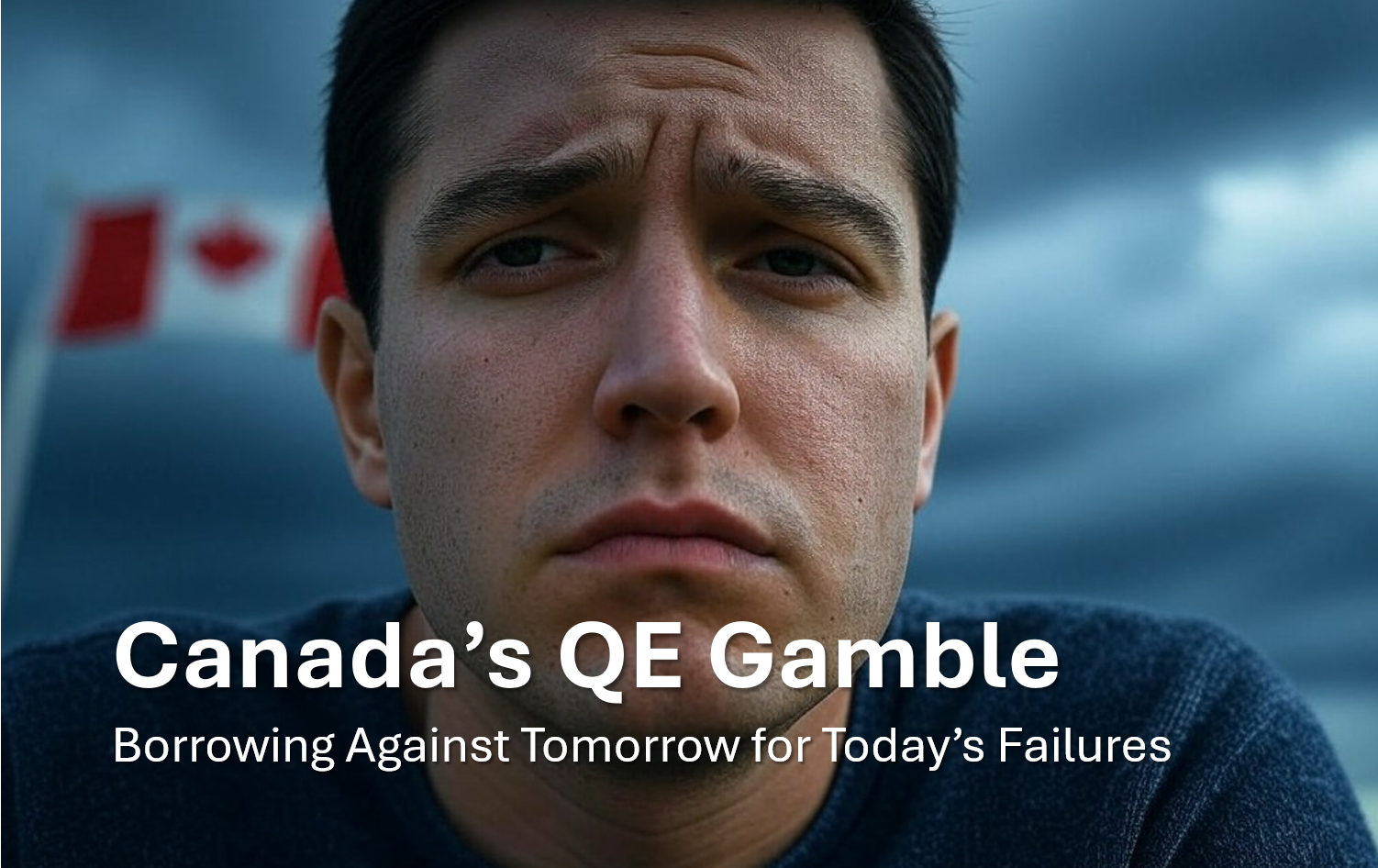
If the last few years of Canadian governance were a movie, it’d be a comedy—but not the good kind. It’d be one of those cringe-worthy, slapstick flicks where every decision leaves you asking, “Who thought that was a good idea?” Enter Canada’s experiment with quantitative easing (QE), a financial stunt that’s left our economy wobbling like a three-legged stool. I wrote about this back in 2022 https://marksdeepthoughts.ca/2022/11/05/the-fall-economic-statement-or-economic-blueprint-for-economic-disaster/
Let’s start with the premise: QE is the government’s version of “just put it on the credit card.” The Bank of Canada printed money to buy up government bonds, pushing down borrowing costs while flooding markets with cash. In theory, it’s a great tool for emergencies. And make no mistake, the pandemic was an emergency. But here’s the kicker—you’re supposed to pay off the credit card once the crisis passes. Instead, Canada maxed it out further, funding projects abroad, inflating the housing market, and leaving future generations to foot the bill.
The Globe and Mail and Financial Post repeatedly sounded the alarm on this, calling out QE’s long-term risks even as the Bank of Canada dismissed inflation as “transitory.” Spoiler alert: it wasn’t. Inflation soared to multi-decade highs, driven in part by the very same QE policy that dumped cheap money into the economy. It’s like watching someone pour gasoline on a fire and then act surprised when things get out of control.
A Reckless Housing Bubble
Nowhere was the impact of QE more glaring than in Canada’s housing market. Record-low mortgage rates, thanks to QE, turned real estate into a speculative frenzy. Home prices skyrocketed by 40% or more in some regions between 2020 and 2022. People weren’t buying homes to live in; they were flipping them like they were on an HGTV reality show. And what did the government do? Nothing. No policies to curb speculation, no coordinated housing strategy, just a shrug and a “good luck” to the average Canadian trying to buy their first home.
Now we’re left with a housing affordability crisis so severe it’s practically a national disgrace. Millennials and Gen Z can’t afford homes, yet our leaders wonder why birth rates are declining and why young families are leaving major cities. Here’s a thought: maybe they can’t start families because they’re too busy living in their parents’ basements, drowning in debt.
Borrowing Against the Future
And let’s not forget the pandemic spending spree—a good chunk of it necessary, sure, but much of it reckless. Programs like CERB were critical, but they were also riddled with loopholes, fraud, and inefficiencies. Meanwhile, Canada pledged billions to international climate funds and foreign development projects while our own healthcare system struggled under the weight of collapsing infrastructure and worker shortages.
The Financial Post summed it up perfectly: “Canada was using its credit card to pay off the children’s loans.” Instead of investing in long-term solutions, we’ve saddled future generations with debt while solving none of our fundamental problems. Housing is unaffordable, healthcare is overburdened, and inflation is eating away at whatever remains of middle-class savings. How’s that for “responsible governance”?
The QE Hangover
And now we’re paying the price. Interest rates have surged as the Bank of Canada scrambles to undo its earlier mistakes. The cost of servicing our national debt is climbing rapidly, squeezing out funding for essential services. Meanwhile, the average Canadian is stuck paying higher mortgage rates, higher grocery bills, and higher everything, all because our leaders decided to gamble with QE without a clear exit strategy.
“New rule: If you can’t manage your own money, you don’t get to manage ours.” That should be tattooed on the foreheads of those responsible for Canada’s economic policies over the last few years. QE wasn’t inherently bad; it’s the way we mishandled it—dragging it out too long, ignoring warning signs, and failing to pivot when the recovery was underway—that turned it into an economic blunder, again I have written about this several times in the past and so have many others.
A Path Forward
So, what now? First, Canada needs to tighten its belt. Stop funding flashy international projects with borrowed money when our own house is on fire. Second, prioritize investments in housing, healthcare, and education—areas that will pay dividends for generations. Third, demand accountability from the Bank of Canada and policymakers for their missteps. A public inquiry into the management of QE wouldn’t be out of place.
Canada deserves better than leaders who treat the economy like a Monopoly game. It’s time to stop borrowing against tomorrow and start building a sustainable future. Otherwise, we’re not just passing the buck to our kids—we’re handing them a bill they’ll never be able to pay. It’s time this Government ease themselves away to a far away place, and let us bring in the new team, and hope to Christ we can dig ourselves out of this hot mess.
 marksdeepthoughts.ca
Leave a comment