

We Could Be One of the Richest Countries in the World
Despite the overwhelming potential for economic prosperity, Canada is held back by climate alarmists who argue against fully utilizing our vast oil reserves. Scientific evidence suggests that climate change is a naturally occurring event, and human impact on the climate is minimal. While other countries, contributing far more to carbon emissions, thrive and prosper, we remain shackled by restrictive policies.
Canada has approximately 164 billion barrels of proven oil reserves, ranking third globally behind Venezuela and Saudi Arabia. If Canada were to exploit these reserves fully, the economic impact could be substantial:
- GDP Growth:
The oil and gas sector already contributes significantly to Canada’s economy, accounting for 6.4% of Canada’s total GDP ($139.2 billion) in 2019. Fully utilizing oil reserves could potentially double or triple this contribution, leading to a substantial increase in overall GDP. - Job Creation:
The oil and gas sector directly employed 178,000 people in 2020 and indirectly supported an additional 415,000 jobs in the supply chain. Full utilization could potentially create hundreds of thousands of additional jobs across various sectors. - Government Revenue:
Increased oil production would lead to higher government revenues through taxes and royalties. This additional income could be directed towards various public services and initiatives:
- Healthcare: Funding for new hospitals, medical research, and improved healthcare services.
- Elder Care: Enhanced support programs and facilities for the elderly.
- Military: Increased defense spending, modernization of equipment, and expanded capabilities.
- Indigenous Support: Significant investments in education, infrastructure, and economic development for Indigenous communities.
- Education: Improved funding for schools, universities, and research institutions.
- Infrastructure: Major investments in roads, bridges, ports, and other critical infrastructure.
- Energy Security:
Canada could become entirely energy independent and a major global oil exporter, potentially rivaling top producers like Saudi Arabia and Russia. - Trade Balance:
Increased oil exports would significantly improve Canada’s trade balance. In 2020, oil and gas exports were valued at $86 billion (16% of total exports). This figure could potentially double or triple with full utilization. - Technology and Innovation:
The massive increase in oil production would likely spur technological advancements in extraction, processing, and transportation methods, potentially making Canadian oil more competitive globally. - Regional Development:
Provinces like Alberta, Saskatchewan, and Newfoundland and Labrador would see substantial economic growth, potentially reducing regional economic disparities within Canada. - Sovereign Wealth Fund:
Canada could establish a significant sovereign wealth fund, similar to Norway’s, to invest oil revenues for long-term national benefit.
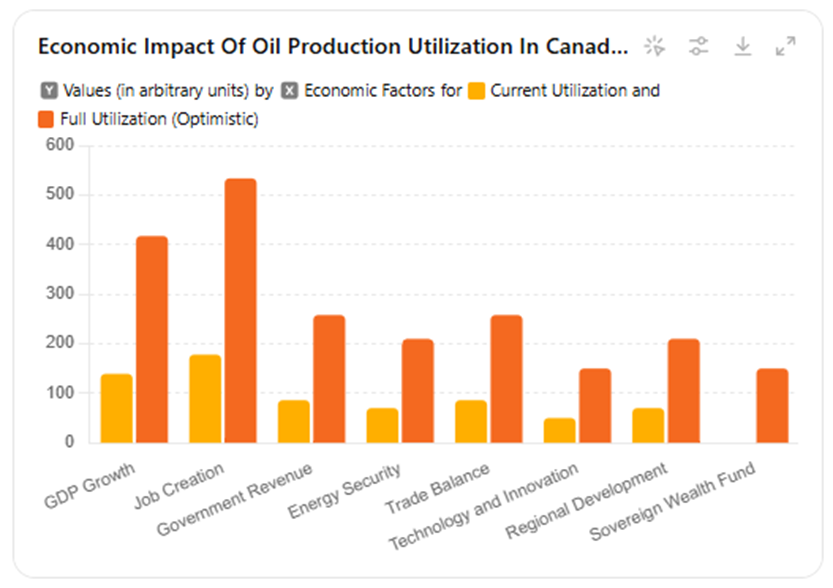
Scenario Key Points:
- GDP Growth:
- Current Utilization: $139.2 billion contribution.
- Full Utilization (Optimistic): Could potentially triple to $417.6 billion.
- Job Creation:
- Current Utilization: 178,000 direct and 415,000 indirect jobs.
- Full Utilization (Optimistic): Could potentially triple job creation.
- Government Revenue:
- Current Utilization: Significant contributions from taxes and royalties.
- Full Utilization (Optimistic): Potentially triple, enabling significantly more funding for public services.
- Energy Security:
- Current Utilization: Significant but not full independence.
- Full Utilization (Optimistic): Complete energy independence with surplus.
- Trade Balance:
- Current Utilization: $86 billion in oil and gas exports.
- Full Utilization (Optimistic): Could triple to $258 billion.
- Technology and Innovation:
- Current Utilization: Moderate advancements.
- Full Utilization (Optimistic): Major advancements in extraction, processing, and transportation methods.
- Regional Development:
- Current Utilization: Moderate growth in key provinces.
- Full Utilization (Optimistic): Major economic growth in provinces like Alberta, Saskatchewan, and Newfoundland and Labrador.
- Sovereign Wealth Fund:
- Current Utilization: No significant fund.
- Full Utilization (Optimistic): Potential for a large sovereign wealth fund similar to Norway’s.
What It Would Mean to the Average Family
If Canada were to fully utilize its oil reserves and implement the resulting economic benefits effectively, the average Canadian family could potentially experience significant improvements in their quality of life. Here’s how this might trickle down:
- Job opportunities and income:
- Increased employment in the oil sector and related industries could lead to more job options and potentially higher wages.
- This could result in increased household income, allowing families to afford better housing, education, and lifestyle choices.
- Lower energy costs:
- With abundant domestic oil production, energy prices could potentially decrease, reducing household expenses on heating, electricity, and transportation fuel.
- Improved public services:
- Increased government revenue could lead to better-funded public services:
- Healthcare: Shorter wait times, more advanced treatments, and better facilities.
- Education: Better-equipped schools, more resources for students, and potentially lower tuition fees for post-secondary education.
- Infrastructure: Improved roads, public transportation, and community facilities.
- Enhanced social programs:
- More funding for social programs could mean:
- Better support for low-income families
- Improved childcare services
- Enhanced elder care and support for retirees
- Economic stability:
- A strong, oil-driven economy could provide more job security and economic stability, reducing financial stress for families.
- Increased disposable income:
- With potentially lower taxes (due to increased government oil revenue) and reduced energy costs, families might have more disposable income for savings, investments, or discretionary spending.
- Community development:
- Oil wealth could fund community improvement projects, leading to better parks, recreational facilities, and cultural institutions.
- Technological advancements:
- Investments in research and development could lead to technological innovations that improve daily life, from better consumer products to advanced healthcare technologies.
- Environmental initiatives:
- While this scenario assumes no climate impact, in reality, some of the wealth generated could be directed towards environmental protection and clean energy development, potentially leading to cleaner air and water in communities.
- National pride and global standing:
- Canada’s increased global economic influence could instill a sense of national pride and potentially lead to better international opportunities for Canadian citizens.
It’s important to note that this scenario is highly simplified and optimistic. In reality, the benefits of increased oil production would need to be carefully managed to ensure equitable distribution across society. Additionally, over-reliance on a single resource can lead to economic vulnerabilities, and the environmental impacts of increased oil production could potentially offset some of these quality of life improvements. A more balanced approach that considers sustainable development, diversification of the economy, and environmental protection would likely provide more stable and long-lasting benefits to Canadian families.

Based on the search results, I can provide a comparison of Canada’s current and potential oil production to other leading countries:
- Current production:
Canada is currently the 4th largest oil-producing country in the world, with production of approximately 5.76 million barrels per day (bpd) in 2023. - Potential production growth:
Canada is poised for significant growth in oil production in 2024, with estimates ranging from:
- 300,000 to 500,000 bpd increase (6-10% growth)
- Up to 500,000 bpd increase according to some projections
This could potentially bring Canada’s total production to between 5.2-5.4 million bpd by the end of 2024.
- Comparison to other top producers:
- United States: Currently produces about 21.91 million bpd
- Saudi Arabia: Produces about 11.13 million bpd
- Russia: Produces about 10.75 million bpd
- Global impact:
- Canada could account for 25-67% of incremental global oil supply growth in 2024
- Canada may outpace the United States in crude oil production growth in 2024
- Long-term potential:
While Canada has significant oil reserves (ranking 3rd globally with about 164 billion barrels), fully utilizing these reserves would require overcoming various economic, environmental, and infrastructure challenges.
It’s important to note that while Canada has potential for significant growth in the short term, long-term production increases would need to consider factors such as environmental regulations, market demand, and infrastructure capacity. The current growth projections are largely due to specific factors like the Trans Mountain Pipeline expansion and the restart of the Terra Nova oil field
OUR 2024 BUDGET
In the context of the 2024 Budget, the discussion on fully utilizing Canada’s vast oil reserves could have significant implications across various economic dimensions. Here is how this could play into several projects and priorities outlined in the 2024 Budget:
1. Economic Growth and Fiscal Balance
The budget highlights the importance of maintaining fiscal responsibility while making generational investments. Fully exploiting oil reserves could lead to a substantial increase in GDP, potentially tripling the current contribution from the oil and gas sector. This would enhance overall economic growth, improving fiscal metrics such as the budgetary balance and debt-to-GDP ratio (budget-2024 (1)).
2. Job Creation and Employment
The budget aims to support economic growth and job creation across Canada. Increased oil production could significantly boost employment in the oil and gas sector and related industries. This aligns with the budget’s objectives of creating jobs and economic opportunities, particularly in regions like Alberta, Saskatchewan, and Newfoundland and Labrador (budget-2024 (1)).
3. Government Revenues and Public Services
Enhanced oil production would increase government revenues through taxes and royalties. These additional funds could support various public services and initiatives, such as:
- Healthcare: Funding for new hospitals, medical research, and improved healthcare services.
- Elder Care: Enhanced support programs and facilities for the elderly.
- Indigenous Support: Investments in education, infrastructure, and economic development for Indigenous communities.
- Infrastructure: Major investments in roads, bridges, ports, and other critical infrastructure (budget-2024 (1)).
4. Energy Security and Trade Balance
Achieving energy independence and becoming a major global oil exporter would improve Canada’s trade balance, currently supported by significant oil and gas exports. This aligns with the budget’s focus on economic resilience and improving trade balances(budget-2024 (1)).
5. Regional Development
The budget emphasizes regional economic development, and increased oil production would greatly benefit oil-rich provinces. This could reduce regional economic disparities and support long-term economic stability in these areas (budget-2024 (1)).
6. Technology and Innovation
The budget supports investments in technology and innovation. Increased oil production would likely spur advancements in extraction, processing, and transportation technologies, aligning with the budget’s focus on innovation-driven economic growth (budget-2024 (1)).
7. Sovereign Wealth Fund
Establishing a sovereign wealth fund from oil revenues, similar to Norway’s, could provide a long-term financial foundation for Canada, supporting future generations and aligning with the budget’s long-term economic goals (budget-2024 (1)).
8. Environmental and Sustainable Development
While the scenario assumes minimal human impact on climate change, in reality, some of the additional revenues could be directed towards environmental protection and clean energy development. This would balance the economic benefits of increased oil production with the budget’s commitments to sustainable development and net-zero transition (budget-2024 (1)).
9. Economic Stability and Inflation Management
Enhanced economic growth from oil production would contribute to economic stability. The budget forecasts stable economic growth and aims to manage inflation effectively. Increased oil revenues could provide additional fiscal flexibility to achieve these goals (budget-2024 (1)).
Conclusion
Integrating the full utilization of Canada’s oil reserves into the 2024 Budget could significantly enhance economic growth, job creation, government revenues, and regional development. It would provide the financial means to support various public services and long-term investments, aligning with the budget’s objectives of economic growth, fiscal responsibility, and generational investment.
These considerations are optimistic and would require careful management to ensure equitable distribution and sustainable development. Balancing economic growth with environmental protection and diversification of the economy would be essential for achieving stable and long-lasting benefits for Canadian families and society as a whole.
 marksdeepthoughts.ca
Leave a comment