

In the nearly decade-long tenure of Canada’s Prime Minister Justin Trudeau, the country’s housing crisis has spiralled into a dire state of emergency. As Trudeau announces his government’s aggressive plan to tackle this crisis by building over 3.4 million new homes by 2031, one can’t help but question: Why now? Under his leadership, the costs of homes have doubled, rents have soared, interest rates have hit their highest marks in decades, and inflation is rampaging through the economy. These issues are exacerbated by an immigration policy that, while enriching the cultural fabric of the nation, has added extraordinary pressure on its already overtaxed housing infrastructure.
Trudeau’s administration has been at the helm for nine years. In that time, the foundational issues contributing to the current housing crisis have only deepened. Now, with the announcement of this homebuilding initiative, Trudeau seems to be acknowledging the severity of the problem—but also implicitly admitting to years of policy oversight or inaction. Is his latest plan just a grandiose scheme to plaster over past failures, or is it a genuine, albeit belated, attempt to rectify his government’s shortcomings?
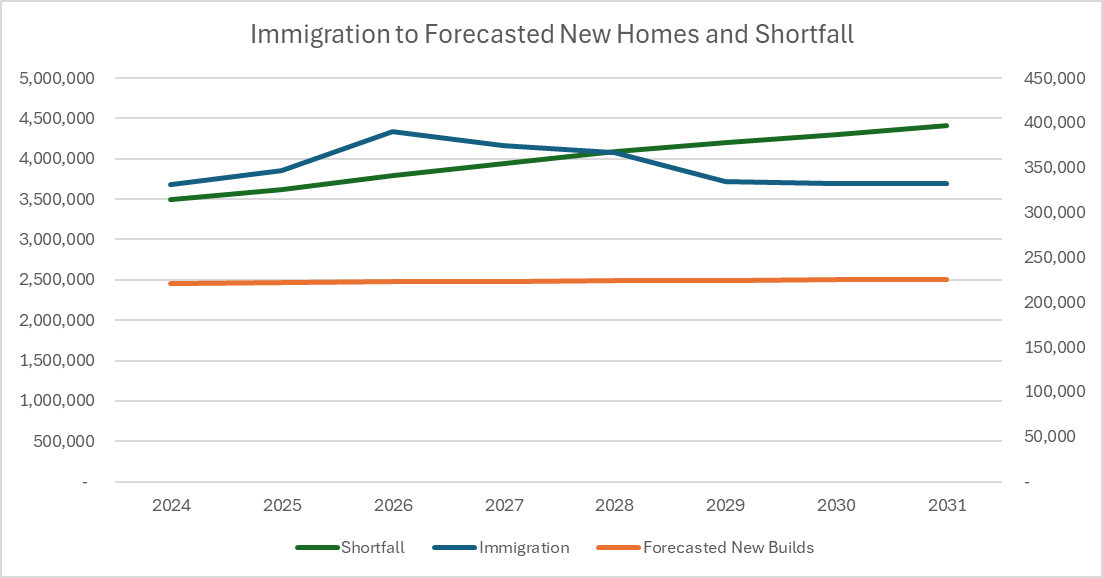
The reality of Trudeau’s proposal is staggering in both its scope and its required execution. To achieve the target of over 3.4 million new homes in less than a decade would mean more than doubling the current capacity of Canada’s construction and infrastructure sectors. This is no small feat. The industry is already operating at peak levels, grappling with shortages in labor and materials that have been compounded by global supply chain disruptions.
Moreover, Trudeau’s ongoing immigration policies, which aim to bring in hundreds of thousands of new residents annually, add another layer of complexity. If these levels are maintained, the actual number of homes needed isn’t just 3.4 million; it could swell to over 4.5 million to accommodate the influx. This projection does not just stretch the imagination but strains credibility. How does the Prime Minister plan to scale up the country’s housing infrastructure to these dizzying heights without a detailed, transparent strategy?
The skepticism around Trudeau’s plan is not just about the numbers—it’s about feasibility, accountability, and genuine political will. Canadians are already bearing the brunt of the housing crisis through skyrocketing costs and increasing living expenses. The Prime Minister’s plan must not only address the logistical nightmares it presents but also ensure that it does not become another hollow promise that leads to more profound public disenchantment.
In essence, Trudeau’s current homebuilding rhetoric feels like too little, too late. It’s a reactive measure rather than a proactive strategy, an acknowledgment of past failures rather than a testament to visionary leadership. As Canadians look towards the future, they need more than just promises. They require robust, realistic plans that don’t just double down on existing capacities but rethink and overhaul how housing development is approached in Canada.
As the Prime Minister pitches his ambitious plan, the electorate is left wondering: Will this just be another entry in a long list of unmet pledges? For a crisis this acute, mere words will not suffice—only decisive action and tangible results will. The clock is ticking, and the time for real solutions is now. Trudeau’s legacy and Canada’s future hang in the balance.
Whoever steps into leadership next will inherit a monumental task, as the country grapples with the complex challenges left in the wake of Prime Minister Justin Trudeau’s administration. This viewpoint isn’t just a murmur from the extreme right—it resonates with the majority of Canadians. Frustration is widespread across the nation over what many see as years of mismanagement and misplaced priorities. Critics argue that Trudeau’s government has acted with an almost dictatorial zeal, funnelling billions in aid to other countries while neglecting pressing domestic concerns. The sentiment among Canadians is clear: they are eager for a leadership that puts Canada first, addressing internal issues with the urgency and importance they deserve. As the next election approaches, the call for a rigorous and thoughtful redirection is undeniable—it’s a call for a leader ready to untangle the complicated web of policies and decisions that have not aligned with the priorities of the Canadian populace.
 marksdeepthoughts.ca
Leave a comment